Training doesn’t require magic. These proven tools make learning faster, clearer, and way more fun for both you and your German Shepherd.
If your German Shepherd has turned your living room into an obstacle course and your favorite shoes into chew toys, you’re not alone. These magnificent dogs pack enough energy to power a small city, and without proper training tools, that energy gets redirected into behaviors that’ll make you question all your life choices. But here’s the thing: GSDs want to learn and please you.
The secret isn’t working harder; it’s working smarter with tools designed specifically for powerful, intelligent breeds. Whether you’re dealing with a hyperactive puppy or an adult dog with some bad habits, the right equipment can be the difference between frustration and breakthrough moments. Ready to discover what actually works?
1. A High-Quality Front-Clip Harness
Let’s start with the elephant in the room: German Shepherds pull. They pull hard. If you’ve ever felt like your shoulder might dislocate during a walk, a front-clip harness is about to become your new best friend.
Unlike traditional harnesses that attach at the back (which actually encourages pulling by letting dogs use their full chest strength), front-clip harnesses redirect your dog’s forward momentum. When they pull, they naturally turn back toward you instead of dragging you into traffic. It’s physics working in your favor for once.
The front-clip harness doesn’t fight against your dog’s strength; it redirects that energy into self-correction, making every walk a training opportunity.
Look for harnesses with padded straps and multiple adjustment points. German Shepherds have deep chests and muscular builds, so proper fit is crucial. Brands like Freedom Harness and PetSafe EasyWalk are popular for good reason: they distribute pressure evenly and won’t chafe even during longer training sessions.
The beauty of this tool is its dual purpose. Yes, it stops the pulling, but it also gives you better control during training exercises. Need your GSD to focus during heel training? The front clip keeps their attention on you rather than every squirrel within a three-mile radius.
2. Long Training Lead (15-30 feet)
Here’s where many GSD owners make a critical mistake: they jump from short leash to complete off-leash freedom too quickly. That gap is where recall training goes to die. Enter the long training lead, the unsung hero of distance training.
A 15 to 30-foot lead gives your German Shepherd the illusion of freedom while keeping you in control. This is essential for practicing recall, stay commands, and distance work without gambling on whether your dog will actually come back. (Spoiler alert: without proper training, they probably won’t, especially if they spot something interesting.)
Here’s why this tool is non-negotiable:
| Training Scenario | How Long Lead Helps | Why It Matters for GSDs |
|---|---|---|
| Recall Practice | Allows distance while maintaining control | GSDs have strong prey drive; you need backup |
| Distraction Training | Can practice focus in new environments safely | Prevents reinforcing ignoring commands |
| Stay Commands | Build duration without risk of breakage | Creates confidence in both dog and handler |
| Emergency Stops | Provides safety net during learning phase | GSDs are fast; catching them is nearly impossible |
Use the long lead in open areas like parks or fields. Let your dog explore while practicing recall at various distances. The key is to never let them reach the end of the lead at full speed (ouch), and gradually increase the challenge level as their response improves.
This tool bridges the gap between on-leash reliability and true off-leash freedom. Most German Shepherds need several months of consistent long lead work before they’re ready for complete freedom in unfenced areas.
3. A Clicker or Marker Word
Timing is everything in dog training, and German Shepherds are sharp enough to notice even split-second delays in your feedback. A clicker provides instant, consistent communication that tells your dog exactly which behavior earned the reward.
Think of a clicker as a camera shutter for behavior. The click captures the precise moment your GSD does something right. Because the sound is unique (unlike your voice, which they hear constantly), it cuts through distractions and creates a clear cause-and-effect relationship. Do the thing, hear the click, get the treat. Simple, but incredibly powerful.
If clickers aren’t your style, a marker word like “yes!” works too, though you’ll need to be extremely consistent with your tone and timing. The advantage of a clicker is that it sounds identical every single time, regardless of your mood, stress level, or how many times you’ve repeated the same training session.
Precision in timing transforms good training into great training. The clicker bridges the communication gap between human intention and canine understanding.
For German Shepherds specifically, clicker training excels because it keeps training sessions positive and mentally stimulating. GSDs can become frustrated or shut down with harsh corrections, but clicker training builds enthusiasm. Your dog starts offering behaviors to earn that click, which is exactly the kind of engaged learning you want.
Start by “charging” the clicker: click, then immediately treat, about 10-15 times. Your dog will quickly associate the sound with rewards. Then begin clicking for simple behaviors like eye contact or sitting. As your GSD catches on (and they will quickly), you can shape increasingly complex behaviors.
4. Durable Treat Pouch
You might be thinking, “Really? A treat pouch made the list?” Absolutely, and here’s why: fumbling for treats in your pockets kills training momentum faster than anything else. German Shepherds have the attention span of a goldfish when something more interesting appears, so every second counts.
A quality treat pouch keeps rewards instantly accessible, which means you can capture and reinforce behaviors the moment they happen. This is especially crucial during the early stages of training when timing makes or breaks your success rate.
Look for pouches with:
- Magnetic or snap closures that you can open one-handed
- Sturdy clips that won’t pop off when your 80-pound GSD hits the end of the leash
- Washable materials because treats get crumbly and gross
- Multiple compartments for different reward values
The multiple compartment feature deserves special attention. German Shepherds are smart enough to understand reward hierarchies. Keep regular kibble or low-value treats for easy behaviors, and reserve the good stuff (cheese, chicken, liver treats) for challenging situations or breakthrough moments.
Professional trainers often carry three types of rewards: low value for known behaviors, medium value for practicing skills, and high value for distractions or new learning. Having these organized and accessible turns you into a more effective trainer instantly.
Plus, let’s be honest: trying to dig treats out of your pocket while controlling a strong, excited German Shepherd is a recipe for scattered treats, frustrated dogs, and neighbors wondering why you’re doing some kind of interpretive dance in your front yard.
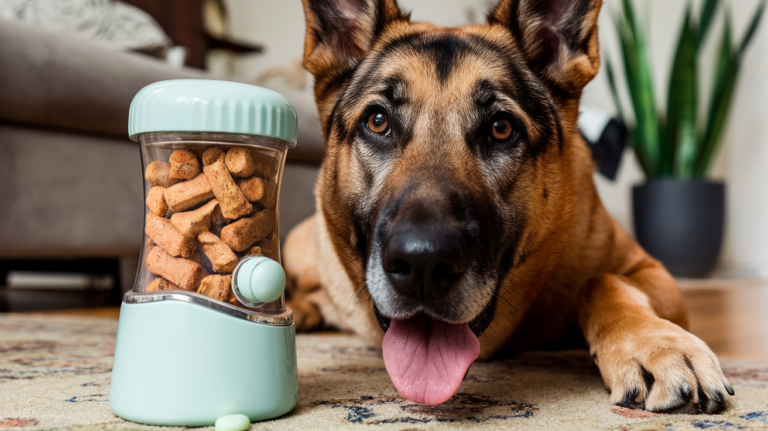
5. Interactive Puzzle Toys and Food Dispensers
Here’s something many GSD owners learn the hard way: a tired dog is a good dog, but a mentally exhausted German Shepherd is a great dog. Physical exercise alone won’t cut it with this breed. Their brains need workouts too, and that’s where puzzle toys become essential training tools.
Wait, puzzle toys for training? Absolutely. These aren’t just entertainment; they’re teaching your German Shepherd problem-solving skills, patience, and frustration tolerance. All of these translate directly into better training outcomes.
Mental stimulation doesn’t just tire your dog out; it builds the cognitive skills that make all other training easier and more effective.
Start with simple puzzles and gradually increase difficulty. Watch your GSD’s confidence grow as they figure out how to flip lids, slide compartments, and manipulate pieces to reach their rewards. This kind of independent problem-solving builds the impulse control that makes obedience training stick.
Food-dispensing toys like Kongs or wobbler toys are perfect for:
- Crate training (gives them something positive to do while confined)
- Reducing separation anxiety (engages their brain when you leave)
- Slowing down fast eaters (GSDs are prone to bloat)
- Providing appropriate chewing outlets (saving your furniture)
Incorporate puzzle toys into your training routine by using them as rewards for major accomplishments. Completed a challenging training session? Your GSD gets to “work” for their dinner via a puzzle toy instead of eating from a bowl. This extends the mental workout and reinforces that training leads to good things.
The key is rotation. German Shepherds get bored quickly, so having 4-5 different puzzles that you rotate keeps things fresh and challenging. Some days use puzzles that require delicate nose work, other days choose ones that need paw manipulation. This variety keeps their problem-solving skills sharp.
These five tools form the foundation of effective German Shepherd training. They’re not magic wands that instantly create perfect behavior, but they are force multipliers that make your training efforts significantly more effective. Combine them with consistency, patience, and genuine understanding of what makes your GSD tick, and you’ll be amazed at the transformation.
Remember: the best training tool is always the one you’ll actually use consistently. Start with what fits your lifestyle and training goals, then expand your toolkit as you and your German Shepherd progress together. Happy training!