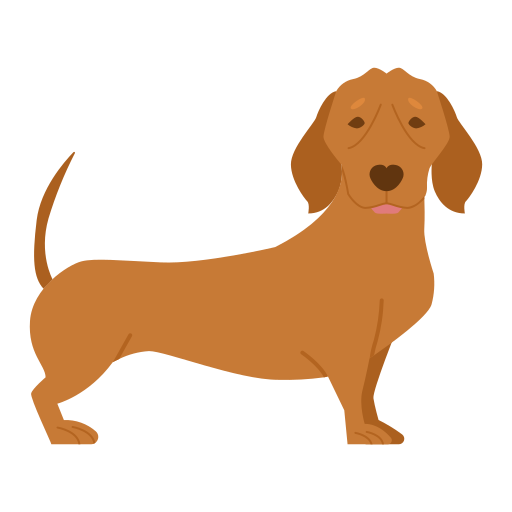
 Dachshund
 Ever notice how your dachshund melts into a puddle the moment your hand finds one specific patch of fur, and pretty much shrugs everywhere else?
There is a reason for that, and it is not random affection.
Dachshund owners tend to discover it by accident. You reach down to scoop up your dog, your fingers brush that broad little chest, and suddenly you have a sixteen pound noodle leaning into your palm with their eyes half closed.
That spot is the front of the chest, right where the breastbone juts out. Scientists have a name for it. Dachshund people just call it the button, and once you find it, you will never pet your dog the same way again.
The Spot Nobody Tells You About
Walk up to almost any dachshund and offer a slow hand at chest height. Nine times out of ten, they will step forward into it.
Not away. Forward.
The technical name for that jutting bit of bone is the prosternum, sometimes called the keel. On a dachshund it is unusually pronounced, a little shelf of chest that sticks out ahead of the front legs like the bow of a very small, very stubborn boat.
Why the keel wins every time
Skin over that area is loose, warm, and rich with nerve endings, and it sits in a place your dog physically cannot reach with their own paws or teeth.
Think about that for a second. Every other itchy spot on a dachshund can be handled solo, with a good scratch or a determined chew. The chest cannot.
So when you scratch there, you are not just being nice. You are doing something for them that they genuinely cannot do for themselves.
A dog does not lean into your hand out of politeness. Leaning is the closest thing they have to saying stay right there, do not stop, this is the good one.
The lean is the tell
Watch the body language while you work that spot. The head lifts slightly. The chin comes up and out of the way, almost like they are offering you a better angle.
Some dogs go further and press their whole chest into your hand, shifting their weight forward until you are basically holding them up.
That is not a coincidence. It is an invitation.
Why Dachshunds Specifically
Plenty of dogs enjoy a chest rub. Dachshunds tend to be fanatical about it, and their history explains a lot.
Built to go headfirst into trouble
These dogs were developed in Germany to follow badgers underground. That meant squeezing through tight tunnels, pushing forward through packed dirt, and holding their ground against an animal that fights back hard.
The deep, prominent chest is part of that design. It gave the dog lung capacity in low oxygen tunnels and a solid front end for shoving through soil.
That same anatomy also created a broad, sensitive, permanently exposed patch of skin at the front of the body. Function first, snuggle bonus second.
Hands from above feel like predators
Here is the part most people never think about: a hand coming down over a dog’s head is, from the dog’s point of view, a large object descending from the sky.
Dachshunds sit only a few inches off the floor. That overhead reach looks even bigger to them than it does to a Labrador.
A chest scratch comes in low and level, from the front, where they can see it the whole way. No looming. No surprise. Just a hand arriving exactly where they can track it, which is why so many nervous dachshunds relax faster with a chest rub than with anything else.
The difference between a dog tolerating affection and craving it is often nothing more than the angle your hand took getting there.
The Runners Up
The chest is the headliner, but a few other spots earn honest applause.
Base of the ears
Slide your thumb along the crease where the ear meets the skull and apply gentle pressure in slow circles.
Dachshund ears are long, heavy, and hang forward, which means the muscles at the base do real work all day.
Most dogs respond to this with a heavy sigh and a slow blink. Some tilt their whole head into your hand and stay there until you give up first.
Under the chin and along the jaw
Reaching for the top of the head is instinct for most humans, and most dogs quietly put up with it.
Try the underside instead. A soft scratch along the jawline and down the front of the throat hits skin that is thin, warm, and rarely touched.
It also keeps your hand in their line of sight, which circles back to the same principle: visible hands are trustworthy hands.
That patch just above the tail
Right where the back ends and the tail begins, there is a small area that turns some dachshunds into wiggling, scooting, delighted maniacs.
Scratch it and watch the back legs start doing something involuntary and ridiculous.
Keep it light, though. Which brings us to the one place worth treating with real care.
Go Easy on the Long Back
Dachshunds are famous for their spines, and not entirely in a good way. The breed carries a high risk of intervertebral disc disease, a condition where the cushions between the vertebrae degenerate and can rupture.
Firm pressing, thumping, or vigorous rubbing straight down the middle of the back is not doing your dog any favors.
Light stroking along the sides of the body is fine and lovely. Save the enthusiastic scratching for the chest, where there is nothing fragile underneath.
Affection should never come with a physical cost. Learn where your dog is sturdy, and put your hands there.
Picking your dog up matters too. Support the chest with one hand and the hindquarters with the other so the spine stays level, and never let those long backs dangle.
How to Actually Do It
Technique is not complicated, but small adjustments make a noticeable difference.
Approach low, move slow
Crouch or sit rather than bending over. Bring your hand in from the front, palm turned slightly up, and let it arrive at chest height without any sudden movement.
Give them a beat to step into it.
Use fingertips, not the whole hand
Flat palms feel like patting, and patting is loud, thumpy, and mostly for the benefit of the human doing it.
Curl your fingers a little and scratch with the pads of your fingertips in slow, small circles.
Work the area from the base of the throat down to where the chest meets the front legs, and let your dog reposition themselves as you go. They will steer you toward the exact spot if you let them.
Run the five second test
Pet your dog for five seconds, then stop completely and take your hand away.
If they nudge your hand, paw at you, or step closer, you have a clear yes. If they hold still, look away, or wander off, that is a no thank you, and honoring it is how you become the human whose hands are always welcome.
This one small habit builds more trust than any amount of enthusiastic scratching.
Time it right
A dog wound up from the mail carrier is not in the market for a slow chest rub.
The best moments come when they are already settling: after a walk, during a movie, in that drowsy stretch before bed.
That is when the chest scratch does its real work, dropping heart rate, loosening muscles, and turning an alert little hunting dog into something closer to a warm loaf of bread on your lap.