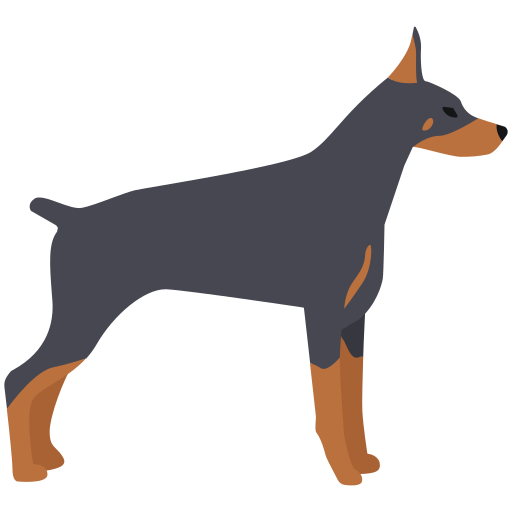
 Doberman
 Conventional dog wisdom says that a dog holding eye contact is issuing a challenge, and that the proper response is to stare back until they blink first. That advice created an entire generation of anxious owners locked in silent standoffs with their own pets. With this breed, it is almost completely backwards.
Dobermans stare because they are bonded to you. The harder the stare, the deeper the attachment usually runs.
Louis Dobermann was a tax collector who wanted a dog that would stick to one person like a second shadow. The fastest way to shadow somebody is to never take your eyes off them.
Which means that when your Dobe plants himself eight feet away and burns a hole through your skull with those amber eyes, he is not plotting a coup. He is doing the job he was designed for, and doing it enthusiastically.
The Velcro Breed Nobody Warns You About
Ask ten Doberman owners what surprised them most and at least six will say the same thing: nobody told them the dog would follow them into the bathroom.
Working breeds fall roughly into two camps. Some watch the environment, and some watch the handler.
Livestock guardians scan the horizon. Herding dogs scan the flock. Dobermans, bred as close personal protection dogs, scan you, because you are the thing they were built to keep track of.
Watching You Is the Whole Job
A dog assigned to guard a perimeter needs to know what is happening at the fence line. A dog assigned to guard a person needs to know what is happening with that person’s body language, tone, hands, and mood.
Your Doberman is not staring into space. He is reading a screen, and the screen is your face.
A Doberman who ignores you is a Doberman with a problem. The staring is the feature, not the bug.
This is why the breed is so infamously easy to train and so infamously easy to accidentally train wrong. They are watching every single thing you do, including the stuff you did not mean to teach them.
Decoding the Stare
Not all staring is created equal. Once you learn the difference, most of the mystery evaporates and you are left with a dog who is basically texting you in a language you finally speak.
The Negotiation Stare
Ears slightly forward, body loose, weight shifted toward you, tail doing something hopeful near the back end.
Your dog wants a thing. Food, a walk, the spot you are sitting in, permission to go outside and bark at a leaf.
Dobermans are exceptional at this because they learn incredibly fast which behaviors produce results. If staring at you once got him a piece of cheese, congratulations: staring is now a permanent feature of your household.
The Checking In Stare
Softer. Briefer. Usually happens on walks, in new places, or when something unfamiliar just happened.
He heard a noise, looked at it, then looked at you to find out how worried he should be. This is one of the most valuable behaviors a protection breed can offer, and it deserves to be rewarded.
Answer him. A calm word or an easy "you’re fine" tells him the situation is handled and he can stand down.
The Love Loop Stare
Long, soft, slightly unfocused, often accompanied by a heavy sigh and a chin dropping onto your foot.
Research on dogs and humans has found that sustained mutual gaze triggers oxytocin release in both species, the same hormone loop that runs between parents and infants. Dogs are, as far as we know, the only animal that hijacked this system to bond with us.
Your Doberman figured this out around 40 million years after the wolves did, and he is using it shamelessly.
Mutual gaze is the only conversation your dog can have with you that requires no translation whatsoever.
The Anxious Stare
Tighter. Harder. The body goes still and the eyes get wide enough that you can see white around the edges.
This one is not affection and it is not a request. Something is worrying him, and he is checking whether it worries you too.
Common triggers include storms, luggage appearing in the hallway, changes in routine, or the sound of a stranger’s car in the driveway. Dobermans are sensitive dogs wearing an intimidating costume, and the sensitivity is real.
When Staring Is a Symptom
Most staring is normal. Occasionally it is not, and this breed has a couple of specific reasons to pay attention.
Staring at Nothing
Eye contact with you is communication. Fixed staring at a blank wall, a ceiling corner, or empty air is a different animal entirely.
Dobermans have a documented predisposition toward compulsive behaviors, including flank sucking and various forms of fixation. Repeated staring at nothing, especially if it comes with pacing, freezing, or trance like behavior, is worth a conversation with your vet.
Sudden Changes in the Pattern
A dog whose staring habits change abruptly is telling you something. Vision loss, pain, cognitive decline in older dogs, and thyroid issues (which this breed is prone to) can all shift how a dog uses eye contact.
Baseline matters. You know what normal looks like for your dog better than anyone, so trust yourself when normal stops looking normal.
How to Answer a Staring Doberman
Here is where owners get themselves into trouble. The stare is not a problem to be eliminated; it is a channel that needs managing.
Stop Rewarding It Accidentally
Every time you look up, sigh, and get off the couch to see what he wants, you are reinforcing the behavior.
That is fine if you like the arrangement. Plenty of us do.
If the staring has escalated into something demanding, the fix is unglamorous: ignore the stare completely, wait for him to settle or look away, and then engage. Attention is the currency, so spend it on the behavior you actually want.
Put the Watching to Work
A Doberman who has nothing to do will watch you, because watching you is the most interesting available option.
Give the brain a better job. Nose work, obedience sessions, trick training, puzzle feeders, structured walks with actual rules, anything that asks him to think rather than simply observe.
Ten minutes of real mental work often produces a calmer dog than an hour of aimless yard time. This breed does not need exhaustion so much as it needs employment.
Learn to Stare Back Correctly
Forget the dominance nonsense. Soft eye contact with a relaxed face, a slow blink, and a warm tone is a genuine reward for a dog who is wired to read you.
Hard, direct, unblinking eye contact with tension in your body is a different signal, and a sensitive dog will feel it immediately.
Your Doberman is not trying to win a staring contest. He is trying to figure out what kind of mood you brought home.
Teach a Release
The single most useful command for a dog like this is one that means "you are off duty."
Pick a word, use it consistently, and pair it with something genuinely relaxing: a chew, a mat, a place to settle in the same room where he can still see you.
Dobermans do not want to be sent away from you. They want permission to stop working while still being near you, and those are very different things.
The Compliment Hiding in Plain Sight
Somewhere in the middle of complaining about the staring, most owners realize what it actually represents.
Thousands of dogs live perfectly happy lives without ever really looking at their people. They exist in the same house, on parallel tracks, occasionally intersecting at dinner time.
That was never going to be your life. You picked a breed that decided, roughly 130 years ago, that a person was worth watching all day long, and the dog on your rug is holding up his end of a very old bargain.