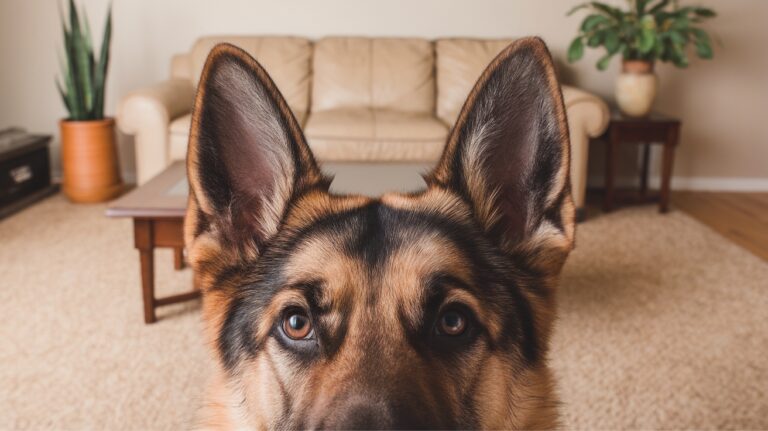
That intense stare means a lot more than you think. Discover the emotional and instinctive reasons your shepherd locks eyes with such unforgettable focus.
There’s a moment every German Shepherd owner knows well. You look up from your phone, your book, your dinner, and there it is: two amber eyes locked onto you like you’re the most important thing in the universe.
It’s intense. It’s a little weird. And it happens constantly.
But that stare isn’t random, and it definitely isn’t creepy. It’s actually one of the most fascinating behaviors in the entire dog world.
It’s Hardwired Into Their DNA
A Working Dog’s Most Powerful Tool
German Shepherds weren’t bred to be lap dogs. They were developed over generations to herd, guard, track, and protect.
All of those jobs required one critical skill: the ability to watch.
A herding dog that doesn’t pay attention is a useless herding dog. So intense focus wasn’t just encouraged in these dogs; it was selected for, generation after generation, until it became instinct.
The stare isn’t a behavior problem. It’s a centuries-old survival skill that never got turned off.
The Eyes Are the Command Center
When a German Shepherd worked alongside a shepherd (the human kind), they had to read body language from a distance. There was no time for verbal commands when a flock was scattering.
The dog learned to watch, interpret, and act. Instantly.
That same neurological wiring is still very much active in your pet-version German Shepherd. The breed just traded sheep fields for living rooms.
What Your Dog Is Actually Trying to Tell You
They’re Waiting for a Cue
One of the most common reasons a German Shepherd stares is simple: they’re waiting for you to do something.
German Shepherds are obsessed with routine. If you always grab the leash at 5 PM, your dog has already memorized your pre-walk sequence down to which pocket you reach into first.
That stare you’re getting at 4:58? That’s anticipation. Pure, barely-contained, “please hurry up” anticipation.
They Want Something (And They’re Being Very Polite About It)
Sometimes the stare is a request. Food, water, attention, a bathroom trip.
Your German Shepherd has figured out that staring at you eventually produces results. In their mind, it’s the most logical communication tool available.
Think of it as the canine version of standing in a doorway and sighing until someone asks what’s wrong.
They Love You (Embarrassingly Much)
Here’s the one that tends to surprise people. Prolonged, soft eye contact between a dog and their owner triggers the release of oxytocin in both parties.
That’s the same bonding hormone involved in human attachment. The same one that floods your system when you hold a baby or hug someone you love.
When your German Shepherd stares at you softly, they are literally chemically bonding with you. You’re making each other feel good just by looking at each other.
Your dog isn’t being weird. Your dog is in love with you.
Reading the Stare Like an Expert
The Soft Stare vs. The Hard Stare
Not all stares are created equal, and this distinction matters.
A soft stare features relaxed eyes, maybe a slow blink, possibly some gentle tail movement in the background. This is the “I love you and I’m watching over you” stare.
A hard stare is different. The eyes are wide, the body is tense, and there’s no tail wagging anywhere in the picture. This one deserves your attention.
When the Stare Is a Warning
A hard stare can be a precursor to a growl, and a growl is always a precursor to something worse. German Shepherds are not subtle about discomfort.
If your dog is staring rigidly at another person or animal, intervene calmly and redirect before the situation escalates.
Never punish a dog for growling or staring as a warning. Removing the warning doesn’t remove the discomfort; it just removes your ability to see it coming.
The “What Is That” Stare
This one has a very specific look. The head tilts. One ear goes up. The eyes lock onto something you almost certainly cannot see or hear.
Your German Shepherd has detected something. A sound four blocks away. A smell drifting in through a window crack. A movement at the edge of their peripheral vision.
They’re not hallucinating. They’re just operating on sensory hardware that vastly outperforms yours.
The Role of Eye Contact in Training
Eye Contact Is Currency
Experienced German Shepherd trainers will tell you that getting a dog to make and hold eye contact is one of the first and most valuable skills to teach.
A dog that looks at you is a dog that is with you mentally. And a dog that’s mentally present is a dog you can work with.
Teaching “Watch Me”
The “watch me” command is exactly what it sounds like. You prompt your dog to look directly into your eyes and hold that gaze.
It sounds simple. It is, in fact, extraordinarily powerful.
Once your German Shepherd understands that looking at you is the gateway to good things (treats, praise, play), you’ll have a dog that checks in with you constantly and voluntarily.
A German Shepherd that stares at you during a walk isn’t distracted. That dog is asking for guidance, and that is exactly the relationship you want.
Common Misconceptions About the Stare
“My Dog Is Trying to Dominate Me”
This one won’t die, but it really should. The old dominance theory of dog behavior has been largely debunked by modern animal behaviorists.
Your German Shepherd staring at you is not a power play. It is not a challenge. It is not a sign that you need to “assert yourself.”
It’s communication. Treat it like communication.
“Something Is Wrong With My Dog”
A staring German Shepherd is an engaged German Shepherd. Concern is warranted if the staring is accompanied by other unusual symptoms like confusion, head pressing, or loss of coordination.
Staring alone, especially in a breed built for visual focus? Completely normal. Probably adorable.
“They Want Me to Stop What I’m Doing”
Sometimes people feel guilty under the weight of that gaze, like they’re failing their dog simply by existing on the couch.
Your German Shepherd is not judging you. They’re watching you, which is their highest compliment.
How to Respond to the Stare
Lean Into It
Make eye contact back. Talk to your dog. Let them know you see them and you’re not going anywhere.
German Shepherds are deeply sensitive to acknowledgment. A simple “I see you, buddy” does more than you’d think.
Figure Out What They Need
If the stare is pointed and persistent, do a quick mental checklist. Water bowl full? Last walk more than a few hours ago? Any scheduled events your dog might be anticipating?
German Shepherds are very rarely staring for no reason at all. There is almost always a reason.
Don’t Reinforce Demanding Behavior
That said, if your dog has learned that staring equals instant attention on demand, it’s okay to gently reshape that pattern.
Wait for a calm moment, then reward. You’re not ignoring your dog; you’re teaching them that patience works even better than intensity.
The Bottom Line on That Unblinking Gaze
It’s a Feature, Not a Bug
The German Shepherd stare is one of the most uniquely fascinating things about the breed. It’s ancient, it’s purposeful, and when you understand it, it becomes one of the most endearing things your dog does.
You have a dog that watches over you, bonds with you through eye contact, reads your moods before you’ve processed them yourself, and tries to communicate with you in the most direct way it knows how.
You Are Their Whole World
And that gaze? That’s what it looks like when someone has decided that you are the most important thing in the room.
Every single time.