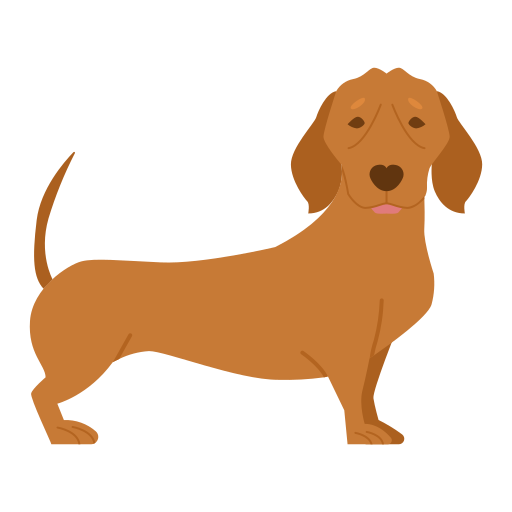
 Dachshund
 Otto was twelve weeks old, mostly eyebrows and wire coat, and he had just worked out that his person had a face.
He had been chewing the corner of a rug. Standard puppy business. Then something made him stop, rock back onto his haunches, and look up.
Not at the hand holding the treat. At the eyes.
His owner swears the room went silent for about four seconds. Otto held the stare like he was reading fine print, huffed once, then flopped sideways onto the floor, apparently satisfied with whatever he had learned.
That was the afternoon she stopped thinking of him as a puppy who happened to live in her house, and started thinking of him as a dog who was studying her.
Anyone who has shared a couch with one of these dogs knows the feeling. The stare arrives early, it arrives often, and it carries more information than most people realize.
A Small Dog With Enormous Opinions About Your Face
Dachshunds are not casual observers. They are auditors.
A lab might glance at you and go back to sleep. A dachshund clocks the exact moment you reach for your keys, your shoes, or the yogurt lid, and locks in until the situation resolves.
That intensity is not neediness. It is a working brain running a constant background scan, and your face is the primary data source it has learned to trust.
The Loop Running Underneath It
When a dog and a person hold a friendly gaze, both brains release oxytocin, the same chemical involved in bonding between parents and infants. The dog looks, the human feels warm, the human responds, the dog gets another hit of the good stuff, and around it goes.
Researchers have described this as a feedback loop that domestication built. Wolves raised by humans mostly do not do it. Dogs do.
Your dachshund figured this out without reading a single study.
The stare is not your dog being demanding. It is your dog running the only communication channel it was ever given.
A Job That Required Looking Up
Think about what these dogs were originally asked to do. Head down a badger burrow alone, in the dark, make decisions with nobody to consult, then hold the line until the human above ground dug down and hauled them out.
That job produced a strange and wonderful combination: total independence underground, total dependence on the partnership above it.
The modern result is a dog that will absolutely ignore your recall in favor of an interesting smell, then trot back and stare into your soul for ninety seconds to check that everything between you is still fine.
The Four Stares You Are Probably Getting
Not all eye contact means the same thing. Learning to sort them is the difference between guessing and knowing.
The Soft Blink
Loose face. Eyes slightly narrowed. Maybe a slow blink or a tiny brow shift.
This one is pure affection and comfort, and it is the closest thing to a compliment your dog can offer.
Blink back slowly. Genuinely, it works. You will often get an ear flick or a tail thump in return, which is roughly the dachshund equivalent of a nod across a crowded room.
The Laser
Pupils fixed, body still, breathing shallow. Nothing else in the room exists.
The Laser usually points at something specific: a squirrel, a doorbell, another dog, a dropped crumb that rolled under the oven six weeks ago.
This is arousal, not affection. If the whole body has gone rigid behind the eyes, that dog is somewhere between fascinated and about to make a decision you will not enjoy.
Interrupt early. Once a dachshund commits, you are negotiating with a freight train that weighs sixteen pounds.
The Sidelong Glance
Head turned away, eyes swiveled toward you, whites showing at the corner.
Trainers call it whale eye, and it is a discomfort signal. Something in the situation is not okay, and the dog is monitoring it while trying to look like it is not.
Common triggers include a stranger leaning over the dog, a hand reaching for a favorite chew, a child hugging a bit too enthusiastically, or a nail clipper appearing anywhere in the general vicinity.
The correct response is to give the dog room, not reassurance. Space defuses. Cooing does not.
The Ambush
You are watching television. You feel the weight of being observed. You look down, and there is a dachshund sitting with perfect posture, staring at you with the patience of a debt collector.
This is a request, and you have roughly forty seconds to figure out which one.
Eye Contact as Actual Training Currency
Here is where the whole thing turns useful. A dog who will look at you on request is a dog who can be redirected, and redirection is the entire game with this breed.
Attention is the first behavior. Every other cue you will ever teach is renting space on top of it.
Building a Name Response Worth Having
Say the name once. When the eyes come to you, mark it with a word like "yes" and pay immediately.
Do not repeat the name. Repeating it teaches your dog that the name is background noise that eventually turns into food, which is a lesson you cannot unteach quickly.
Practice in the boring kitchen before you practice in the exciting park. Ten seconds, five times a day, beats one long frustrating session every Sunday.
The Look at Me Reset
Pick a cue that is not the dog’s name. "Watch," "eyes," or "hey friend" all work fine, provided you are consistent.
Start with a treat at your eye, release it the instant the gaze lands, then fade the lure fast so the dog is offering the look rather than following your hand.
The payoff shows up on a walk, when a neighbor’s terrier appears at forty feet and you need your dog’s brain back before the barking starts.
About the Stubbornness Thing
Dachshunds get called stubborn constantly. Most of the time, what people are describing is a dog that was never given a reason to check in.
These are scent hounds with strong opinions and a low tolerance for repetition. Ask twenty times in a row and you will get a dog who has learned that ignoring you is survivable and mildly entertaining.
Ask rarely, pay well, and quit while the dog still wants more. The eye contact gets faster and more voluntary within days.
When the Staring Becomes a Problem
Not every gaze is charming, and pretending otherwise does the dog no favors.
Locked On to a Stranger
A hard, unblinking stare at a person or another dog, often paired with a stiff body and a closed mouth, is a warning rather than a greeting.
Break it before it escalates. Turn your body, move away, create distance, and reward the moment your dog disengages and looks back at you.
Punishing the stare is a genuinely bad idea. Suppress the warning and you get a dog who skips straight to the next step in the sequence.
The Dachshund Who Will Not Look at You
Some dogs avoid eye contact entirely. Frequently these are rescues, or dogs whose previous humans leaned heavily on correction.
Avoidance is a learned safety strategy. Looking at the person meant something unpleasant happened next, so the dog stopped looking.
Rebuilding takes patience and hand feeding. Sit sideways, stay quiet, and drop a treat every time the eyes flicker toward your face, even for a fraction of a second. Weeks, not days.
A dog who chooses to look at you has decided you are safe. That decision belongs to the dog, and it cannot be rushed.
Keeping the Channel Open
Small habits do more than big training sessions.
Feed a few pieces of dinner by hand a couple of times a week, delivered at eye level rather than into the bowl.
Say something to your dog when you walk past. Not commands, just conversation. Dogs who are spoken to regularly check faces more often.
Kneel or crouch instead of looming. A dog with a long back and short legs spends its life looking at knees, and getting your face into its world changes the quality of the exchange enormously.
Otto is four now, still mostly eyebrows, and he still does the thing he did on that rug. His owner will be reading, and the weight of the stare will arrive, and she will look up to find him doing his careful four second read of her face before settling back down.
Nothing is ever asked for. He is just checking that the two of them are still on the same page.