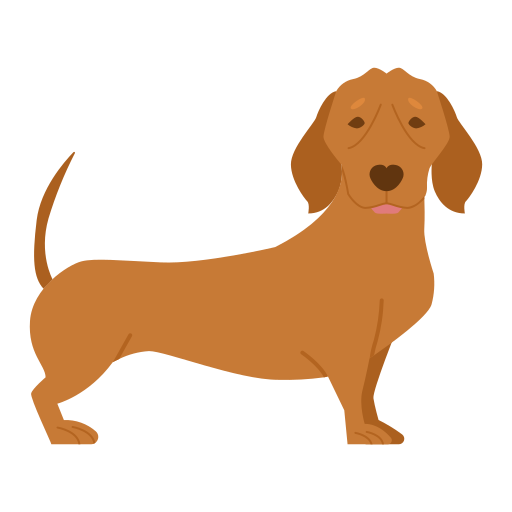
 Dachshund
 That ridiculous bark, the one that sounds like it belongs to a dog three times the size, was engineered on purpose. German breeders needed a hunting dog that could disappear into a badger tunnel and still be heard through several feet of packed dirt.
The volume was a design requirement, not a defect.
Which means when your dog absolutely loses it at the mail carrier, you are not watching a behavior problem unfold. You are watching a 300 year old job description execute perfectly, in your living room, at 7:40 in the morning.
Almost everything that frustrates owners about this breed works the same way. The digging, the burrowing, the selective hearing, the strong opinions about carpet placement: all of it traces back to work nobody has asked these dogs to do since roughly the invention of the telegraph.
Here is what yours would tell you, if the two of you happened to share a language.
"My Body Is Doing Math You Cannot See"
The long spine gets all the attention. The real story is in the legs.
Dachshunds carry a gene for chondrodystrophy, which means their cartilage develops differently from other breeds. Short legs are the visible result. Discs that dry out and harden years earlier than they should are the invisible one.
So when people say to be careful with the back, they usually picture a dog gracefully snapping in half like a breadstick. That is not how it works. What actually happens is a hardened disc under normal pressure, on a normal Tuesday, during a normal jump off the couch.
A back injury in this breed is almost never caused by one dramatic moment. It is caused by a thousand ordinary ones that nobody thought twice about.
The Couch Is the Villain, Not the Stairs
Stairs get blamed constantly. Stairs are fine, relatively speaking, because the dog controls the descent and lands in small increments.
Jumping off a sofa is a different physics problem entirely. Full body weight, launched downward, absorbed by front legs the length of a dinner roll.
Ramps solve this in about a week. Most dogs figure them out faster than their owners expect, especially if you put something delicious at the top for the first few days.
The Collar Situation
Neck pressure on a dog built like this transfers straight down the spine. A harness distributes that same force across the chest instead.
Keep the collar for tags. Walk on the harness.
"Stubborn Is the Wrong Word"
Here is the thing owners get wrong more than anything else.
Retrievers were bred to take direction from a person standing fifty yards away. Dachshunds were bred to go underground, alone, into the dark, and make life or death decisions about a badger with no human input whatsoever.
Independence was the whole point. A dog that stopped to check in with its handler mid tunnel was a dog that got hurt.
So your dog is not ignoring you out of spite. Your dog is running a decision tree that was built to prioritize its own judgment, and your recall command is one input among several.
Asking a dachshund to obey without thinking is like asking a mathematician to stop showing their work.
What Training Looks Like Instead
Repetition kills their interest fast. Five perfect sits earns you nothing but a dog who has decided this game is beneath them.
Short sessions work better. Three minutes, high value food, then stop while they still want more.
And make the request worth their while every single time in the beginning. These dogs run a constant internal cost benefit analysis, and "because I said so" scores extremely poorly on it.
"The Burrowing Thing Is Not Negotiable"
Watch one get into a blanket. It is not lying down on the blanket. It is tunneling, with genuine intent, occasionally with its whole face buried and its back legs still kicking.
That instinct is as hardwired as the bark. Denying it does not make it go away, it just makes the dog frantic about finding somewhere acceptable, which is how you end up with a hole in your good comforter.
Give them a legitimate outlet. A dedicated blanket, a covered bed with a hood, a fleece cave in the corner of the couch.
Digging Follows the Same Logic
A dachshund that destroys your flower bed is not being destructive. It is doing exactly the thing its ancestors were rewarded for, in the only dirt available.
A sandbox or a designated digging corner in the yard redirects it almost entirely. Bury a few toys, let them find one, and the flower bed loses its appeal fast.
"Cold Hits Me Differently Than It Hits Other Dogs"
Low body mass, minimal fat reserves, and a belly that sits about four inches off the ground.
Frost, wet grass, and cold tile all reach them faster than they reach a taller dog. The shivering is not drama and it is not a bid for attention.
Smooth coats feel it worst. Longhairs and wirehairs get a little more insulation, though not nearly as much as their fluff suggests.
Coats are genuinely functional here, which is not true for most breeds. Buy one that covers the chest and belly, not just the back.
"My Nose Overrides My Ears"
Scent hound. Sight second, sound third, nose first, always.
A dachshund on a fresh trail is not choosing to ignore you. In that moment, the part of the brain processing your voice has been comprehensively outvoted.
A recall command competing with an interesting smell is not a fair fight, and pretending otherwise gets dogs lost.
This is why off leash freedom in unfenced areas goes badly so often. The dog is not testing you. The dog has received better information from a rabbit trail and has acted on it.
Fenced Space Changes Everything
Give them a secure yard or a long line in an open field and the same instinct becomes a gift. Watching one work a scent is genuinely fascinating, all that focus and drive packed into a dog the size of a loaf of bread.
Let them sniff on walks, too. A twenty minute walk with sniffing beats a forty minute march past everything.
"I Would Rather Be Near You Than Almost Anywhere Else"
Pack hunters bond hard. That is the trade you make for all the independence discussed above.
They will follow you to the bathroom. They will relocate every time you relocate, sighing audibly about it, and settle again three feet from wherever you landed.
Separation anxiety runs high in this breed for exactly that reason. Crate training early, leaving for short stretches before you need to leave for long ones, and building the habit of independence gradually all pay off enormously later.
The Velcro Problem Cuts Both Ways
A dog this attached will also read your mood with unsettling accuracy. Tension in your voice registers. Frustration during training registers.
Stay light and they stay engaged. Get sharp and they shut down, then decide the whole exercise is unpleasant and worth avoiding.
"Small Does Not Mean Fragile Everywhere"
One last misconception worth clearing up.
The spine needs protection. The rest of the dog does not need bubble wrap.
These are athletic, high drive, surprisingly tough animals that were built to fight cornered badgers in confined spaces. They need real exercise, real mental work, and real challenges.
Under exercised dachshunds get loud, destructive, and pushy about food. Well exercised ones sleep sixteen hours a day and act like model citizens for the other eight.
The tricky part is that their exercise has to work around the back. Long walks on flat ground are perfect. Repetitive jumping, hard landings, and roughhousing with much larger dogs are not.
Scent games fill the gap beautifully. Hide treats around a room, let them hunt, and watch a dog that has been pacing all afternoon suddenly find its purpose again.