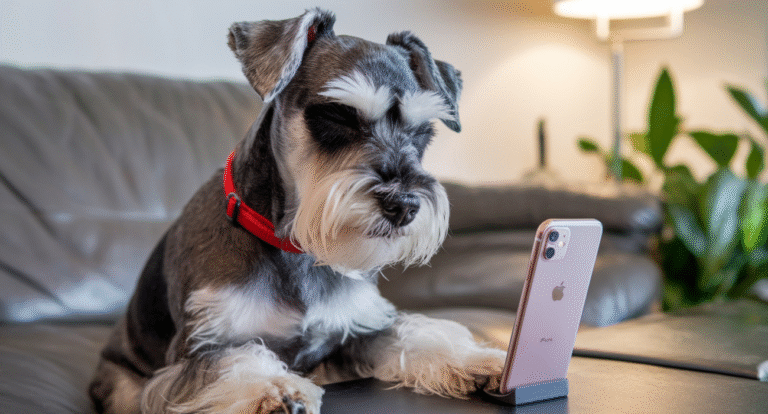
That adorable head tilt actually means something. Discover the fascinating reasons behind your Schnauzer’s cutest habit.
You’re sitting on the couch, telling your Schnauzer about your day, when suddenly that adorable furry head tilts to one side. Your heart melts instantly. But wait, is your bearded buddy just being cute, or is there something deeper happening behind those expressive eyebrows?
That iconic head tilt isn’t just a party trick your Schnauzer perfected to score extra treats (though it definitely works for that purpose). Scientists and animal behaviorists have been studying this endearing gesture for years, and what they’ve discovered might surprise you. Your Schnauzer is actually doing some pretty complex cognitive processing when that little head goes sideways.
They’re Actually Listening Really Hard
When your Schnauzer tilts their head, they’re not just posing for Instagram. They’re adjusting their ears to better capture sound. Dogs’ ear anatomy is quite different from ours, and those adorable floppy or pointed ears (depending on whether your Schnauzer’s ears are cropped) work like satellite dishes, constantly adjusting to pick up audio signals.
Schnauzers are particularly attuned to human speech patterns. When you’re talking to them, they’re trying to isolate specific words they recognize. Words like “walk,” “treat,” “dinner,” or “squirrel” trigger intense focus. The head tilt helps them adjust the position of their ear canals to maximize sound reception. Think of it like fine tuning an old radio to get the clearest signal.
But here’s where it gets really interesting. Research suggests that dogs tilt their heads more frequently when hearing novel or confusing sounds. If you say something unexpected or use an unusual tone of voice, your Schnauzer might tilt their head to gather more auditory information and figure out what the heck you just said.
When your Schnauzer tilts their head at the sound of your voice, they’re engaging in active listening that rivals the attention most humans give during important conversations. It’s their way of saying, “I’m trying really hard to understand you.”
The Vision Factor You Probably Never Considered
Here’s something most Schnauzer owners don’t realize: that magnificent beard might actually be blocking their view. Researchers have proposed that dogs with longer muzzles and more facial hair (hello, Schnauzers!) tilt their heads to get a better visual angle on human faces, particularly our mouths.
Dogs are incredibly skilled at reading human facial expressions and body language. They watch our mouths when we speak because they’ve learned to associate lip movements with sounds and meaning. Your Schnauzer’s luxurious facial furnishings, while undeniably handsome, create a visual barrier that the head tilt helps overcome.
A fascinating study conducted with various dog breeds found that dogs with flatter faces (brachycephalic breeds) tilted their heads less frequently than dogs with longer muzzles. Schnauzers, with their distinctive rectangular heads and prominent beards, fall squarely into the frequent head tilter category. They’re literally trying to see around their own facial hair to get a better look at you.
| Factor | How It Affects Head Tilting | Schnauzer Specific Notes |
|---|---|---|
| Ear Position | Adjusting to capture sound waves more effectively | Schnauzers have excellent hearing; they tilt to pinpoint exact sound sources |
| Muzzle Length | Longer muzzles may block visual field | Medium length muzzle plus beard creates significant visual obstruction |
| Facial Hair | Creates visual barriers to human faces | Dense beard and eyebrows are signature Schnauzer features that encourage tilting |
| Cognitive Processing | Indicates active thinking and problem solving | Schnauzers are highly intelligent and tilt more when processing complex information |
Your Schnauzer is Trying to Read Your Emotions
Dogs are emotional sponges, and Schnauzers are particularly sensitive to their humans’ feelings. When you’re speaking, your Schnauzer isn’t just listening to what you’re saying but how you’re saying it. That head tilt often appears when they’re trying to decode your emotional state.
Tone of voice matters tremendously to dogs. Your Schnauzer can distinguish between happy voices, sad voices, angry voices, and excited voices. When your emotional tone doesn’t match what they expect, or when they’re picking up on subtle emotional cues, they’ll often tilt their head while they work through the information.
Are you using a happy voice but your body language seems tense? Is your voice calm but your words are coming faster than usual? These inconsistencies fascinate dogs, and they’ll tilt their heads as they attempt to reconcile the mixed signals. Schnauzers, being the clever and observant dogs they are, seem particularly prone to this behavior.
Some behaviorists believe the head tilt is also a social signal from dog to human. It’s as if your Schnauzer is saying, “I’m paying attention to you. I care about what you’re communicating.” This theory makes sense when you consider that dogs have evolved alongside humans for thousands of years, developing sophisticated ways to interact with us.
The Intelligence Connection
Here’s something that might make you feel even more proud of your brainy Schnauzer: research suggests that head tilting might be associated with intelligence and vocabulary comprehension in dogs. A study examining “gifted word learner” dogs (those rare pups who can learn the names of dozens or even hundreds of toys) found that these smarty pants tilted their heads significantly more often than average dogs.
Schnauzers are consistently ranked among the more intelligent dog breeds. They were originally bred as versatile farm dogs, required to think independently, solve problems, and respond to various commands. This working heritage means your Schnauzer comes equipped with serious cognitive horsepower.
When you say a word your Schnauzer knows, particularly the name of a favorite toy or activity, watch what happens. Chances are good you’ll see that head tilt appear as your dog mentally retrieves the associated memory. It’s like watching the gears turn in their furry little head as they process language.
The head tilt isn’t just cute; it’s a window into your Schnauzer’s cognitive processing. Each tilt represents your dog actively engaging with language, attempting to match sounds with meanings, and demonstrating the remarkable intelligence that made Schnauzers such successful working dogs.
Could It Be a Medical Issue?
While head tilting is usually completely normal and adorable, it’s important to know when it might signal a problem. Excessive head tilting, especially when accompanied by other symptoms, could indicate a medical issue that needs veterinary attention.
Ear infections are common in Schnauzers, particularly those with uncropped ears. If your dog is tilting their head persistently to one side, shaking their head frequently, scratching at their ears, or if you notice any discharge or odor from the ears, schedule a vet visit. Ear infections can be painful and require treatment.
Vestibular disease is another condition that can cause dramatic head tilting. This affects the inner ear and balance system, causing dogs to tilt their heads, walk in circles, or seem disoriented. While it can look alarming, many cases resolve on their own with supportive care, though veterinary evaluation is essential.
Here’s a simple way to distinguish between “cute” head tilting and “concerning” head tilting: normal head tilts are temporary responses to specific stimuli. Your Schnauzer hears something interesting, tilts their head for a few seconds, then returns to normal. Problematic tilting is persistent, often favoring one specific direction, and doesn’t stop when the stimulus is removed.
Training Your Schnauzer to Tilt on Command
Since the head tilt is so unbearably cute, many Schnauzer owners wonder if they can train their dogs to do it on command. Good news: you absolutely can! This trick is relatively easy to teach, especially if your Schnauzer already tilts their head naturally.
Start by identifying what triggers your dog’s natural head tilt. For many Schnauzers, it’s specific sounds or words. Some dogs tilt at whistle sounds, others at squeaky noises, and many respond to questions asked in a particular tone. Once you know what makes your Schnauzer tilt naturally, you can begin associating that trigger with a verbal command.
Choose a word like “curious” or “what’s that?” and say it every single time your Schnauzer tilts their head naturally. Immediately follow with praise and a small treat. Your clever Schnauzer will quickly learn that the head tilt earns rewards. Within a few weeks of consistent practice, most Schnauzers will start offering the head tilt when they hear the cue word, even without the original trigger sound.
The key is patience and consistency. Never force your dog’s head into position (that’s uncomfortable and breaks trust). Instead, wait for natural tilts, mark them with your chosen word, and reward generously. Before long, you’ll have a party trick that’s guaranteed to make everyone who meets your Schnauzer absolutely melt.
Teaching your Schnauzer to tilt on command isn’t just about having a cute trick to show off. It’s an exercise in communication, building your dog’s vocabulary, and strengthening the bond between you through positive reinforcement training.
Why Some Schnauzers Tilt More Than Others
If you’ve spent time around multiple Schnauzers, you’ve probably noticed that some are prolific head tilters while others rarely do it. Individual personality plays a huge role in this behavior. More curious, attentive Schnauzers tend to tilt their heads more frequently than their more laid back counterparts.
Age can also be a factor. Younger Schnauzers, still learning about the world and developing their understanding of human communication, often tilt their heads more frequently than older dogs who’ve already figured most things out. However, senior Schnauzers sometimes increase head tilting as their hearing naturally declines with age, requiring them to work harder to process sounds.
The strength of your bond with your Schnauzer matters too. Dogs who are deeply connected to their humans and highly motivated to understand them tend to display more frequent head tilting. This is one of those behaviors that reflects the quality of your relationship. Your Schnauzer cares about what you’re saying and wants to understand you better, so they put in the extra effort to decode your communication.
Environmental factors play a role as well. Schnauzers raised in homes with lots of verbal interaction and conversation tend to develop more pronounced head tilting behaviors. If you’re the type of owner who talks to your dog throughout the day, explaining what you’re doing and asking questions (we’re not judging; we do it too!), you’re reinforcing this attentive behavior.
Making the Most of Your Schnauzer’s Head Tilt
Understanding why your Schnauzer tilts their head can actually improve your communication with them. When you see that head tilt appear, you know your dog is actively processing information and trying to understand you. This is the perfect moment to clearly communicate what you want.
Use this heightened attention span to your advantage during training. When your Schnauzer tilts their head at a command, they’re demonstrating focus and cognitive engagement. This is an ideal time to reinforce the behavior you’re teaching or introduce a new concept.
Pay attention to what triggers your individual Schnauzer’s head tilts. Does your dog tilt more at certain words? Specific tones of voice? Novel sounds? Understanding your dog’s unique tilting patterns gives you insight into what captures their attention and what they find confusing or intriguing.
And finally, just enjoy it! The head tilt is one of those special behaviors that makes living with a Schnauzer such a joy. It’s a reminder that your dog is constantly trying to bridge the communication gap between species, working hard to understand you better. Every tilt is a little demonstration of love, attention, and the desire to connect with you on a deeper level.
So the next time your bearded friend cocks their head at you with those soulful eyes beneath those expressive eyebrows, remember: you’re witnessing a complex interplay of auditory adjustment, visual compensation, emotional reading, and cognitive processing. It’s not just cute (though it’s definitely that). It’s your intelligent, attentive, wonderful Schnauzer doing exactly what they were bred to do: paying close attention to their human and trying their absolute best to understand you.