Avoid the mistakes most new owners make. These essentials help you skip regrets and create a smooth start with your Schnauzer companion.
You’re scrolling through dog photos online, and suddenly there it is. Those eyes. That beard. That unmistakable Schnauzer swagger. Within weeks, you’ve got your new best friend home, and you’re convinced you’ve got this dog parenting thing totally figured out. Spoiler alert: you probably don’t.
The Schnauzer learning curve is real, folks. These aren’t your average couch potato pups who are happy with whatever life throws their way. They’re intelligent, opinionated, and they will train you if you don’t train them first. The good news? Most rookie mistakes are totally fixable once you know what they are.
1. Skipping Early Socialization Because “They’re Just Naturally Friendly”
Here’s a myth that needs to die: Schnauzers don’t need socialization because they’re naturally good with people and other dogs. Wrong, wrong, wrong. In fact, Schnauzers can be naturally suspicious of strangers and territorial with other dogs if they don’t learn proper social skills early on.
The Schnauzer temperament is protective by nature. Without proper socialization, that protectiveness can morph into reactivity, excessive barking, or even aggression. Your adorable puppy needs to meet different people, experience various environments, and interact with other dogs during their critical socialization window (roughly 3 to 14 weeks old).
The socialization window doesn’t stay open forever. What you skip now, you’ll spend years trying to fix later.
Think of socialization as an investment account. Every positive experience you deposit during puppyhood pays dividends throughout your dog’s entire life. Take your Schnauzer to puppy classes, invite friends over, walk through different neighborhoods, and introduce them to children, elderly people, and people wearing hats, sunglasses, or uniforms. Yes, really. Schnauzers notice everything, and what they don’t encounter young, they may find threatening later.
2. Underestimating Their Exercise and Mental Stimulation Needs
Look, nobody’s saying Schnauzers are Border Collies or Australian Shepherds. They won’t demand a 10 mile run before breakfast. But the mistake new owners make is treating them like lap dogs who are content with a quick potty break and some couch time. These dogs were bred to be ratters and farm dogs. That working dog DNA doesn’t just disappear.
A bored Schnauzer is a destructive Schnauzer. They’ll dig, bark incessantly, chew your favorite belongings, and generally make their displeasure known. The solution isn’t necessarily more physical exercise (though they do need daily walks), it’s more mental stimulation.
| Activity Type | Time Investment | Schnauzer Satisfaction Level |
|---|---|---|
| Basic walk around the block | 15 minutes | Low to Medium |
| Walk with training games | 20-30 minutes | High |
| Puzzle toys and food games | 15-20 minutes | Very High |
| Fetch or flirt pole play | 20-30 minutes | High |
| Scent work or hide and seek | 15-25 minutes | Very High |
Schnauzers are problem solvers. Give them problems to solve! Hide treats around the house, teach them new tricks, use puzzle feeders, play hide and seek, or try nose work games. A 20 minute training session will tire them out more effectively than an hour of aimless walking.
3. Letting Those “Cute” Puppy Behaviors Slide
That tiny Schnauzer puppy jumping on you? Adorable. That same behavior when they’re 40 pounds of muscle and beard? Not so adorable. This is where so many new owners shoot themselves in the foot. What you allow at 10 weeks old becomes an ingrained habit by 10 months old.
Schnauzers are incredibly smart, which means they learn bad habits just as quickly as good ones. Actually, scratch that. They learn bad habits faster because those habits usually benefit them somehow. Jumping gets attention. Barking gets you to respond. Stealing food off the counter gets them a snack.
The “it’s just a puppy” excuse has an expiration date that comes way faster than you think. Start training from day one. That means no jumping, no begging at the table, no sleeping in your bed if that’s not your long term plan, and no excessive barking. Consistency from the beginning saves you from having to break stubborn habits later.
Every behavior you think is temporary is actually a preview of your future unless you actively intervene.
4. Neglecting Grooming Until It Becomes a Nightmare
Schnauzers have hair, not fur, and that distinction matters big time. Their double coat requires regular maintenance, and “regular” doesn’t mean every few months when you finally can’t stand looking at them anymore. We’re talking every 6 to 8 weeks for professional grooming, plus weekly brushing at home. Skip this, and you’re looking at painful matting, skin issues, and a very unhappy dog.
New owners often underestimate the grooming commitment because Schnauzer puppies don’t seem that high maintenance initially. Then the adult coat comes in, and suddenly you’ve got a dog with thick, wiry outer hair and a soft undercoat that tangles if you look at it wrong.
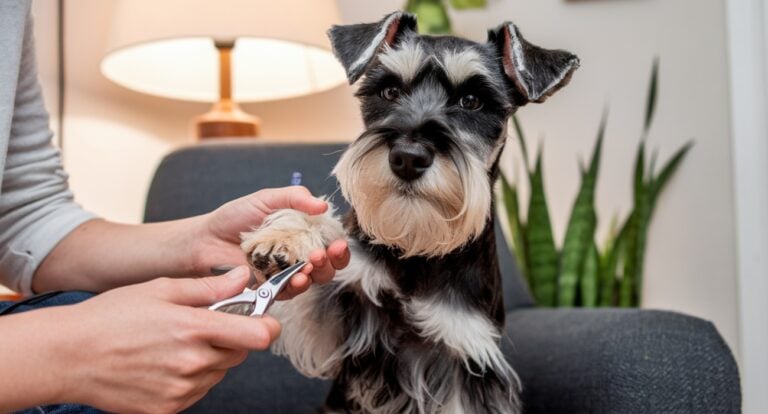
Here’s what rookie owners wish they’d known: start grooming routines immediately, even before your puppy really needs it. Get them comfortable with being brushed, having their paws handled, getting their nails trimmed, and standing still for grooming. Find a groomer you trust and stick to a regular schedule. Your future self (and your Schnauzer’s skin) will thank you profusely.
And please, for the love of everything holy, don’t attempt to groom your Schnauzer yourself unless you’ve been properly trained. Those adorable Schnauzer cuts you see on Instagram? They require skill. Bad grooming can ruin their coat texture permanently.
5. Feeding Low Quality Food to “Save Money”
Let’s talk about something that affects literally every aspect of your Schnauzer’s health: nutrition. Some new owners figure dog food is dog food, so they grab whatever’s cheapest at the grocery store. This is penny wise and pound foolish, especially with Schnauzers who can be prone to pancreatitis, bladder stones, and digestive sensitivities.
Schnauzers need high quality protein as the primary ingredient, not corn or wheat fillers. Their food should support their energy levels without causing weight gain (Schnauzers can become chunky faster than you’d expect). Many Schnauzers do best on limited ingredient diets or foods formulated for sensitive stomachs.
The “savings” from cheap food disappear real quick when you’re paying for vet visits to treat preventable conditions. Pancreatitis alone can cost thousands to treat and often results from high fat diets or sudden dietary changes. Bladder stones, which Miniature Schnauzers are genetically predisposed to, can be influenced by diet as well.
Do your research. Talk to your vet. Read ingredient labels. Yes, quality food costs more upfront, but it’s an investment in longevity and quality of life. Plus, dogs eating nutrient dense food actually eat less because they’re getting what they need, so that premium bag lasts longer than you’d think.
6. Ignoring Training Because “They’re Too Stubborn”
Oh boy, this one gets me every time. Someone gets a Schnauzer, discovers they have a strong will and independent streak, and decides training is futile. So they just… give up. And then they wonder why their Schnauzer runs the household like a tiny, bearded dictator.
Yes, Schnauzers can be stubborn. They’re also whip smart and highly trainable when you use the right approach. The secret isn’t forcing compliance through dominance (please don’t do this), it’s making training fun and rewarding. Schnauzers want to know what’s in it for them.
Your Schnauzer isn’t stubborn. They’re just smarter than your training method.
Positive reinforcement training works beautifully with this breed. Use high value treats, keep sessions short and fun, and make your Schnauzer think following your directions was their idea. They excel at obedience, tricks, and even dog sports when properly motivated.
The biggest mistake is inconsistency. If you enforce rules sometimes but not others, your Schnauzer learns that rules are optional. They’ll constantly test boundaries to see what they can get away with. Set clear expectations, reward good behavior immediately, and redirect unwanted behavior without anger or frustration. Training isn’t a battle of wills; it’s a partnership.
7. Not Setting Boundaries Around Barking From Day One
Schnauzers bark. It’s what they do. They were bred to alert their humans to potential threats, and in their minds, everything is a potential threat. The mailman, the neighbor’s cat, a leaf blowing past the window, someone daring to walk on the sidewalk that exists near their house. All threats. All worthy of a full alert bark session.
The mistake new owners make is thinking this is cute or letting it slide because “they’re just being protective.” Then suddenly you’ve got a dog who barks at absolutely everything, and your neighbors hate you. Teaching “quiet” commands and managing barking triggers needs to start immediately.
| Barking Trigger | Prevention Strategy | Training Required |
|---|---|---|
| Doorbell/knocking | Desensitization training, “place” command | Medium effort |
| Window watching | Block visual access, provide alternative activities | Low effort |
| Separation anxiety | Gradual alone time, crate training | High effort |
| Attention seeking | Ignore unwanted barking, reward quiet | Medium effort |
| Alert barking outside | “Quiet” command training, controlled exposure | High effort |
Some barking is normal and even desirable (you probably want to know if someone’s actually at the door). But excessive, uncontrolled barking becomes a serious quality of life issue for everyone involved. Teach an “enough” or “quiet” command early. Reward your Schnauzer for being calm and quiet. Don’t accidentally reinforce barking by giving attention when they do it.
Remember, you can’t eliminate barking entirely, nor should you want to. But you can teach your Schnauzer when barking is appropriate and when it needs to stop. The earlier you start, the easier it is.