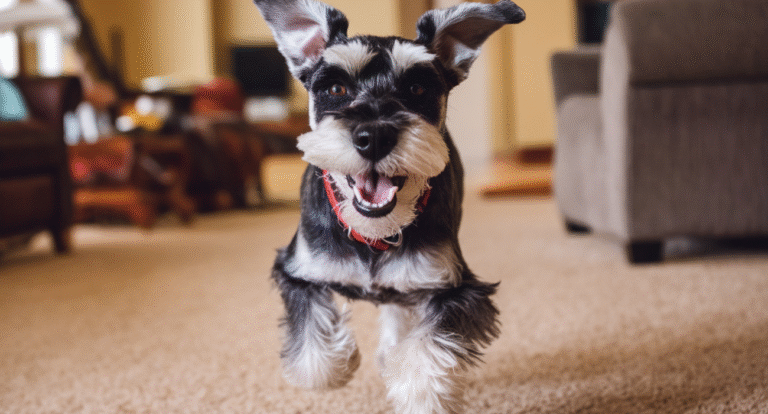
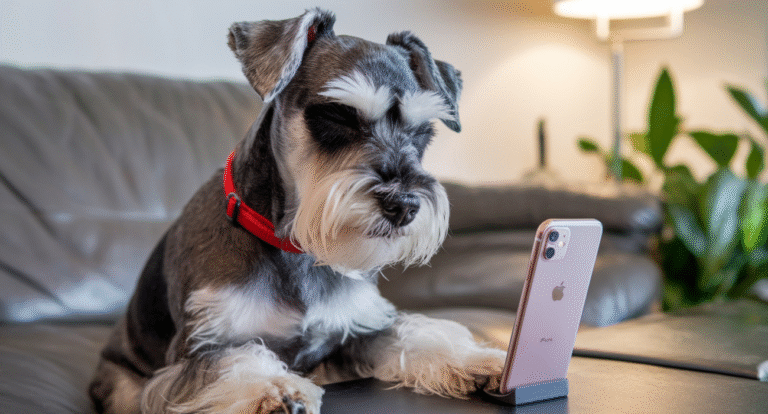
Try this one powerful trick to burn off that endless Schnauzer energy. Expect a calmer, happier home by the end of the day.
Watch a Schnauzer for five minutes and you’ll notice something remarkable. They’re always thinking. Whether they’re figuring out how to reach that toy under the couch, strategizing the best route to steal food from the counter, or simply observing everything with those intense little eyes, their minds never stop running.
This constant mental activity is both their charm and your challenge. Physical exercise will tire their body, sure, but it won’t satisfy the mental hunger that drives so much of their restless behavior. What they really need is something entirely different.
Why Physical Exercise Alone Fails
You’ve probably tried it all. The long walks. The dog park visits. Maybe even those expensive doggy daycare sessions where your Schnauzer supposedly plays for hours. And yet, twenty minutes after getting home, they’re back to their usual antics: barking at shadows, pestering you for attention, or redesigning your backyard landscaping.
Here’s what’s happening: Schnauzers were bred to be ratters and guard dogs. Their ancestors spent their days independently solving problems, making decisions, and staying alert to potential threats. Running around doesn’t scratch that itch. It’s like giving a chess grandmaster a treadmill and expecting them to feel fulfilled.
Physical exhaustion and mental satisfaction are completely different states. Your Schnauzer might have tired legs, but their brain is still firing on all cylinders, searching for the stimulation it desperately needs. This is why they can sleep for an hour after a long walk and then immediately resume causing chaos.
The Power of Mental Stimulation
Mental stimulation is the secret weapon that changes everything. When you engage your Schnauzer’s brain, you’re not just tiring them out; you’re satisfying a fundamental need that physical exercise cannot touch.
Mental exercise can tire a dog as much as a two hour hike, but in a fraction of the time and without the wear and tear on their joints.
Think about how you feel after an intensely focused work session or after taking a difficult exam. Your body hasn’t moved much, but you’re genuinely exhausted. Dogs experience the same phenomenon. Fifteen minutes of concentrated problem solving can leave your Schnauzer more pleasantly tired than an hour of fetch.
How Mental Stimulation Works
When your Schnauzer engages in mentally challenging activities, several things happen simultaneously:
- Their brain burns calories. Yes, thinking actually consumes energy. Complex cognitive tasks require glucose and create genuine fatigue.
- They enter a flow state. Just like humans, dogs can become so absorbed in an interesting challenge that time seems to disappear. This focused state is deeply satisfying and naturally calming.
- Their stress hormones decrease. Appropriate mental challenges (not frustrating ones) trigger the release of dopamine and other feel good chemicals. Your Schnauzer ends up not just tired, but genuinely content.
The #1 Way: Interactive Puzzle Feeding
The single most effective method for draining your Schnauzer’s energy is interactive puzzle feeding. This approach combines three powerful elements: mental challenge, natural foraging instincts, and extended engagement time.
Instead of dumping kibble in a bowl (a thirty second activity that provides zero mental stimulation), you make your Schnauzer work for every bite. This doesn’t mean being cruel; it means honoring their instinct to hunt and forage.
Why Puzzle Feeding Dominates
Schnauzers are scent hounds with strong prey drives. In their original role, they would spend hours searching, tracking, and capturing rats in barns and stables. Puzzle feeding recreates this experience in a safe, indoor environment.
| Traditional Bowl Feeding | Interactive Puzzle Feeding |
|---|---|
| Completed in 30 to 60 seconds | Takes 15 to 45 minutes |
| Zero mental engagement | High cognitive demand |
| Often leads to gulping and bloating | Encourages slow, mindful eating |
| Provides no enrichment | Satisfies natural foraging instincts |
| Does nothing for energy levels | Creates genuine mental fatigue |
The beauty of this method is its efficiency. You’re already feeding your dog daily. By transforming mealtime into an extended mental workout, you’re getting maximum benefit from time you were already spending.
Implementing Puzzle Feeding Successfully
Starting puzzle feeding requires some strategy. You can’t just throw your dog’s food into a complicated puzzle on day one and expect success. Like any training, it needs gradual progression.
Starting Simple
Begin with easy challenges that build confidence. Scatter feeding is the perfect introduction: simply spread your Schnauzer’s kibble across a clean floor or yard. This activates their foraging instincts without frustrating them. Most dogs find this thrilling because it mimics the search and discover pattern they’re genetically programmed to enjoy.
You can also use a muffin tin with tennis balls. Place kibble in the muffin cups and cover each with a tennis ball. Your Schnauzer needs to remove the balls to access the food. It’s simple enough to figure out quickly but engaging enough to hold their attention.
Advancing the Challenge
Once your Schnauzer masters basic puzzles, gradually increase complexity. Snuffle mats are excellent intermediate tools. These fabric mats have layers of fleece strips where you hide kibble, requiring your dog to sniff and root through the material to find each piece.
The key is finding the sweet spot: challenging enough to engage their brain, but not so difficult that they give up in frustration.
Food dispensing toys like the Kong Wobbler or puzzle feeders with sliding compartments add another layer of difficulty. Your Schnauzer needs to manipulate the toy in specific ways to release the food. This type of problem solving creates genuine mental fatigue.
Advanced Techniques
For Schnauzer owners ready to go all in, consider creating your own puzzle stations around the house. Hide portions of your dog’s meal in different puzzle toys scattered throughout your home. Your Schnauzer then needs to locate and solve each puzzle, turning mealtime into an extended treasure hunt.
Some owners freeze puzzle toys with wet food or mix kibble with water before freezing. This extends the challenge significantly, as your dog needs to lick and work at the frozen contents. A frozen Kong can keep a Schnauzer occupied for thirty minutes or more.
Beyond Food Puzzles
While puzzle feeding is the #1 method, you can amplify results by incorporating other mental stimulation throughout the day.
Scent Work and Nose Games
Schnauzers have approximately 220 million scent receptors (humans have only 5 million). Training basic scent work taps into this superpower. Start by teaching your Schnauzer to find specific scented objects. This could be as simple as hiding a favorite toy and encouraging them to search, or as advanced as training them to identify essential oil scents.
Even simple nose games provide tremendous mental engagement. Try the “which hand” game: put a treat in one closed fist, present both fists to your dog, and reward them for choosing correctly. This straightforward activity requires focus, impulse control, and decision making.
Training New Behaviors
Regular training sessions, even just five to ten minutes, provide excellent mental workouts. But here’s the trick: teach useless tricks. You don’t need to stick to sit, stay, and heel. Teach your Schnauzer to spin, weave through your legs, play dead, or fetch specific toys by name.
The learning process itself is what matters. Each new behavior creates neural pathways and requires concentration. Your Schnauzer doesn’t know that “balance a treat on your nose” has no practical purpose; they only know it’s a fascinating challenge that earns rewards and attention.
The Results You Can Expect
When you commit to draining your Schnauzer’s energy through mental stimulation, the changes can be dramatic. Most owners report significant behavioral improvements within just one to two weeks.
Behavioral Changes
Your Schnauzer will likely become calmer and more settled indoors. That frantic energy that used to lead to destructive behavior gets channeled into appropriate outlets. Many owners notice their dogs sleep more deeply and for longer periods, having achieved genuine satisfaction rather than mere physical exhaustion.
Nuisance behaviors often decrease significantly. Excessive barking, jumping, and attention seeking behaviors typically stem from boredom and unmet mental needs. When those needs are satisfied, the behaviors naturally diminish.
A mentally stimulated Schnauzer is a well behaved Schnauzer. It’s not about dominance or discipline; it’s about meeting their fundamental needs.
The Bonding Benefit
Perhaps the most unexpected benefit is the strengthening of your relationship. When you engage your Schnauzer’s mind, you become an endless source of interesting experiences. Your dog starts viewing you not just as the food provider, but as the facilitator of fun and challenges.
This creates a dog who wants to engage with you, who checks in with you regularly, and who sees you as the most interesting thing in their environment. That’s a far better foundation for a relationship than simple obedience training.
Making It Sustainable
The key to long term success is making mental stimulation a natural part of your routine, not an added chore. Once you shift your mindset, it becomes surprisingly effortless.
Daily Integration
Instead of viewing puzzle feeding as extra work, recognize that you’re simply relocating the time you’d spend preparing food. Rather than thirty seconds at a bowl, you spend two minutes setting up puzzles. Your time investment increases marginally while your dog’s engagement time increases exponentially.
Rotate different puzzles and methods to maintain novelty. What’s challenging today becomes easy tomorrow, so variety keeps your Schnauzer’s interest high. You don’t need dozens of expensive toys; even cardboard boxes, paper bags, and household items can become engaging puzzles.
Measuring Success
Pay attention to your Schnauzer’s behavior patterns. Are they settling more easily? Sleeping more soundly? Pestering you less frequently? These are signs that their mental needs are being met.
Remember that mental stimulation is cumulative. One puzzle feeding session won’t transform a hyperactive Schnauzer overnight, but consistent daily mental challenges create lasting change. Think of it like going to the gym: one workout doesn’t make you fit, but regular sessions transform your body over time.
Common Mistakes to Avoid
Even with the best intentions, some owners sabotage their success. Here are the pitfalls to watch for:
- Making it too difficult too soon. If your Schnauzer can’t figure out the puzzle within a few minutes, they’ll give up and you’ve created frustration instead of satisfaction. Always start easier than you think necessary.
- Using only one type of puzzle. Dogs adapt quickly. That puzzle that took twenty minutes on day one might take five minutes by week two. Rotate and vary your approach.
- Forgetting to adjust food portions. If you’re using treats for training and puzzles, reduce meal sizes accordingly. Mental stimulation doesn’t prevent weight gain; calorie management does.
- Expecting perfection immediately. Some Schnauzers take to puzzles instantly; others need time to understand the concept. Be patient and celebrate small victories.
The truth is simple: your Schnauzer’s endless energy isn’t a flaw that needs fixing. It’s a feature that needs proper channeling. By focusing on mental stimulation through puzzle feeding and cognitive challenges, you transform that exhausting energy into engaged problem solving. Your home becomes peaceful, your dog becomes content, and you both win.