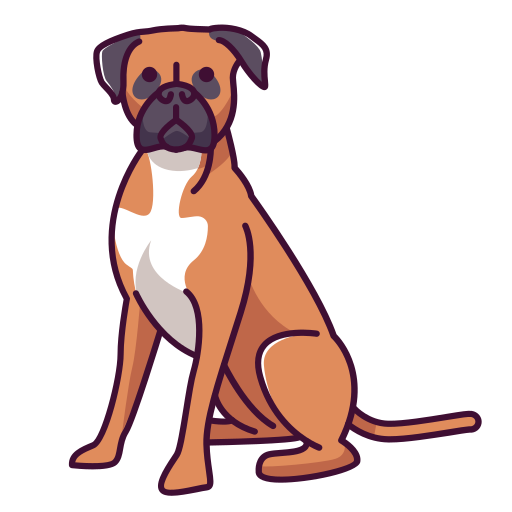
 Boxer
Boxer Ask a room full of Boxer owners what makes a walk worthwhile and you will hear the same answer over and over: distance. Three miles beats two, two beats one, and a dog who flops onto the kitchen tile at the end of it has been walked properly.
That belief is the single biggest misconception about walking a Boxer, and it survives for a very understandable reason. Breed guides all repeat that this is an athletic dog with serious exercise needs, which is completely true, and old training advice piles on with the line about a tired dog being a good dog.
Here is the catch: it works just well enough to feel correct. March a Boxer far enough and he will absolutely nap.
Then eight in the evening arrives and that same dog is body checking the sofa, stealing a sock, and staring at you with those ridiculous wrinkled eyebrows. His legs got drained. His brain never got touched at all.
A walk that genuinely satisfies a Boxer is one that makes him think, sniff, choose, and adjust. Mileage is a byproduct, not the point.
What Your Boxer Is Actually Doing Out There
The Nose Is Doing the Heavy Lifting
Dogs read the world through scent the way we read a phone screen, and a Boxer stopping at a fence post is not being stubborn. He is catching up on the neighborhood news.
Sniffing lowers arousal, burns mental fuel, and settles a dog far more efficiently than another quarter mile of pavement.
So when you tug him along because you are on a schedule, you are skipping the most valuable part of the outing. Give him a solid two or three minutes at a good spot. Watch how differently he behaves the rest of the way.
Boredom Looks a Lot Like Bad Behavior
Boxers were bred to work alongside people, solving small problems all day long. A predictable loop around the same block gives that brain absolutely nothing to chew on.
The leash pulling, the spinning, the theatrical whining at the door: much of that is a smart dog asking for a better job.
A Boxer who has walked two miles and thought about nothing is still a Boxer with a full tank. The energy did not go anywhere. It just changed shape.
Break the Route Before It Breaks Him
The Rotating Three
Build three separate routes and cycle them so he never quite knows which one is coming. Novelty does something to a Boxer that repetition simply cannot fake.
Reverse them, too. Walking the same loop backward genuinely feels like a new street to a dog, because the scent order flips and the sight lines change.
Drive Somewhere Once a Week
Load him up on a Saturday and go anywhere. A hardware store parking lot, a quiet fairground, a friend’s gravel driveway, a trailhead twenty minutes out of town.
Fifteen minutes in a brand new place will do more for your dog than an hour on the familiar sidewalk. New ground beats extra ground, every time.
Boxers are also natural show offs, so a location with a few polite strangers in it gives him a social outlet on top of the mental one.
Small Games That Turn a Stroll Into a Sport
Surprise Sits
Randomly ask for a sit while you walk. No warning, no pattern, no set number of steps.
Reward the fast ones generously and shrug off the slow ones. Within a week your dog is checking in with you constantly, because he never knows when the game is on.
This single habit fixes more leash pulling than most gadgets do.
Find It
Carry a few high value treats and toss one into the grass while he watches. Say your cue, let him hunt.
Boxers commit to this game with their entire body. The wiggle starts, the nose goes down, the stumpy tail goes into overdrive.
Pace Roulette
Walk slowly for ten steps, then jog for ten, then drift back to a crawl. Add a random direction change when he stops paying attention.
Your neighbors may think you have lost it. Your dog will think you are the most interesting person alive.
Dogs do not follow people who are boring. Become slightly unpredictable and your Boxer will glue himself to your side without a single correction.
Gear Changes the Whole Experience
The Long Line Is the Cheapest Upgrade You Will Ever Buy
A fifteen or twenty foot line in an open field gives a Boxer something a six foot leash never can: real choice about where to go and how fast to get there.
He gets to gallop, circle back, veer off after a smell, and still stay safely attached to you.
Practice in a wide open space first, keep the slack managed, and never use one around trees or other dogs until you have both got the hang of it. Tangled Boxer legs are a comedy you only need to experience once.
Two Points of Contact
Boxers are chesty, powerful, and enthusiastic in ways their necks were not designed to handle. A well fitted harness with a front clip spreads that pressure out and gives you steering instead of a tug of war.
Pair it with a leash that has a clip at each end and you gain real control without hauling on his throat.
Skip retractable leashes entirely. They teach a dog that leaning into pressure gets him more room, which is the precise opposite of what you want.
Timing Matters More for This Breed Than Most
Heat Is the Real Enemy
Boxers have shortened muzzles, which means their built in cooling system is running at a serious disadvantage. Panting simply does not move enough heat on a hot afternoon.
Press the back of your hand to the sidewalk for seven seconds. Uncomfortable for you means burned paws for him.
Early morning and after sundown are your friends in summer, and a shorter walk in decent conditions beats a long one in dangerous ones by a mile.
Dark Mornings and Cold Snaps
That sleek coat offers roughly zero insulation. A shivering Boxer is not being dramatic, he is genuinely cold.
A fitted jacket, a brisker pace, and a reflective strip or two handle winter walks nicely.
Comfort is not a luxury for this breed. A dog who is too hot or too cold cannot enjoy anything you have planned, no matter how creative the plan is.
When Excitement Tips Into Chaos
The Front Door Circus
The leash comes out and your Boxer transforms into a spring loaded maniac. Familiar?
Try this instead: pick up the leash, and the instant the bouncing starts, calmly set it back down and sit. Repeat as many times as it takes.
You are not punishing him. You are teaching him that calm is the thing that opens the door, and Boxers figure that arithmetic out remarkably fast.
The Passing Dog Problem
Most Boxers are not aggressive toward other dogs. They are simply desperate to go say hello, and the leash frustration turns that friendliness into a lunging, gasping mess.
Increase your distance before he crosses his threshold. Feed treats steadily while the other dog passes, then release him to sniff something interesting once the coast is clear.
Distance is the tool that makes everything else possible, and giving yourself an extra ten feet is never a failure.
Give him a cue word for greetings, too, so he learns that some dogs are for meeting and others are just scenery. That distinction takes the pressure off both of you.