Mental challenges matter. These fun tests push focus, problem solving, and confidence in engaging ways.
Ever wonder what’s really going on inside your German Shepherd’s head? Spoiler alert: it’s a lot. These dogs are the overachievers of the canine world, bred for generations to think, problem solve, and work alongside humans in complex tasks. That magnificent brain needs a workout just as much as those powerful muscles do.
Mental exercise isn’t just about preventing destructive behavior (though that’s a nice bonus). It’s about tapping into your dog’s natural abilities and watching them absolutely light up when they solve a puzzle. Plus, there’s nothing quite like the smug satisfaction on a German Shepherd’s face when they’ve cracked the code. Time to set up some challenges that’ll truly test what your four legged genius can do.
1. The Shell Game Showdown
Remember that classic street hustle where someone hides a ball under cups and shuffles them around? Your German Shepherd can totally master this, and watching them figure it out is pure entertainment. Start with three cups (plastic works great) and a favorite treat. Let your dog watch as you hide the treat under one cup, then slowly shuffle them around.
Most German Shepherds will catch on surprisingly quickly to this game. At first, they might try to knock over all the cups (the brute force approach), but soon they’ll start tracking the correct cup with laser focus. The beauty of this challenge is that you can increase difficulty gradually. Start with minimal movement, then add more complex shuffling patterns as your pup improves.
Why this works: This game exercises your dog’s visual tracking abilities, memory, and impulse control all at once. German Shepherds are naturally observant, and this challenge taps directly into their tendency to watch and analyze everything around them.
This isn’t just a party trick. Teaching your German Shepherd to track moving objects strengthens the same neural pathways they’d use in serious working scenarios, from search and rescue to protection work.
2. The Name Game: Object Identification Challenge
German Shepherds have an incredible capacity for learning words and associating them with specific objects. Some studies suggest intelligent breeds can learn upwards of 200+ words. Why not put that to the test? Gather several of your dog’s favorite toys and start teaching them individual names for each one.
Begin with just two toys that look distinctly different. Use consistent naming (Mr. Squeaky, Blue Ball, Rope Toy) and repetition. Ask your dog to “bring Mr. Squeaky” and reward heavily when they bring the correct toy. Once they’ve mastered two items, gradually add more to their vocabulary.
The real magic happens when you can send your German Shepherd to another room and have them retrieve a specific toy by name from a pile of options. It’s like having a very furry, very enthusiastic personal assistant.
| Difficulty Level | Number of Toys | Expected Training Time |
|---|---|---|
| Beginner | 2 to 3 toys | 1 to 2 weeks |
| Intermediate | 5 to 7 toys | 3 to 4 weeks |
| Advanced | 10+ toys | 2 to 3 months |
| Expert | 20+ toys | 6+ months |
3. The Puzzle Toy Gauntlet
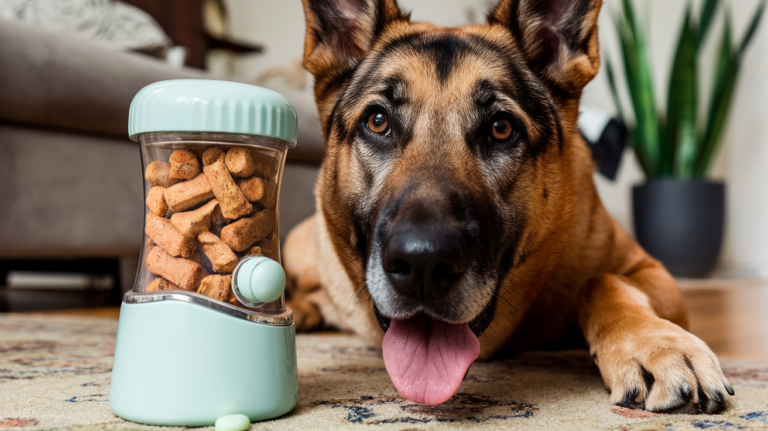
Interactive puzzle toys are phenomenal for German Shepherds because they combine problem solving with that all important food motivation. These range from simple treat dispensing balls to complex multi-step puzzles that would make a Rubik’s Cube jealous. The key is finding the right difficulty level for your dog’s current abilities.
Start with level one puzzles where your dog might need to slide a simple panel or lift a flap to access treats. Watch how they approach the problem. Do they go straight for brute force, or do they pause and analyze? German Shepherds often show remarkable patience with these toys, methodically working through each step.
As your dog masters simpler puzzles, graduate to advanced options with multiple compartments, different opening mechanisms, and sequential steps. Some German Shepherds become absolutely obsessed with these challenges, refusing to give up until they’ve accessed every last treat.
Pro tip: Rotate puzzle toys every few days to keep things fresh. Even the same puzzle becomes new again after a week’s absence, and variety prevents your clever dog from getting bored.
4. Hide and Seek: Advanced Edition
You’ve probably played basic hide and seek with your German Shepherd, but let’s elevate it. This version involves hiding yourself in increasingly creative locations while your dog uses their nose, ears, and problem solving skills to track you down. German Shepherds excel at this because it taps into their natural tracking instincts.
Start in the house with easy hiding spots: behind a door, in a closet with the door cracked open, or under a blanket on the bed. Give your “find me” command and wait. Most German Shepherds will methodically search room by room, using both scent and logic to locate you.
The cognitive workout here is intense. Your dog is processing sensory information, remembering the layout of your home, eliminating possibilities, and making strategic decisions about where to search next. It’s basically a full brain workout wrapped in a game.
Once your pup masters indoor hiding spots, take it outside. Hide behind trees, in garden sheds, or around corners of buildings. The outdoor version adds environmental distractions and requires even sharper focus. The victorious wiggle when they finally find you? Absolutely priceless.
5. The Obstacle Course Brain Teaser
Physical obstacle courses are fun, but add a cognitive element and you’ve got something truly special for your German Shepherd. Set up a course that requires your dog to make decisions at various points, not just jump and weave on autopilot.
For example, place two paths to the finish line but make one clearly longer. Will your dog figure out the shortcut? Add a station where they must ring a bell before proceeding, or create a section where they need to retrieve an object and carry it through part of the course.
The setup can be as simple or elaborate as you want. Use items you have around: chairs to weave through, boxes to jump over, blankets to crawl under, and hula hoops to jump through. The critical part is adding choice points where your German Shepherd must think, not just follow.
Change the course configuration regularly. German Shepherds have excellent spatial memory, so they’ll memorize a static course quickly. By changing it up, you keep those neurons firing and force fresh problem solving every time.
6. The Treat Scatter Search
This challenge engages your German Shepherd’s incredible nose while giving their brain a serious workout. Scatter small treats across an area (start with a small room, then expand to larger spaces or your entire yard) and let your dog systematically search and find every single piece.
What makes this mentally demanding isn’t just the sniffing; it’s the methodology. Watch your German Shepherd develop a search pattern. Most will work in a grid like fashion, ensuring they cover every inch of territory. This mirrors actual scent work used in professional detection dogs.
Increase difficulty by:
- Hiding treats in slightly elevated locations (on low furniture, in plant pots)
- Using smaller treat pieces that require more precise sniffing
- Expanding the search area significantly
- Adding distracting scents to the environment
This activity is particularly brilliant for high energy German Shepherds because it exhausts them mentally. Fifteen minutes of focused scent work can tire out your dog as much as an hour long walk. Their brain is working overtime to process all that olfactory information.
7. The Box Puzzle Bonanza
Grab various sized boxes (cereal boxes, shoeboxes, shipping boxes) and create a puzzle where your German Shepherd must figure out how to access treats hidden inside. This tests problem solving, persistence, and creativity.
Start simple: put treats in an open box. Then progress to a box with flaps they need to push open. Next, try a box inside a box. Eventually, you can create elaborate setups with multiple boxes, some containing treats and others empty, teaching your dog to discriminate and think strategically.
German Shepherds often surprise their owners with creative solutions to box puzzles. Some will use their paws like hands, others will use their snouts like levers, and the truly clever ones will flip entire boxes upside down to dump out contents. There’s no single right answer, and watching your dog’s unique approach is fascinating.
The beauty of box puzzles is the low cost and infinite variety. Boxes are free, biodegradable when your dog inevitably destroys them, and you can create new configurations endlessly. Plus, most German Shepherds find the act of tearing into boxes deeply satisfying, so they’re getting mental stimulation and a fun outlet for natural behaviors.
| Challenge Type | Mental Skills Exercised | Difficulty to Set Up |
|---|---|---|
| Shell Game | Visual tracking, memory, impulse control | Easy |
| Name Game | Language comprehension, memory | Easy |
| Puzzle Toys | Problem solving, persistence | Easy (purchase required) |
| Hide and Seek | Scent tracking, spatial reasoning | Medium |
| Obstacle Course | Decision making, spatial intelligence | Medium |
| Treat Scatter | Scent discrimination, methodical searching | Easy |
| Box Puzzles | Creative problem solving, persistence | Easy |
Remember: The goal isn’t perfection; it’s engagement. Your German Shepherd’s brain needs exercise just like their body, and these challenges provide exactly that. Mix and match activities, follow your dog’s interests, and most importantly, have fun together. A mentally stimulated German Shepherd is a happy, well-behaved companion who’s too busy being brilliant to get into trouble. Now get out there and put that furry genius to work!