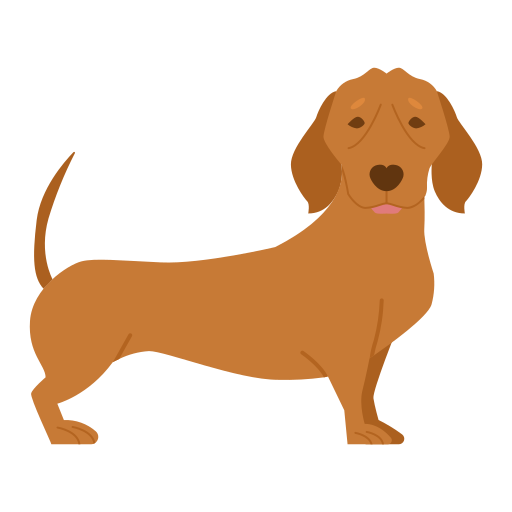
 Dachshund
 Why does she follow me to the bathroom?
That question has been asked by roughly every dachshund owner who has ever tried to close a door. You shut it, and a small paw appears underneath. You open it, and there she is, staring up like you just returned from a six month deployment.
Dachshunds do this. All of them, more or less.
But there is a difference between a dog who prefers your company and a dog who cannot function without it, and figuring out which one you have at home matters more than most people realize.
The Breed Was Built This Way
Blaming your dachshund for being clingy is a bit like blaming a border collie for herding your toddler. The wiring came standard.
Dachshunds were bred to hunt badgers, which sounds unrelated to velcro behavior until you think about how that hunt actually worked. The dog went underground alone, the handler stayed above, and the entire arrangement depended on constant awareness of where the human was.
That underground work required a dog who was independent enough to fight a badger in a tunnel and bonded enough to come back when called.
Small Dog, Big Attachment
Size plays a role too. Small dogs get carried more, sit in laps more, and generally spend more physical hours in contact with their people than a Labrador ever will.
Your dachshund learned early that being near you is where good things happen.
Add a low center of gravity and short legs, and the easiest place in the house to be is wherever you already are, ideally under a blanket.
A dachshund does not see you as a person who lives in the house. A dachshund sees you as the house.
Normal Clingy Versus Not Normal Clingy
Here is where owners get tripped up. Following you room to room is standard issue. Screaming when you take out the trash is not.
The distinction is what happens when you are actually gone.
A dog with a healthy attachment gets a little bummed, settles down, and takes a nap. A dog with genuine separation distress does not settle at all.
Signs Your Dog Is Just Being a Dachshund
Following you around the house, even to the bathroom. Sighing dramatically when you sit down without inviting her up. Choosing the exact cushion you are on out of an entire empty couch.
Waiting by the door when she hears keys.
None of this is a problem. It is just the breed doing what the breed does, which is monitoring you.
Signs Something Deeper Is Going On
Pacing, panting, or drooling before you leave. Destructive chewing that starts within minutes of the door closing. Barking or howling that continues the entire time you are out.
Accidents in the house from a dog who is otherwise reliably trained.
Refusing food or a favorite chew while alone, which is one of the most telling signs of all. A dog who will not eat a bully stick is a dog who is genuinely stressed, not just bored.
If you are seeing these, the clinginess is a symptom rather than a personality trait.
Why It Sometimes Gets Worse Over Time
Clinginess is not static. It shifts, and usually the shift has a reason behind it.
Something in the House Changed
Dogs read routine better than they read us. A new work schedule, a baby, a move, a roommate leaving: any of these can crank up attachment behavior fast.
Even something small counts. Rearranging furniture has genuinely triggered clingy phases in sensitive dogs.
Pain Is a Sneaky Culprit
This one gets missed constantly, and with dachshunds it deserves real attention.
Back problems are common in the breed, and a dog in early stages of disc discomfort will often become noticeably more attached before any limping or yelping shows up. Sticking close to you is a coping strategy.
Sudden clinginess in a dachshund is a vet question before it is a training question.
Vision loss, hearing loss, and general aging do the same thing. An older dog who cannot see the room as clearly will orbit you because you are the reliable landmark.
Accidental Training
Sometimes we build the behavior ourselves without meaning to.
Every time you reach down and pet a dog who is nudging you, you are paying for the nudge. Do that four hundred times and you have a dog who nudges professionally.
That is not a moral failing on your part. It is just how reinforcement works, and it means you also have the ability to shift it.
What Actually Helps
The goal is not a dog who stops loving you. The goal is a dog who feels fine when you are on the other side of a door.
Build Distance in Tiny Doses
Start absurdly small. Walk to the kitchen, come back before she has time to worry, and do it again.
Then thirty seconds behind a closed door. Then a minute.
You are teaching her that departures are boring and returns are guaranteed, which sounds simple but has to be repeated more times than you would guess.
Make Alone Time Have a Payoff
Give her something genuinely good that only appears when you leave. A frozen stuffed toy, a puzzle feeder, a chew she does not get otherwise.
The point is emotional association, not distraction.
Over time, the sound of your keys should start predicting something great rather than something awful.
Reward the Behavior You Want
Most of us pet the dog who is in our face and ignore the dog who is quietly lying down eight feet away.
Flip it. When she settles somewhere on her own, calmly drop a treat near her without making eye contact or turning it into an event.
Do that consistently and you will notice her choosing her own spot more often, which is exactly the outcome you want.
Physical and Mental Exercise, Actually
A dachshund who has been on a decent walk and done some sniffing work is a dachshund with less energy to devote to surveillance.
Scent games are especially effective here. Hiding treats around a room and letting her hunt them taps into the exact instincts the breed was built around.
Ten minutes of nose work will tire her out more than a half hour of walking, which is useful information on days when your schedule is tight.
When to Bring in Help
Some cases do not resolve with home management, and there is no prize for struggling alone.
If your dog is injuring herself trying to escape a crate, if the panic starts the moment you pick up your shoes, or if nothing you try seems to move the needle after a few weeks, it is time to loop in professionals.
Start with your vet to rule out pain or medical causes.
From there, a certified behavior consultant who works with separation anxiety specifically can build a desensitization plan tailored to your dog. This is a real specialty, and the results are often dramatically better than generic advice.
Separation anxiety is one of the most treatable behavior problems there is, provided you treat the anxiety instead of the symptom.
Medication is also worth discussing without stigma. For some dogs, anti anxiety support is what makes the training possible in the first place.
Living With a Velcro Dog
Assuming you have ruled out the serious stuff, a lot of dachshund clinginess is simply something to enjoy rather than fix.
You picked a breed that was designed to bond hard and stay close. That is not a bug.
The dog under your blanket right now, the one wedged against your leg with her chin on your ankle, is doing precisely what two hundred years of breeding shaped her to do.
Set some boundaries where you need them. Teach her that being alone is survivable.
Then let her follow you to the bathroom, because honestly, that fight was never winnable anyway.