Help your Schnauzer relax when left alone. These seven tricks offer quick comfort for happier days, even when you’re not at home.
Schnauzers are notorious stage five clingers, and honestly, we love them for it. These spirited little (or not so little) companions think they’re supposed to be attached to you 24/7. When reality sets in and you actually have to leave the house without them, things can get messy. Literally.
The torn up couch cushions, the scratch marks on the door, the symphony of barks that your neighbors have definitely mentioned. If this sounds like your life, you’re not alone. Separation anxiety is incredibly common in Schnauzers, but the good news is that it’s also very manageable with patience and the right approach.
1. Create a Departure Routine That’s Boringly Predictable
Your Schnauzer is watching your every move. When you start doing that specific sequence of things (shower, coffee, shoes, keys, coat), their anxiety meter starts climbing. The solution? Make these cues so routine and unremarkable that they lose their power.
Start by performing your departure routine at random times when you’re not actually leaving. Put on your coat, grab your keys, then sit down and watch TV. Pick up your bag, walk to the door, and then go make a sandwich. This desensitizes your pup to these triggers.
The key is consistency without drama. Don’t make a big fussy goodbye with lots of petting and baby talk. That actually reinforces their anxiety by confirming that your departure is indeed a BIG DEAL. Instead, keep it casual and matter of fact. A simple “be right back” in a normal tone does wonders.
When leaving becomes as mundane as breathing, your Schnauzer learns there’s absolutely nothing to worry about.
2. Exercise: The Magic Tired Dog Formula
A tired Schnauzer is a calm Schnauzer. It’s almost embarrassingly simple, yet so many people overlook this fundamental truth. These dogs were bred to work on farms, trotting alongside horses and hunting vermin. That energy doesn’t just disappear because they’re living in an apartment now.
Schedule a vigorous play session or brisk walk at least 30 minutes before you need to leave. We’re talking real exercise here, not just a quick bathroom break around the block. Mental stimulation counts too. Hide and seek, puzzle toys, or training sessions can tire out that clever Schnauzer brain just as effectively as physical activity.
The timing matters enormously. Exercise too early, and they’ll be recharged by the time you leave. Too late, and you’re rushing. Find that sweet spot where they’re pleasantly exhausted right when you head out the door, and you’ll be amazed at the difference.
3. Design a “Safe Space” That Actually Feels Safe
Crate training gets mixed reactions, but hear me out: many Schnauzers genuinely love having a den like space to call their own. The trick is making it a positive sanctuary, not a punishment zone.
Start by placing the crate in a quiet area where they can still sense household activity. Make it cozy with their favorite blanket (preferably one that smells like you). Feed them meals in there. Toss in special treats randomly. Leave the door open so they can come and go freely.
Some Schnauzers prefer a specific room instead of a crate. That works too! The goal is creating an environment where they feel secure and comfortable, not trapped. Consider these elements:
| Element | Why It Matters | Implementation Tip |
|---|---|---|
| Familiar Scents | Reduces anxiety through olfactory comfort | Leave an unwashed t-shirt you’ve worn |
| White Noise | Masks scary outdoor sounds | Use a fan or pet specific sound machine |
| Appropriate Size | Prevents feeling exposed or cramped | Should stand, turn, and lie down easily |
| Chew Safe Items | Provides stress relief outlet | Rotate toys to maintain interest |
4. Practice Micro Absences Before Big Ones
You can’t go from never leaving your Schnauzer alone to being gone for eight hours and expect smooth sailing. Building up their tolerance happens gradually, in baby steps that set them up for success.
Start absurdly small. Leave the room for 30 seconds. Come back. No fanfare, no excitement. Just casual normality. Then try one minute. Then two. Then five. If your Schnauzer shows distress at any level, you’ve moved too fast. Drop back to the previous duration where they were comfortable.
Work up to leaving the house for just a minute or two. Stand outside the door. Listen. Are they calm? Great! Come back in like nothing happened. Gradually extend these practice sessions over days or weeks, depending on your dog’s anxiety level.
Progress isn’t linear, and that’s completely okay. Some days will be better than others, and patience is your most valuable tool.
This process sounds tedious because it absolutely is. But rushing this stage is the number one reason people fail at solving separation anxiety. Your Schnauzer needs to learn through repeated positive experiences that you always come back, and that being alone isn’t scary.
5. Leverage Food Puzzles and Long Lasting Chews
Strategic bribery? Absolutely. And it works beautifully. The goal is to create such a positive association with your departure that your Schnauzer actually starts looking forward to alone time.
Introduce special treats or toys that only appear when you leave. A frozen Kong stuffed with peanut butter and kibble can occupy a Schnauzer for 20 to 30 minutes. Puzzle feeders make them work for their breakfast, engaging that problem solving brain. Bully sticks, antlers, or other safe long lasting chews provide both mental engagement and stress relief.
The golden rule: these special items disappear when you return. This creates scarcity and value. If the amazing frozen Kong is available all the time, it loses its magic. But if it only shows up at departure time, suddenly your leaving becomes the trigger for something wonderful instead of something terrible.
Rotate your offerings to prevent boredom. Monday might be the Kong, Wednesday a puzzle feeder, Friday a special chew. Keep your Schnauzer guessing about which delightful surprise they’ll receive.
6. Consider Calming Supplements and Aids
Sometimes dogs need a little extra help managing their anxiety, and there’s absolutely no shame in that. Several options exist that can take the edge off without sedating your pup.
Natural supplements like L-theanine, chamomile, or CBD products formulated for pets have shown promising results for many dogs. Adaptil diffusers release calming pheromones that mimic those produced by nursing mother dogs. Anxiety wraps or thunder shirts provide gentle, constant pressure that some Schnauzers find soothing.
Always consult your veterinarian before starting any supplement regimen. What works wonderfully for one dog might be ineffective for another. In severe cases, your vet might recommend prescription anti-anxiety medication as part of a comprehensive treatment plan. There’s no prize for suffering through this alone, and medication can be a game changer when combined with behavioral training.
Think of these aids as tools in your toolkit, not magic solutions. They work best alongside the other strategies in this list, creating a multi-pronged approach to managing anxiety.
7. Recruit Technology to Bridge the Gap
We live in the future, so why not use it? Modern technology offers some genuinely helpful solutions for separation anxiety that weren’t available to previous generations of dog parents.
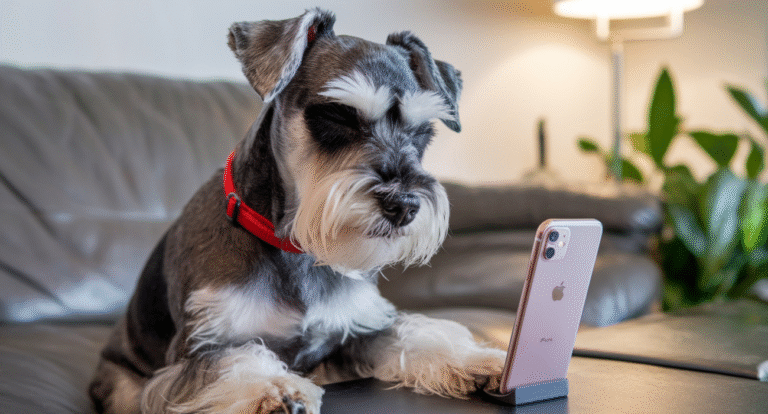
Pet cameras with two way audio let you check in and even talk to your Schnauzer remotely. Some dogs find hearing their person’s voice incredibly reassuring. Others get more worked up (know your dog!). Many cameras now include treat dispensing features, allowing you to reward calm behavior from afar.
Automatic feeders can dispense small amounts of kibble at scheduled intervals throughout the day, giving your Schnauzer something to anticipate and breaking up the monotony of alone time. Some even let you record a message that plays at feeding time.
Background noise helps many Schnauzers stay calm. Leave the TV on a channel with human voices (avoid ones with lots of doorbells or dog barking!). Music specifically composed for canine ears is available on streaming platforms. Some dogs prefer audiobooks, finding the steady rhythm of a human voice comforting.
The important thing is finding what works for your Schnauzer. Every dog is an individual with unique preferences and triggers. What calms one might agitate another, so be prepared to experiment and adjust your approach based on your specific dog’s responses.