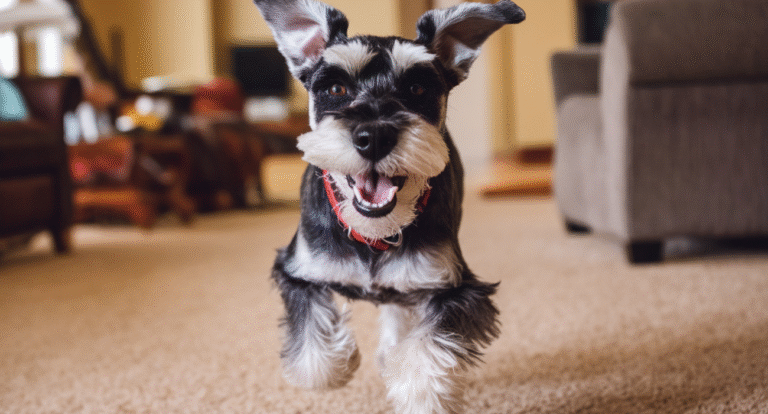
Schnauzers find clever ways to communicate. Learn the subtle signals that show exactly what your pup needs from you.
Your Schnauzer thinks you’re a bit slow. No offense, but while you’re busy trying to interpret that mysterious head tilt, they’ve already tried seventeen different ways to tell you they need to go outside. These intelligent, stubborn, and absolutely charming dogs have communication skills that rival a Shakespearean actor, complete with dramatic timing and exaggerated gestures.
The beauty of Schnauzer communication is that it’s simultaneously subtle and completely over the top. One moment they’re giving you a gentle nose nudge, and the next they’re performing an interpretive dance in front of the treat cabinet. Learning to read these signals transforms your relationship from confused roommates to synchronized partners.
1. The Intense Stare Down (AKA The Schnauzer Mind Meld)
There’s staring, and then there’s Schnauzer staring. This isn’t a casual glance or a fleeting look of interest. This is a focused, unblinking, soul piercing gaze that seems to reach directly into your consciousness and plant thoughts there. When your Schnauzer deploys this tactic, they’ve moved beyond subtle hints and entered the realm of telepathic demands.
The stare usually happens in specific contexts: dinnertime (yours, not theirs), treat time, or when they’ve decided it’s walk o’clock according to their internal schedule. You’ll often find your Schnauzer positioning themselves directly in your line of sight, sometimes at concerning angles, ensuring you cannot possibly ignore them. They might be sitting three feet away or pressed against your leg, but the intensity remains constant.
What makes this particularly effective is the guilt factor. Those bushy eyebrows create an expression that somehow manages to convey both judgment and desperate need simultaneously. You’ll find yourself putting down your fork, closing your laptop, or pausing your show simply because the weight of that stare becomes too much to bear.
The Schnauzer stare isn’t just looking; it’s a full body experience that makes you question every life choice that led to you not immediately addressing their needs.
2. The Strategic Paw Placement
Schnauzers have weaponized their paws in ways that demonstrate sophisticated understanding of human psychology. The paw tap is their Swiss Army knife of communication, versatile enough to express everything from “pet me” to “I require immediate access to the outdoors” to “that’s MY spot on the couch.”
The delivery varies based on urgency. A gentle paw on your arm might mean they’d appreciate some attention when you have a moment. A repeated pawing at your leg signals moderate urgency, perhaps they’d like their water bowl refilled. But the full force paw slam onto your keyboard, book, or phone? That’s DEFCON 1. Something needs to happen NOW, and your Schnauzer has decided that whatever you’re doing is significantly less important.
What’s fascinating is how they adjust pressure and frequency. They’re conducting a symphony with your attention as the instrument, and they know exactly which notes to play. Some Schnauzers develop signature moves: the double tap, the scratch down, or the personal favorite of many, the “let me just rest my paw on you for forty-five minutes straight” technique.
3. The Vocal Variety Show
Forget the notion that dogs just bark. Schnauzers have a vocal range that would make a Broadway star jealous. They’ve got barks, yes, but they also have grumbles, groans, huffs, whines, yips, yodels, and a sound that can only be described as “talking back.”
Each vocalization serves a distinct purpose. The sharp, repetitive bark at the door means someone (or something) is outside and requires investigation. The low grumble while they’re settling into bed is just them commenting on the day, no response needed. The high pitched whine at 3 AM means nature calls, and it cannot wait until morning no matter how much you wish it could.
Many Schnauzer owners report that their dogs seem to actually talk to them, stringing together different sounds in patterns that feel suspiciously like sentences. “Roo roo roo arooo” might translate to “I believe it’s dinnertime and you’re late.” The grumpy “harumph” as they flop down definitely means “I suppose this will do, though I had other preferences.”
| Schnauzer Sound | Likely Translation | Urgency Level |
|---|---|---|
| Sharp, repetitive bark | Someone’s at the door! | High |
| Low grumble | Just thinking out loud | Low |
| High pitched whine | Bathroom emergency | Critical |
| “Roo roo roo” talking | Dinnertime negotiation | Medium |
| Single loud “BOOF” | Announcement of opinion | Medium |
| Continuous yipping | Extreme excitement or frustration | High |
4. The Precision Object Interaction
Your Schnauzer has figured out that certain objects get certain reactions, and they’re not above using props in their communication efforts. They’ll bring you their leash when it’s walk time, drop their bowl at your feet when hungry, or deposit a toy in your lap when playtime is overdue.
But it goes deeper than simple fetch and carry. Schnauzers will position items strategically. The toy placed directly in your walking path isn’t an accident; it’s a carefully constructed obstacle designed to make you acknowledge their desire for play. The leash draped across your shoes is a not so subtle hint about outdoor adventures.
Some Schnauzers take this to artistic levels, arranging multiple objects to convey complex messages. Toy plus leash might mean “I want to bring this on our walk.” Bowl moved to an unusual location could indicate dissatisfaction with the current feeding station. They’re basically creating still life paintings, except the subject is always “human, please attend to this immediately.”
When your Schnauzer starts rearranging household items like a furry interior decorator, they’re not being weird. They’re being eloquent.
5. The Body Language Broadcasting System
Schnauzers are expressive. Their entire body becomes a messaging billboard when they need to communicate something important. The play bow (front end down, rear end up, tail wagging frantically) is universally recognized, but there are dozens of subtler signals happening constantly.
Watch the tail: A slow wag means cautious interest, while the full body wag indicates pure joy. The tucked tail signals discomfort or anxiety. The ears also tell stories. Forward and perked means alert curiosity. Pinned back might indicate submission or worry. Combined with body posture, you’re getting real time updates on their emotional state.
Then there’s the full body commitment moves. The dramatic floor flop says “I’m exhausted and possibly dying, or I want belly rubs, honestly it could go either way.” The stretchy morning routine is part yoga demonstration, part “good morning, I need things.” The zoomies (random bursts of sprinting) communicate excess energy that MUST be released immediately, preferably with your participation.
The position they choose for sitting or lying down also matters. Pressed against your leg means they want contact and reassurance. Sitting between you and the door means they’ve appointed themselves guardian. Sprawled across your lap despite being too large for your lap means you are now furniture, and they are now comfortable, and this arrangement is not negotiable.
6. The Strategic Location Selection
Where your Schnauzer positions themselves is rarely random. They’ve mastered the art of location based communication, turning geography into language. When they plant themselves directly in front of the treat cabinet, the message is clear. When they sit by the door, ditto. But the real sophistication shows in their subtler positioning choices.
Notice how they might sit halfway between you and their empty water bowl, looking back and forth between the two? That’s triangulation. They’re literally pointing out the problem by becoming a furry arrow. Or when they station themselves at the top of the stairs when it’s bedtime, they’re not just randomly choosing that spot; they’re positioned along the path you need to take, facilitating the transition to evening routine.
Some Schnauzers develop favorite “demanding spots” where they know they have maximum visibility and impact. The center of the kitchen during meal prep. The exact spot in the hallway with the best acoustics for attention seeking barks. The patch of floor where sunlight hits and makes their beard look extra pathetic when they want sympathy.
They’ll also use blocking techniques. Standing in doorways to prevent you from leaving a room without addressing their needs. Laying across your feet so you can’t walk away from the conversation. Positioning themselves between you and your destination, forcing negotiation before passage is granted.
7. The Routine Reinforcement Method
Schnauzers are creatures of habit, and they use routine as a communication tool with frightening efficiency. Once they’ve established that walks happen at 7 AM, treats arrive at 3 PM, and dinner is served at 6 PM, they become living alarm clocks. Except these alarms cannot be snoozed.
They’ll start the reminder process well in advance of the scheduled time. Fifteen minutes before walk time, you’ll notice increased alertness and strategic positioning near where the leash is kept. Ten minutes before, the staring begins. Five minutes before, the pacing starts. By the actual time, if you haven’t responded, you’re getting the full communication arsenal: stares, paws, vocalizations, and possibly some creative problem solving.
What’s remarkable is their ability to adjust these routines to train you. If you cave and feed them fifteen minutes early one day, that new time becomes the expectation. They’re not being difficult; they’re being consistent. In their minds, they’ve simply updated the schedule, and you need to get with the program.
Your Schnauzer doesn’t have a clock, but they have something better: an unwavering belief in the sanctity of routine and the persistence to enforce it.
They’ll also create new routines through sheer repetition. If every time you put on your shoes, they go crazy with excitement because sometimes shoes mean walks, they’re building an association. Eventually, shoe wearing becomes a promise in their mind, and breaking that promise requires explanation (which you’ll attempt to provide, speaking in full sentences to a dog, because Schnauzer ownership does that to people).
The routine extends to comfort and security needs too. Bedtime rituals become sacred. If the pattern is last bathroom break, then tooth brushing, then settling in specific spots, any deviation causes concern. They’ll remind you of missed steps in the routine, sometimes with surprising urgency, because structure makes them feel secure.
Understanding these seven communication methods transforms life with your Schnauzer from a series of confusing interactions into a rich dialogue. These dogs aren’t just pets; they’re partners with opinions, needs, and an impressive ability to make those needs known. The more you tune into their signals, the more you’ll realize they’ve been having full conversations with you all along. You’re just finally learning to listen.