Spot nail overgrowth with these five clear clues your Schnauzer needs a trim, keeping their paws healthy and comfy.
Listen closely. Do you hear that distinctive click, click, click sound following you around the house? That’s not your Schnauzer’s way of practicing tap dancing, it’s their nails staging a protest. While these spirited little dogs are known for their bushy eyebrows and distinguished beards, their paw maintenance often flies under the radar until something goes wrong.
Nail care isn’t just about aesthetics or protecting your floors from scratch marks. Overgrown nails can actually change how your pup walks, leading to joint problems and discomfort. Think of it this way: imagine wearing shoes two sizes too small all day, every day. Not fun, right?
1. The Audible Click Test (Your Floors Don’t Lie)
This is hands down the easiest and most reliable method for determining nail status. When your Schnauzer walks across tile, hardwood, or any hard flooring surface, their nails should not make contact with the ground. If you’re hearing that telltale clicking sound with each step, those nails have crossed the line from acceptable to excessive.
Here’s what’s happening: when nails grow too long, they extend beyond the protective paw pad and literally hit the floor with each step. Imagine tap shoes, but involuntary and uncomfortable. This constant contact doesn’t just create noise; it also pushes the nail back into the nail bed with every stride, which can be genuinely painful over time.
The click test is nature’s built-in alarm system, warning you that your Schnauzer’s nails have gone from functional tools to problematic overgrowth.
The ideal scenario? Silent steps. Your Schnauzer should glide across your floors like a ninja (well, as ninja-like as an excitable terrier can manage). Some pet parents get so used to the clicking that they stop noticing it, so try this: record a short video of your dog walking across a hard surface, then play it back with the volume up. You might be surprised by what you hear!
2. The Standing Position Check
Get down to your Schnauzer’s level and examine their paws while they’re standing naturally on flat ground. The nails should be just barely visible when viewed from the front, and they definitely shouldn’t be touching or spreading out against the floor. Think of proper nail length as a car tire: you want a tiny bit of clearance from the ground.
When you look at the paw from the side, the nail should follow a gentle curve but not extend past the bottom of the pad. If the nails are curling downward or pointing toward the ground instead of forward, you’ve waited too long. This applies to all four paws, though front nails typically grow faster than back nails in most Schnauzers.
| Viewing Angle | What Healthy Nails Look Like | Red Flags |
|---|---|---|
| Front View | Barely visible; pads fully contact ground | Nails spreading outward; pads lifted off ground |
| Side View | Gentle curve; doesn’t extend past pad | Curved downward; extends significantly past pad |
| Underneath | Nail tips don’t touch surface | Tips make contact with ground before pads |
Pay special attention to the dewclaws (those little thumbs on the inner legs) if your Schnauzer still has them. These nails never touch the ground naturally, so they grow continuously without any wear and can actually curl around into the paw pad if completely neglected. Yikes!
3. The Paper Slip Test
Here’s a clever trick that removes all guesswork: slide a piece of standard printer paper between your Schnauzer’s nails and the floor while they’re standing normally. Can the paper slip through easily? Perfect! Your pup’s nails are at an acceptable length. Does the paper get stuck, crumpled, or refuse to slide through at all? Time to break out the nail clippers.
This test is particularly useful for Schnauzers with dark nails, where the quick (the blood vessel inside the nail) is impossible to see. Black nails are notoriously tricky to trim safely, so knowing when to trim becomes even more critical than knowing how much to trim. The paper test gives you objective feedback without requiring any nail anatomy knowledge.
You can also use this opportunity to check for uneven nail lengths. Sometimes one nail grows faster than others, or your Schnauzer might favor certain paws while walking, causing asymmetrical wear. Each nail should allow roughly the same amount of paper clearance. If one paw’s nails are noticeably longer, don’t skip it just because the others look okay!
4. Watch Their Walking Posture and Gait
Overgrown nails literally change how your Schnauzer moves through the world. When nails are too long, your dog can’t fully place their paw pads flat on the ground. Instead, their weight shifts backward onto different parts of the paw, altering their entire stance and gait. Over time, this compensation pattern can stress joints, tendons, and muscles throughout their body.
Look for these behavioral clues:
- Hesitation on stairs or slippery surfaces
- A slightly hunched or unnatural standing position
- Reduced enthusiasm for walks or play
- Favoring certain paws or an odd, stilted gait
- Difficulty on smooth floors (those overgrown nails eliminate traction)
Your Schnauzer might also start sitting in weird positions or frequently shifting their weight while standing. They’re essentially trying to get comfortable despite having the equivalent of uncomfortable, too-long toenails digging into their digits. Some dogs become less active overall, not because they’re lazy or aging, but because movement has become uncomfortable.
A Schnauzer’s gait is a window into their comfort level. When nails interfere with natural movement, the entire body compensates, often leading to problems far beyond the paws themselves.
The truly sneaky part? These changes happen gradually. Your dog adapts little by little, so you might not notice the altered posture until you see them walk normally again after a proper nail trim. Many pet parents report their Schnauzer suddenly acting “younger” or more energetic post-grooming, when really, the dog is just moving comfortably again.
5. Physical Signs of Overgrowth
Sometimes you need to get hands-on to spot the problem. Set aside a few minutes to thoroughly examine each paw. Gently press on the paw pads and look at the nails from multiple angles. Here’s what you’re investigating:
Curling or twisting: Nails should grow relatively straight. If they’re curving dramatically to the left, right, or curling under toward the paw pad, they’ve been neglected for too long. This is especially common in less active or senior Schnauzers who don’t naturally wear down their nails through regular activity.
Splaying toes: When standing, your Schnauzer’s toes should be relatively close together. Overgrown nails force the toes apart, creating a splayed appearance. This isn’t just cosmetically odd; it’s biomechanically problematic and can lead to chronic toe and joint issues.
Redness or irritation: Check the skin around the nail base and between the toes. Long nails can cause inflammation, and in severe cases, nails can actually grow into the paw pad, creating wounds and infections. Your Schnauzer might lick or chew at their paws excessively if they’re experiencing nail-related discomfort.
Broken or split nails: Excessively long nails are more vulnerable to catching on carpet, furniture, or outdoor terrain. You might notice chipped edges, vertical splits, or even completely broken nails (which can bleed significantly and require immediate attention).
Your Schnauzer’s paws are precision instruments designed for running, digging, and navigating diverse terrain. When nails grow beyond their functional length, every step becomes a compromise.
Additionally, watch for behavioral cues during your examination. Does your Schnauzer pull their paw away when you touch certain nails? Do they seem relieved when you release pressure? These reactions suggest sensitivity or pain, both indicators that those nails have been overdue for trimming.
Maintaining the Perfect Length
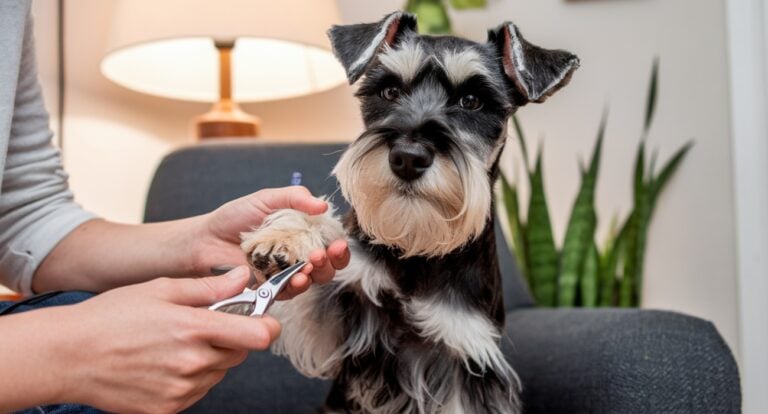
Now that you’ve identified the problem, consistency is key. Most Schnauzers need nail maintenance every three to four weeks, though individual variation is huge. Puppies might need more frequent attention due to rapid growth, while highly active adults who regularly walk on concrete might naturally file their nails and need less intervention.
Consider alternating between professional grooming and at-home maintenance. Even if you’re nervous about trimming too much (nobody wants to hit the quick and cause bleeding), you can still use a nail file or grinding tool to gradually reduce length between professional appointments. Many Schnauzers tolerate grinding better than clipping anyway, as it’s less likely to cause painful pressure or accidental injuries.
Your Schnauzer’s nails are a non-negotiable part of their health care routine, sitting right alongside dental care, proper nutrition, and regular exercise. Those distinctive bearded faces and spirited personalities deserve to be supported by comfortable, healthy paws. By staying alert to the five signs we’ve covered, you’ll catch overgrowth early and keep your furry friend strutting their stuff pain-free!