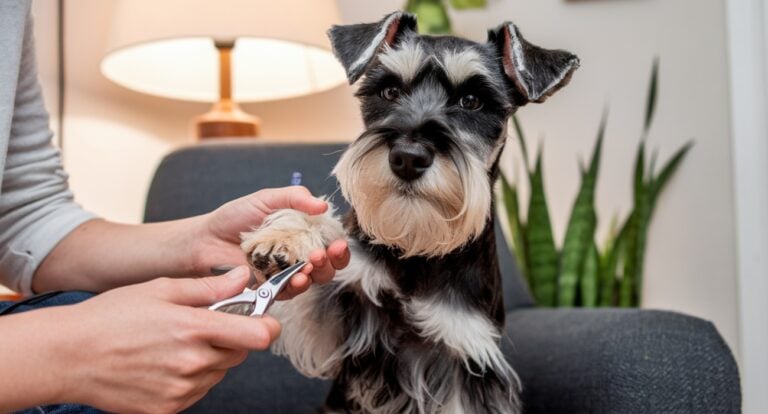
Get your Schnauzer’s full attention with one clever trick. Perfect for training or everyday listening, it’s surprisingly easy to master.
Every Schnauzer owner has been there. You’re standing in your kitchen, treat in hand, repeating yourself for the fifth time while your dog investigates something infinitely more interesting on the floor. The irony? Schnauzers are actually brilliant dogs. They ranked 12th in Stanley Coren’s intelligence rankings.
So why won’t they listen? Because somewhere along the way, you accidentally taught them that listening is optional. Don’t worry, this isn’t your fault. It’s surprisingly easy to do. But here’s what IS in your control: learning the one trick that completely reverses this dynamic and gets your Schnauzer hanging on your every word.
Understanding the Schnauzer Mind
Before we dive into the trick itself, you need to understand what makes your Schnauzer tick. These dogs weren’t bred to be lapdogs or yes-men. The three Schnauzer varieties (Miniature, Standard, and Giant) all originated in Germany as working dogs. Their jobs included guarding farms, hunting rats, and protecting their families. Notice what all those tasks have in common? Independent decision making.
When a rat scurried into the barn at 2 AM, your Schnauzer’s great-great-great-grandfather didn’t wait for permission to chase it. He acted. This heritage lives in your dog’s DNA, which explains why they sometimes look at you like you’re merely offering suggestions rather than commands.
But here’s where it gets interesting. Schnauzers are also incredibly loyal and people-oriented. They want to please you. They’re just doing a cost-benefit analysis every single time you give a command, weighing whether compliance is worth it. And that’s exactly where our trick comes in.
The One Trick: The Attention Transfer
Here it is, the technique that will revolutionize your relationship with your Schnauzer: Always reward attention BEFORE rewarding the behavior.
I know what you’re thinking. “That’s it? That’s the big secret?” Stay with me, because this is far more powerful than it sounds. Most owners reward their dogs for completing actions: sitting, lying down, coming when called. But what if you rewarded them for something that happens before the action? What if you made paying attention to you the most valuable thing your Schnauzer could possibly do?
The dog who finds value in simply watching their owner becomes a dog who never misses a cue.
How It Actually Works
Traditional training operates on a simple equation: command + compliance = reward. Your Schnauzer sits, you give a treat. They come when called, they get praise. This works, sure, but it creates a transactional relationship. Your dog learns that specific actions earn specific rewards, but they don’t necessarily learn to pay attention to you as a general rule.
The Attention Transfer flips this model. Instead of rewarding the sit, you reward the moment your dog looks at you before you even ask them to sit. You’re capturing and reinforcing the exact microsecond when your Schnauzer’s focus lands on you. Do this consistently, and something magical happens: your dog begins to offer attention freely, constantly checking in with you to see if that behavior earns them something good.
Breaking Down the Technique
Step One: Capture the Glance
Start in a low distraction environment (your living room works perfectly). Have high value treats ready. These shouldn’t be regular kibble; we’re talking small pieces of chicken, cheese, or whatever makes your Schnauzer’s eyes light up. Now here’s the counterintuitive part: do nothing. Just exist in the space with your dog.
Your Schnauzer will eventually glance at you. The instant their eyes meet yours, mark it (with a clicker or the word “yes”) and immediately deliver a treat. Don’t ask for anything else. Don’t make them sit or perform. You’re literally rewarding eye contact and nothing more.
Repeat this 10 to 15 times per session, multiple sessions per day. Your goal is to create an almost Pavlovian response where looking at you predicts good things happening.
Step Two: Add Duration
Once your Schnauzer is regularly offering eye contact (usually within two to three days), start adding tiny amounts of duration. Wait for the glance, count “one Mississippi” in your head, then mark and reward. Gradually extend this to two seconds, then three. You’re teaching your dog that sustained attention pays off even more than a quick glance.
This is where you’ll see your Schnauzer start to really focus. Those intelligent eyes will lock onto yours with an intensity that might surprise you. That’s the moment you know the technique is working.
Step Three: Integrate With Commands
Now comes the integration phase. When your Schnauzer offers you sustained eye contact (at least two to three seconds), give a simple command like “sit.” Because they’re already mentally engaged with you, the compliance rate will skyrocket. Mark and reward immediately when they complete the behavior.
Here’s the crucial part: you’ve now created a chain where attention → command → behavior → reward. But in your dog’s mind, it all started with giving YOU their focus. You’ve become the most interesting, most rewarding thing in their environment.
Why This Works So Well With Schnauzers
| Schnauzer Trait | How Attention Transfer Leverages It |
|---|---|
| High Intelligence | Quickly learns the attention = rewards pattern |
| Independent Thinking | Chooses to offer attention rather than feeling forced to obey |
| Strong Prey Drive | Redirects focus from distractions to owner |
| Food Motivation | High value rewards make the owner more interesting than environment |
| Loyal Nature | Deepens the bond through positive interaction |
Schnauzers are problem solvers. When you use the Attention Transfer technique, you’re essentially giving them a puzzle to figure out: “What makes the human dispense treats?” They’ll work this out quickly (remember, 12th in intelligence rankings), and once they do, you’ll have a dog who actively seeks to pay attention to you.
This method also respects their independent nature. You’re not forcing compliance through corrections or intimidation. Instead, you’re making attention feel like their idea, their choice, their path to good things. For a breed that values autonomy, this psychological shift is everything.
Common Mistakes to Avoid
Mistake One: Asking for Too Much Too Soon
The biggest error new practitioners make is rushing the process. They reward one or two glances, then immediately expect their Schnauzer to maintain eye contact while a squirrel runs past the window. Build the foundation slowly. Your dog needs hundreds of repetitions in low distraction environments before you add challenges.
Mistake Two: Using Low Value Rewards
Your regular training treats won’t cut it for this technique, at least not initially. You’re asking your Schnauzer to fundamentally change what they find valuable. That requires rewards that genuinely compete with everything else in their environment. Think of it this way: would you change your entire work ethic for a 5% raise or a 500% raise? Your dog faces the same calculation.
Mistake Three: Inconsistency
This technique only works with consistency. You can’t practice it Monday and Wednesday, then ignore it the rest of the week. Every family member needs to reinforce attention the same way. Your Schnauzer should learn that all humans reward focus, creating a general pattern rather than a person-specific trick.
Taking It to the Next Level
Adding Environmental Challenges
Once your Schnauzer reliably offers attention at home, gradually introduce distractions. Start small: maybe the TV is on during your training session. Then practice in the backyard. Then near the front door. Eventually, work up to busy environments like parks or pet stores.
Every new environment is a test. Every successful attention check in a distracting place strengthens the behavior exponentially.
The beauty of the Attention Transfer is that it generalizes beautifully. Unlike teaching a specific behavior (which might work in the living room but fall apart outside), teaching attention itself translates across all environments. Your Schnauzer learns that checking in with you is valuable regardless of location.
Incorporating Into Daily Life
Stop thinking of this as a training technique and start thinking of it as a lifestyle. Reward random attention checks throughout the day. Your Schnauzer glances at you while you’re cooking dinner? Toss them a green bean. They look up during a walk? Immediate praise and a treat. You’re creating a relationship where your dog’s natural inclination is to monitor you constantly, waiting for the next good thing.
Using It for Problem Behaviors
Here’s where things get really interesting. That Schnauzer who barks at every passerby? The one who lunges at other dogs on walks? The attention you’ve built becomes your greatest tool. When you notice your dog starting to fixate on a trigger, you can call their attention back to you before the behavior escalates. Because you’ve made attention so valuable, your Schnauzer has a reason to disengage from the distraction and refocus on you.
The Science Behind the Method
Animal behaviorists call this technique “capturing offered behaviors,” and it’s rooted in solid operant conditioning principles. By rewarding attention, you’re increasing the frequency of attention. It’s that simple and that powerful. The behavior that gets rewarded gets repeated.
But there’s something deeper happening too. You’re changing your Schnauzer’s fundamental orientation toward you. Instead of being the person who gives commands (which, let’s face it, can be annoying), you become the source of all good things. You’re not a taskmaster; you’re a vending machine of awesome outcomes. Your dog stops seeing you as someone to potentially ignore and starts seeing you as someone to constantly monitor.
Research in canine cognition shows that dogs who maintain strong eye contact with their owners show increased oxytocin levels (the bonding hormone) in both species. You’re not just training obedience; you’re literally strengthening the neurochemical bond between you and your Schnauzer.
Troubleshooting
“My Schnauzer Won’t Look at Me”
If your dog genuinely never offers eye contact, you may need to shape the behavior in smaller steps. Start by rewarding any orientation toward you: a head turn, an ear swivel, anything that suggests awareness of your presence. Gradually raise your criteria until you’re getting actual eye contact.
“It Works at Home But Nowhere Else”
This means you haven’t generalized the behavior yet. You need to practice in dozens of different locations, slowly increasing difficulty. Think of it like learning a language: understanding it in a classroom is different from speaking it in a foreign country. Your Schnauzer needs practice in diverse settings.
“My Dog Stares at Me Constantly Now”
Congratulations! This is actually a good problem to have. You can put the behavior on a variable reinforcement schedule, where you only reward attention checks intermittently. This actually strengthens the behavior further (it’s the same principle that makes slot machines addictive). Your dog will continue offering attention, never sure which check-in will earn the jackpot.
Real World Applications
The true test of any training technique is whether it improves daily life. With a Schnauzer trained in Attention Transfer, you’ll notice:
- Recall becomes reliable. Your dog checks in with you naturally during off-leash time, making it easy to call them back before they even wander too far.
- Leash walking improves. A dog constantly monitoring you doesn’t pull as much because they’re mentally engaged with you rather than fixated on their surroundings.
- Training new behaviors becomes faster. Once your Schnauzer knows to pay attention first, teaching anything else becomes simpler because you already have their focus.
A Schnauzer who chooses to listen is infinitely more reliable than a Schnauzer who complies out of fear or obligation.
The relationship shift is the real victory here. You’ll go from feeling like you’re constantly nagging your dog to feeling like you’re working as a genuine team. And isn’t that what we all really want? Not a robot who follows commands, but a partner who chooses to stay connected with us.