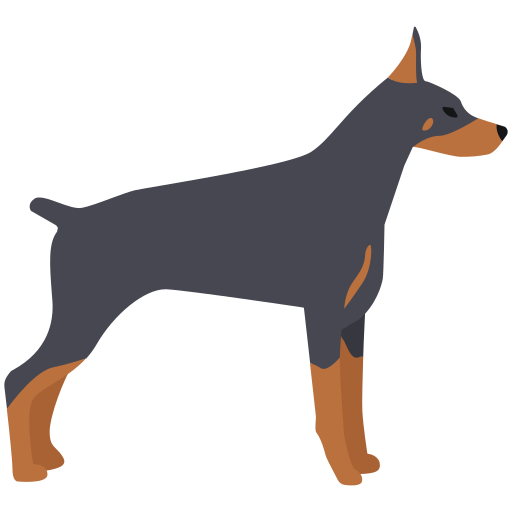
 Doberman
 My neighbor once told me my Doberman looked like she wanted to eat her, and honestly, I didn’t correct her fast enough.
That was the moment I realized how much baggage this breed carries. People see the sleek black coat, the cropped ears, the intense stare, and their brain fills in the rest of the story before the dog has done a single thing.
The truth is far less dramatic. And far more inconvenient, depending on how much you value personal space.
Where the Anti-Social Myth Actually Came From
Dobermans were bred in 1890s Germany by a tax collector named Karl Friedrich Louis Dobermann. He wanted a dog that would walk beside him while he knocked on doors and asked people for money they didn’t want to give.
You can see how that origin story might color public perception.
The breed’s early reputation was built on function: alert, protective, unwilling to back down. Add a century of movies casting Dobermans as the villain’s guard dogs, and the stereotype practically wrote itself.
Hollywood did this breed dirty. Genuinely dirty.
The Difference Between Reserved and Anti-Social
Here’s where the language matters. "Anti-social" implies a dog that dislikes company, avoids interaction, and would rather be left alone forever.
That is not a Doberman.
What Dobermans actually are is discerning. They evaluate. A stranger walks up, and the dog runs a quick internal assessment before deciding whether this person deserves enthusiasm or a polite wait-and-see.
Golden Retrievers skip that step entirely. Dobermans do not.
A dog that pauses before greeting you isn’t rejecting you. It’s doing math.
Reserved means "I need a minute." Anti-social means "I want nothing to do with you." Those are wildly different postures, and conflating them has damaged this breed’s reputation for decades.
The Velcro Dog Nobody Warns You About
Ready for the plot twist?
Dobermans are one of the most aggressively affectionate breeds you will ever share a home with. Not affectionate in a gentle, dignified way, either.
They lean. They lay their entire seventy-pound body across your lap like it’s a normal thing to do. They follow you into the bathroom and stare at you with mild concern while you brush your teeth.
The nickname "Velcro Doberman" exists for a reason, and every owner learns it within about forty-eight hours.
What Bonding Actually Looks Like in This Breed
Doberman attachment isn’t casual. They pick their people, and once that decision is made, it’s permanent.
This means separation anxiety is a real consideration. A Doberman left alone for ten hours a day is a Doberman who will find creative ways to express displeasure, usually involving your baseboards.
They also tend to bond deeply with an entire family rather than fixating on one person, though most will have a clear favorite. Kids often land near the top of that list. The dog just quietly appoints itself as the small human’s shadow.
Nobody asked it to. It’s simply the job now.
So Why Do They Act Weird Around Strangers?
Because they’re supposed to.
A well-bred Doberman has a temperament built around threat assessment. That’s not aggression, it’s discretion. The dog notices things, files them away, and reacts proportionally.
What that looks like in practice: a Doberman meeting a new person at the door may hang back for thirty seconds. Watching. Reading the room, reading your body language, checking whether you seem relaxed.
Then, more often than not, it decides the visitor is fine and immediately demands to be petted.
The stare isn’t a threat. It’s a background check.
The dogs who genuinely struggle with strangers are usually dogs who missed something during development, not dogs who were born unfriendly.
Socialization Is Not Optional Here
Every breed benefits from early socialization. Dobermans require it.
The window between eight and sixteen weeks is where a puppy learns what the world contains and whether it’s safe. A Doberman that meets fifty different people, hears vacuum cleaners and skateboards, and visits a hardware store during that period grows into a stable, confident adult.
A Doberman that meets nobody grows into a dog that finds everything suspicious.
That’s not a breed problem. That’s a homework problem.
Dobermans and Other Dogs
This is where things get more honest, and where the stereotype has a small kernel of truth buried in it.
Doberman-to-human sociability is generally excellent with proper raising. Doberman-to-dog sociability is more variable.
Same-sex aggression shows up in this breed more than in some others, particularly between two intact males or two intact females. It’s not universal, but it’s common enough that experienced owners plan around it.
Many Dobermans do beautifully at dog parks. Others would prefer a quiet walk with their person and no negotiations.
Reading Your Own Dog
Not every Doberman wants the same social life, and that’s genuinely fine.
Some are wildly outgoing and will greet every dog on the block like an old friend. Some tolerate other dogs politely but privately consider them unnecessary. Some have one or two dog friends and no interest in expanding the roster.
Forcing a selective dog into a chaotic dog park does not teach it to be social. It teaches it that you don’t listen.
Pay attention to what your dog is telling you. Loose body, wagging tail, play bow? Green light. Stiff posture, hard stare, closed mouth? Time to leave.
The Temperament Test Most People Never Hear About
Here’s something the average person doesn’t know: the breed has an official temperament evaluation.
The Doberman Pinscher Club of America runs a Working Aptitude Evaluation that tests dogs on neutral stranger encounters, friendly stranger encounters, unusual noises, and pressure. Dogs that show unwarranted aggression fail.
Thousands of Dobermans pass every year.
A breed that was actually anti-social would not have a certification program built around proving how well its members handle social pressure. And breeders who care about temperament actively select for stability, not suspicion.
Good breeding produces a dog that thinks. Bad breeding produces a dog that reacts.
That distinction explains most of the difference between the Dobermans people fear and the Dobermans people live with.
What This Means If You’re Considering One
A Doberman is not a low-maintenance social butterfly. Anyone who tells you otherwise is selling puppies.
What you’re signing up for is a smart, sensitive, intensely bonded dog that needs structure and exposure to become its best self. Do that work, and you get an animal that greets your friends warmly and still notices when something in the yard is off.
Skip the work, and you get exactly the dog the stereotype describes.
Practical Steps for a Social Doberman
Start early. Puppy classes, controlled meetups, calm exposure to noise and movement and unfamiliar surfaces.
Keep going. Socialization isn’t a box you check at four months and abandon. Adolescent Dobermans (roughly seven to eighteen months) often go through a phase where previously friendly dogs get suddenly cautious, and that’s exactly when consistency matters most.
Advocate for your dog. If a stranger reaches over your Doberman’s head while it’s clearly uncomfortable, you say something. Every bad interaction you allow makes the next one harder.
And let the dog have opinions. A Doberman that’s allowed to observe before engaging will engage far more willingly than one that’s dragged into every greeting.
The Reputation vs. the Reality
Ask anyone who lives with this breed and you’ll hear the same thing, usually with some exasperation attached.
They’re not scary. They’re needy. They’re funny, dramatic, weirdly clumsy for such an athletic animal, and physically incapable of leaving you alone in a room.
The dog that people cross the street to avoid is, in most homes, lying upside down on the couch with its legs in the air.
Anti-social is the wrong word entirely. Selective, sure. Watchful, absolutely. Attached to the point of absurdity, without question.
But anti-social? Ask my neighbor. She’s been thoroughly converted, mostly against her will, and now brings treats.