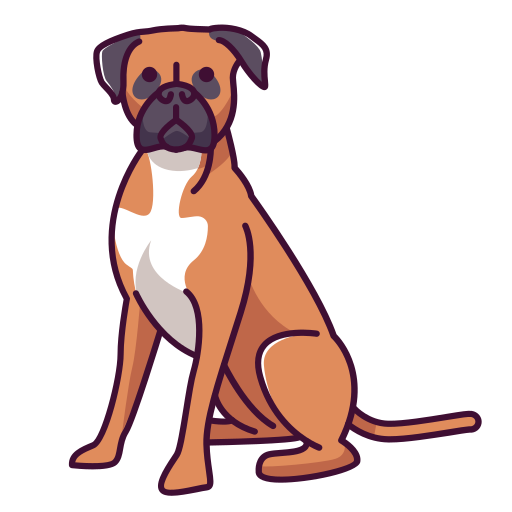
 Boxer
Boxer The best vet visit your Boxer will ever have is the one where absolutely nothing happens to him.
No shots. No thermometer. No stranger pressing on his ribcage while he tries to work out whether he should be worried about it.
Sounds like a waste of gas and an afternoon. It is, quietly, one of the most useful things you can do for your dog.
Run the math the way your Boxer runs it. He goes to that building roughly twice a year, and both times something uncomfortable happens to his body. Two visits, two bad outcomes, one hundred percent hit rate.
He is not being dramatic about the exam room. He is being statistically reasonable.
So the simple change is this: start showing up when there is no appointment, no reason, and nothing to be done. Walk in, eat snacks, walk out. That’s it. That’s the whole trick.
Why Boxers Take Vet Visits Harder Than Most Breeds
Plenty of dogs get nervous at the clinic. Boxers have a few extra strikes against them, and understanding those makes the fix land a lot faster.
They are reading your face the entire time
Boxers are absurdly tuned in to human emotion. It’s what makes them such good family dogs and such terrible poker players.
You already know the drive. You get quiet in the car, you grip the leash tighter in the parking lot, you use that slightly-too-bright voice when you say "we’re just going to see the doctor!"
He clocks every bit of that before the front door even opens.
A Boxer does not learn to fear the vet’s office. He learns to fear the version of you that shows up at the vet’s office.
That body has nowhere to put the adrenaline
A stressed Labrador tends to go still. A stressed Boxer tends to go sideways, into the counter, off the wall, onto the scale, and back into your knees.
All that muscle and drive needs an outlet, and a slick tile lobby full of strange smells gives him nothing productive to do with it.
The exam itself is genuinely weird for them
Boxers have short muzzles, sensitive skin, and a lot of them dislike having their feet held with a passion normally reserved for the mailman.
Add ear checks and temperature taking, and you have a bundle of the exact handling most Boxers were never taught to tolerate. Nobody practiced it at home. The first rehearsal is opening night, in front of a stranger, under fluorescent lights.
The Change Itself: The Visit Where Nothing Happens
Call it a social visit, a happy visit, a drive-by, whatever you like. The concept is beautifully dumb in its simplicity.
You take your Boxer to the clinic on a day when he has no appointment. You go inside. He gets fed something outrageous. You leave.
What it actually looks like in practice
Call the front desk first and ask when they’re slow. Most clinics have a dead hour, usually mid-morning or mid-afternoon, and the staff will tell you if you ask nicely.
Bring something better than kibble. Freeze-dried liver, string cheese, leftover rotisserie chicken, the stuff you’d normally feel guilty about.
Walk in. Let him sniff the lobby. Feed him for standing there being a completely ordinary dog who is not currently on fire.
Then walk out. Five minutes, maybe less. Resist every urge to make it a bigger production than it is.
Add the scale, then add the staff
Once the lobby is boring, step him onto the scale. Feed. Step off. That’s the whole session.
The scale matters more than people realize, because it’s often the first thing that happens on a real visit and it’s the one piece of equipment nobody ever practices.
After a few of those, ask a receptionist or a tech to toss him a treat. Not to touch him, not to greet him, just to be the person food comes from.
The goal is not for your Boxer to tolerate the clinic. It is for him to walk in already expecting something good, so there’s no fear left for the exam to attach itself to.
How often, and for how long
Once a week for a month or two is plenty. Some owners fold it into an existing errand loop and barely notice the time.
After that, once a month keeps the association alive. It costs you almost nothing and it changes the entire emotional tone of every real appointment for the rest of his life.
Reinforce It at Home in Under Two Minutes a Day
The clinic visits do the heavy lifting on the location. Home handling does the rest.
The five second rule for body parts
Pick one body part per day. Touch it, feed a treat, let go. Repeat four or five times, then quit while he’s still interested.
Ears on Monday. Paws on Tuesday. Mouth on Wednesday. Nobody said this had to be complicated.
The key is that the treat comes after the touch, not before, and never while he’s pulling away. Timing is the whole game here, and getting it slightly wrong just teaches him that squirming makes food appear.
Practice the positions, not just the touching
Vets do a few predictable things. They stand a dog on a table or the floor, hold the head still, lift the lip, and steady the body from the side.
Practice a hand under his chin while he holds still for three seconds. Practice standing quietly beside you with light pressure against his shoulder.
Boxers learn this stuff fast when it’s a game and slowly when it’s a wrestling match.
Feed something ridiculous on the actual exam day
A lick mat smeared with peanut butter or squeeze cheese, held at nose level, will occupy a Boxer through a surprising amount of poking.
Ask your clinic if you can bring one. Most will say yes, and a lot of them keep their own stash for exactly this reason.
Small Habits That Undo All Your Work
Some of these are almost universal, and every one of them is easy to drop once you see it.
Sympathy voice
Cooing "it’s okay, buddy, you’re okay" in a soft, worried tone does not reassure a Boxer. It confirms his suspicion that something is very much not okay.
Use the same flat, cheerful voice you’d use to ask him whether he wants dinner.
Feeding him breakfast first
Show up with a hungry dog. Skip or shrink the morning meal on appointment days so the treats actually mean something.
A full Boxer will turn down chicken. A slightly empty one will follow you into a burning building for it.
Letting the lobby become a free-for-all
Boxers greet other dogs with all the subtlety of a thrown couch, and a bad lobby encounter can wipe out weeks of progress in ten seconds.
Ask to wait in the car and get a text when the room is ready. Almost every clinic does this now, and it removes about eighty percent of the chaos.
Waiting until something is wrong
Here is the part that stings a little.
Most owners start this work after a bad visit, which means the dog is already carrying baggage and you’re now undoing something instead of building it.
Every quiet, boring, uneventful trip to the clinic is a deposit. The scary visits are withdrawals, and you want a full account before you ever need to make one.
What Changes When You Actually Do This
The obvious win is a calmer dog. The less obvious wins are the ones that matter more.
Your vet gets an accurate exam instead of a wrestling estimate. Heart rate reads normal because he isn’t terrified, so a real murmur is easier to catch.
Sedation becomes less necessary, which for a brachycephalic breed like a Boxer is a genuinely meaningful safety difference.
And you catch things earlier, because you stop unconsciously postponing appointments you dread.
That last one is the quiet reason this matters. Boxers are prone to a handful of conditions where early detection changes everything, and the owner who doesn’t mind going to the clinic is the owner who goes when something first seems slightly off.
A dog who likes the vet gets seen more. A dog who gets seen more lives longer.