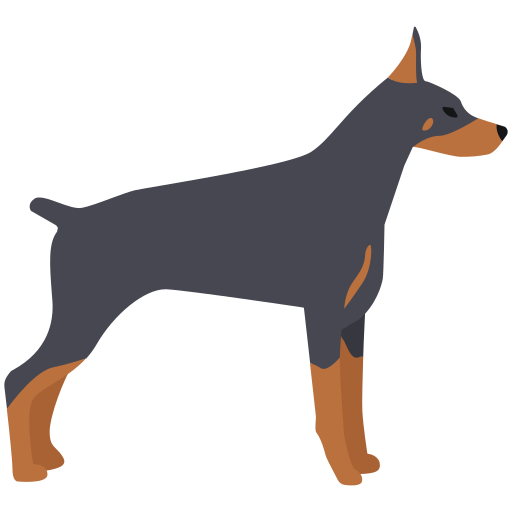
 Doberman
 Why does a dog bred for protection work, built like a sports car, and blessed with a stare that could stop a mail carrier at forty yards, completely fall apart because you shut the bathroom door?
Owners ask this silently, usually while peeling a sock out of a mouth that costs more per pound to feed than they do.
The answer is not complicated. Underneath the sleek coat and that famously serious face runs the emotional operating system of a two year old who just learned the word mine.
Anyone who has raised both a Doberman and a human toddler already knows. The rest of you are about to feel very seen.
The Emotional Weather Changes Every Nine Minutes
A Doberman does not have moods. A Doberman has weather systems.
One moment he is a dignified guardian surveying his property from the top of the couch cushions like a general reviewing troops. Nine minutes later he is upside down, legs in the air, screaming because a leaf moved.
Toddlers do the exact same thing, just with more yogurt involved.
The Meltdown Over Absolutely Nothing
Here is a partial list of things that have genuinely offended a Doberman: a vacuum, a suitcase, a hat, the concept of rain, a statue, a different dog existing three streets over, and the owner sneezing.
The dramatic collapse onto the floor is not an accident. That is a statement.
You will try to reason with him. He will look at you with an expression that says the injustice is ongoing and you are complicit.
A Doberman does not experience disappointment. A Doberman experiences betrayal, and he will be reviewing the footage later.
Object Permanence Is Optional
Toddlers famously believe that if they cannot see you, you no longer exist. Dobermans have taken this concept and made it significantly louder.
Step behind a door and you have not simply left the room. You have left the timeline.
The sound that follows is somewhere between a howl, a groan, and a small engine failing to turn over. Breeders call it the Doberman grumble. Neighbors call it something else.
The Velcro Thing Nobody Warns You About
The nickname is real. Dobermans are called velcro dogs because they will follow you into rooms they have zero interest in, purely to keep tabs on your location.
Bathroom. Laundry room. That weird closet with the water heater.
He does not want to be there. He simply cannot allow you to be somewhere he is not, which is a level of attachment normally reserved for people who have known each other since birth.
Most owners give up on privacy around week two. It is easier that way, and honestly the company grows on you.
Everything Goes in the Mouth. Everything.
Toddlers taste the world to understand it. Dobermans do this too, except their reach extends to counter height and their jaws were designed by people who wanted results.
Remote controls. Shoes. A single AirPod, never the pair. Rocks, for reasons that remain unexplained by science.
The Counter Surfing Era
At around eight months, something clicks. He realizes the counter is not a wall. It is a buffet with a view.
That first stolen sandwich rewires his brain permanently. From that moment on, every horizontal surface in your home is under active surveillance.
You will find yourself pushing dinner to the back of the counter the way parents move medicine to the top shelf. Same instinct, same energy, same slightly haunted look.
The Testing Phase Is Real, and It Is Personal
Somewhere between six and eighteen months, your loving companion decides to run a full audit on every rule you have ever established.
Sit? Never heard of it. Come? Sounds like a suggestion. Leash manners? He would like to renegotiate.
This is not defiance in the way people assume. It is a genuinely intelligent animal checking whether the boundaries you set on Tuesday still apply on Saturday, which is the single most toddler behavior in existence.
Consistency is not about being strict. Consistency is about being predictable, and a Doberman will find the one crack in your routine you did not know existed.
The owners who struggle are usually the ones who folded once at 11pm because they were tired. He remembers. He always remembers.
Why Intelligence Makes It Harder, Not Easier
People assume a smart dog is an easy dog. Adorable assumption.
Smart means he learns your patterns faster than you learn his. Smart means he knows the difference between the treat pouch being on your hip and being on the counter.
Smart means when he ignores you, he is not confused. He has simply run the numbers and decided the alternative was better.
The Nap Situation
Toddlers fight sleep like it is a personal enemy, then crash mid sentence with a cracker still in hand.
Dobermans operate identically. Full tilt zoomies through the house at 7pm, followed by total system shutdown at 7:04pm, usually across your lap with a leg on your keyboard.
They also sleep hard. Snoring, twitching, occasionally running in place while making noises that suggest an ongoing dream about squirrels.
Waking one up is a two step process. Step one, say his name from a safe distance. Step two, accept that he will look deeply annoyed for the next several minutes.
Separation Anxiety Has an Actual Costume Department
Leaving the house triggers a specific performance. The slow walk to the door. The head on the paws. The eyes.
Those eyes have secured more early returns home than any excuse in office history.
Crate Training Is Not Cruel, It Is a Nap Room
Plenty of new owners resist crates because they feel like punishment. Framed correctly, a crate is closer to a crib: a small, safe space where the world stops asking anything of him.
Feed meals in there. Toss high value chews in there. Never use it as a consequence.
Done right, you will eventually find him going in on his own to sulk after a disagreement, which is objectively hilarious.
The Affection Is Overwhelming and Slightly Inappropriate
Nobody explains that a Doberman considers himself lap sized. Seventy five pounds of muscle will step onto your legs with the confidence of a chihuahua and then sigh like you are the one making it weird.
He will lean on your knees while you stand. He will put his head directly on your chest during a phone call. He will insert himself between you and any hug you attempt with another human, because sharing was never part of the deal.
Personal space is a concept your Doberman has heard about but does not personally subscribe to.
Toddlers are exactly this way, right down to the jealousy when you hug someone else in the house.
Redirecting the Chaos Instead of Fighting It
The fastest way to lose is to treat all of this as bad behavior. Almost none of it is.
A Doberman with a job is a completely different animal from a Doberman with an empty afternoon. Give him a puzzle feeder, a fifteen minute training session, a scent game with treats hidden under cups.
Mental work drains him faster than a long walk ever will, which is the single most useful thing new owners learn.
Small Adjustments That Change Everything
Feed at least one meal a day out of something he has to work for.
Teach a solid place command so he has a default setting when guests arrive.
Rotate toys weekly instead of leaving everything out, because novelty matters more than quantity.
Run short training bursts, five minutes at a time, several times a day. His attention span is not built for marathons, and neither is yours after work.
The goal is never a robot. The goal is a big, ridiculous, emotionally invested dog who knows where the lines are and mostly stays inside them, apart from the days he simply does not feel like it.
Which, if you think about it, is roughly the best outcome anyone gets with a toddler too.