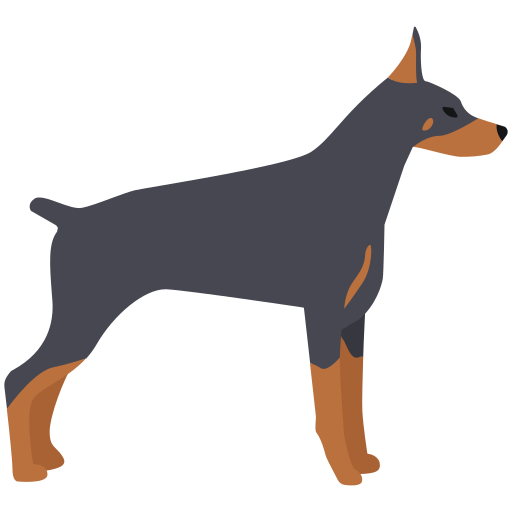
 Doberman
 140 years. That is roughly how long the Doberman has existed as a breed, which is barely a blink next to the ancient herders, hunters, and haulers that fill most dog history books.
Karl Friedrich Louis Dobermann was a German tax collector with a rough route and a talent for selective breeding. He did not want a farm dog that could moonlight as protection. He wanted a dog built from scratch to walk beside him and think while it did.
Other breeds needed centuries to become themselves. The Doberman got there in about two decades of focused, stubborn effort.
That compressed origin explains a lot about why sharing a house with one feels so different from sharing a house with any other dog. The five traits below are not simply things Dobermans happen to do well. They are things this breed does in a way you will have a genuinely hard time finding anywhere else.
1. The Shadow Effect
Owning a Doberman means quietly accepting that you will never again be alone in a room.
Bathroom privacy is now a nostalgic concept
You get up to grab a glass of water. Sixty pounds of sleek muscle gets up with you, not in a frantic way, just matter of factly, as if the two of you had agreed on this outing in advance.
Plenty of breeds follow their people around. What separates the Doberman is the precision of it.
A Lab bounds after you. A Doberman positions itself, usually about eighteen inches off your left hip, and matches your pace without ever getting underfoot. Turn around fast and you will find a nose right there, patient and unbothered.
Why it goes deeper than clinginess
The velcro habit is not insecurity, at least not in a balanced dog. It is the byproduct of a breed developed to work in constant physical partnership with one specific human.
A Doberman does not follow you because it needs supervision. It follows you because, somewhere in its wiring, it has decided that you are the assignment.
Owners describe it as flattering and slightly ridiculous in equal measure. You will trip over your dog. You will also never feel unaccompanied again.
2. The Doberman Lean
Ask any longtime owner for the single most Doberman thing a Doberman does, and you will hear about the lean.
The full body press
The dog approaches, turns sideways, and slowly transfers its entire body weight into your legs. No jumping. No pawing. Just a steady, deliberate thunk of warm dog against your shins.
Then it stands there. Sometimes for several minutes.
Great Danes do a version of this. So do a few other large breeds. But the Doberman lean has a quality of intent that feels almost conversational, like the dog is making a statement rather than asking for something.
Reading the lean correctly
Body language people generally read leaning as an affiliation signal, a way of saying we are together right now.
With this breed it also functions as a check in. A Doberman that leans while you talk to a stranger is not being needy; it is placing itself between two things and gathering information with its skin.
The best part is how badly it scales. Your dog does not care that it is no longer a puppy. It will attempt the exact same maneuver at eighty pounds and knock you sideways into the kitchen counter.
3. The Grumble
Dobermans talk. Not bark, though they certainly do that too. Talk.
An entire vocabulary of weird noises
There is a low rolling grumble that means contentment, usually produced while flopping onto a bed. There is a higher, more urgent version reserved for the moment you pick up a leash. There is a sound best described as a groan with opinions, deployed when you sit in the dog’s preferred spot.
New owners panic the first time they hear the grumble, because it registers as a growl.
It is not.
Learning to translate
Watch the body, not the volume. Loose posture, wagging nub, half closed eyes, and a rumbling chest add up to a dog telling you it is happy, in the only register it has.
The Doberman grumble is the most misread sound in the dog world. Nine times out of ten it means comfort, not warning.
Individual dogs develop personal catalogs, too. Some sigh dramatically. Some do a thing best described as a chirp. Many keep up a running commentary through an entire evening on the sofa, responding to nothing in particular.
Guests find this deeply unsettling. Owners find it hilarious.
4. The Instant Off Switch
Here is the trait that surprises people most, and it is the one that makes the breed livable.
Alert in half a second
Something shifts outside. The dog goes from horizontal puddle to fully upright in a motion so fast it barely reads as movement, ears up, weight forward, eyes locked on the window.
Total transition time: less than a second.
Horizontal again just as fast
Now watch what happens when nothing comes of it. The Doberman evaluates, decides the situation is boring, and pours itself back onto the couch as though the previous moment never happened.
No pacing. No lingering anxiety. No thirty minutes of restless patrolling.
Many working and guardian breeds struggle to power down; they stay wound up long after the trigger has passed. The Doberman’s ability to fully release tension is one of the quiet reasons it adapts to family homes better than its reputation suggests.
This is also why the breed is often called a velvet hippo behind closed doors. The intensity is real, but it is situational rather than constant, and the default setting is aggressively lazy.
5. The Uncomfortably Accurate Read on People
Spend a year with a Doberman and you will start trusting its opinion of strangers more than your own.
Judging quietly, filing it away
Most dogs greet everyone identically, or they greet nobody. This breed sorts.
A Doberman meeting new people tends to hang back for a beat, gather data, and then commit. Some visitors get an immediate lean and a grumble. Others get polite neutrality: present, watchful, unwilling to engage.
Very occasionally a dog will simply not warm up to someone, and owners learn to notice.
Nobody is claiming these dogs read minds. They read microexpressions, posture, and tension, and they do it faster than we do.
The problem solver streak
That same intelligence shows up in ways less charming than character judgment.
Dobermans figure things out. Latches, containers, the specific sequence of sounds that means somebody is about to leave the house without them.
Bored ones invent projects, and their projects are usually expensive. A Doberman with nothing to think about will teach itself to open the pantry, then teach itself to close it, apparently to cover its tracks.
Which is the real trade in this breed. You get a dog that watches you constantly, reads a room in seconds, leans on you like a piece of furniture, grumbles opinions all evening, and switches between guardian and goofball faster than you can follow.
You also get a dog that notices everything, including the gaps in your routine, and expects you to keep up.