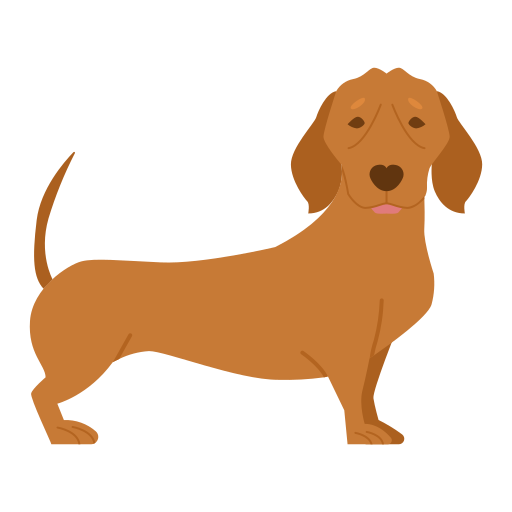
 Dachshund
 Why does a dog the size of a bread loaf believe he is the only thing standing between you and the delivery driver?
Nobody is in danger. The house is quiet. The threat is a man in shorts holding a package of dish soap.
And yet there it is: the low rumble, the stiff little body pressed against your thigh, the sudden conviction that something must be done about this.
Dachshund owners live inside this contradiction. The same dog who cannot climb onto the couch without an invitation and a running start has appointed himself head of security. He takes the job seriously. He works nights.
The behavior looks irrational because the danger is imaginary. But the wiring behind it is very real, and it goes back a lot further than your living room.
The Answer Starts in a Badger Den
Dachshunds were not designed to be lap ornaments. That part came later, mostly by accident, and mostly because they are excellent at it.
They were built to go underground and confront a badger.
Read that sentence again. A badger is a thick slab of muscle and claws that can weigh more than the dog hunting it. The dachshund’s job was to squeeze into a dark tunnel, find that animal, and hold the line until the humans caught up.
Bred to Make the Call Alone
Here is the part that explains almost everything about your dog’s personality.
Once a dachshund went into the tunnel, no human could see him, reach him, or tell him what to do. He had to assess the situation and decide on his own.
Breeds developed for that kind of work are selected for independence, nerve, and a willingness to act first and consult later. That is not stubbornness. That is job training passed down through a couple hundred generations.
A retriever was bred to wait for instructions. A dachshund was bred for the moment when no instructions are coming.
Your dog still runs that program. The tunnel is now a hallway. The badger is the Amazon guy. The decision making process has not changed at all.
That Bark Was a Feature
People love to joke about the voice. A dachshund bark sounds like it belongs to a dog three times the size, and it arrives at a volume that seems physically impossible.
That was intentional.
Hunters needed to hear their dog through several feet of packed earth. Selective breeding gave the dachshund a deep, carrying, absolutely relentless bark so his location could be tracked from above ground.
So when your neighbor asks why such a small dog is so loud, the honest answer is that the loudness was the entire point.
Guarding You Is Not One Behavior
This is where a lot of owners get stuck, because two very different things get filed under the same word.
Sorting them out matters, because they need different responses.
Protective Alerting
Alerting is the dog announcing information. Someone is at the door. A car pulled into the driveway. A skateboard passed the window.
The body language is usually loose and bouncy. Ears forward, tail up and moving, barking that comes in bursts and then stops when you handle it.
This dog is telling you something. Annoying, sure, but socially normal.
Guarding You Like a Possession
Resource guarding looks different, and it feels different in the room.
The dog goes still. The bark drops into a growl. He may put his body between you and the approaching person, or freeze on your lap with his weight leaned into you.
His eyes track the "intruder" without the head moving much. He does not bounce back to normal when you speak to him.
That dog is not sharing information with you. He is making a claim about you, and the claim is that you are his and the other person needs to back off.
The first version is a doorbell with opinions. The second version is a small dog who has decided he is management.
Why the Alarm Goes Off When You Are Perfectly Safe
Okay, so why does the danger meter read high when nothing is wrong?
Because your dog is not evaluating danger the way you are. He is evaluating change, and he is doing it with a threshold that was set several centuries ago by people who wanted a dog that never backed down.
The Threshold Is Low on Purpose
A hunting dog who ignored ambiguous signals was a useless hunting dog. Better to react to ten harmless things than to miss the one that mattered.
That tradeoff was correct in a field. It is wildly overcalibrated in a two bedroom apartment where the biggest daily event is the recycling truck.
Your dachshund is not being paranoid. He is being accurate to his original job description in a world that no longer has that job.
Small Body, Big Feelings
Size plays into it too, though not the way people usually mean.
Small dogs get picked up without warning, moved without consent, and approached by strangers who reach straight over their heads. Plenty of them learn that the world does things to them without asking.
A dog who feels physically unable to control what happens next often gets louder, not quieter. Noise becomes the tool that works.
The Lap Problem
Notice when the guarding usually happens. Most owners report it on the couch, in bed, or with the dog held in their arms.
Elevation and enclosure make a big difference. On your lap he has height, a defended position, and a very valuable resource directly underneath him.
Same dog, standing on the kitchen floor, is often dramatically more relaxed about the exact same visitor.
Turning the Volume Down
None of this means you are stuck with a tiny tyrant. It does mean the fix is about lowering his sense of responsibility rather than out arguing him.
Do Not Punish the Growl
Please read this one twice.
A growl is communication. It is your dog saying he is uncomfortable and would like the situation to change before things escalate.
Punish the growl often enough and you do not get a comfortable dog. You get a dog who skips the warning and goes straight to snapping, because the warning stopped working.
Silencing the growl does not remove the feeling. It just removes your notice.
Change the Meaning of the Trigger
Instead of correcting the reaction, work on what the trigger predicts.
Doorbell rings, excellent chicken appears. Visitor sits down, more chicken. The person your dog was suspicious of becomes the reliable source of the best food in the house.
Keep the distance far enough that he can still think. A dog who is already barking is past the point where learning happens.
Give Him a Different Job
Teach a mat or a bed cue and make it genuinely rewarding. When someone comes over, he has somewhere to be and something to do that is not "assess and repel."
Feed him there. Give him a stuffed chew there. Make that spot the best real estate in the room.
The goal is not obedience for its own sake. The goal is a dog who exhales because the decision is no longer his to make.
Adjust the Lap Rules
You do not need to banish him from the couch forever. You do need to decide who invites whom.
Ask him to come up rather than letting him install himself. Ask him to get down occasionally, then reward it, so the position stays flexible instead of fortified.
If the guarding is intense in your lap, keep him on the floor when guests arrive for a while. Position is powerful, and taking away the throne takes a surprising amount of pressure off him.
Where the Line Actually Is
Some of this behavior is simply dachshund, and living with the breed means accepting a certain amount of unsolicited commentary about pedestrians.
But there are points where it stops being character.
Growling at family members who approach you. Snapping at anyone who reaches near you. A dog who cannot recover and settle after the trigger has left.
That is a dog who is genuinely stressed, and stress that severe does not resolve on its own with patience alone.
Bring in a certified behavior consultant who works with reward based methods, and loop in your vet first. Pain changes tolerance faster than anything else, and this breed has a spine that deserves a careful look before you assume the problem is purely emotional.