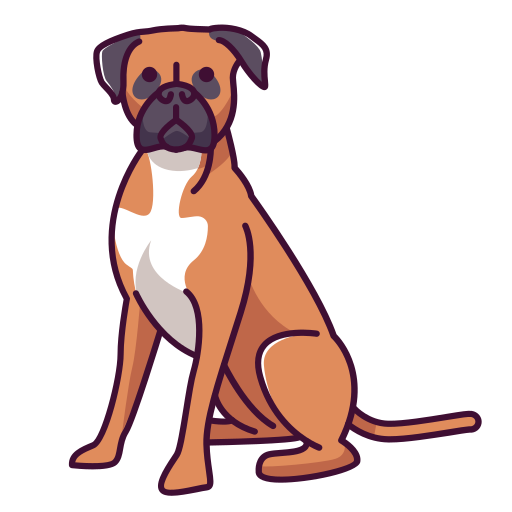
 Boxer
Boxer Ever found yourself apologizing for your Boxer at the park while three other owners quietly gather up their dogs?
Welcome to a very specific club. Boxers have a reputation for being goofy social butterflies, which is exactly why their social misfires stand out so much when they happen.
This is a breed that was built to be springy, expressive, and permanently thrilled about everything. That same enthusiasm can bulldoze straight through the quiet etiquette that other dogs expect from a stranger they just met.
Here is the good news: a socially awkward Boxer is almost never an aggressive one. He is usually a dog with enormous feelings, rubber legs, and absolutely no idea that the Beagle in front of him has already asked him twice to please calm down.
Below are five signs your Boxer is fumbling the social stuff, and what you can actually do about each one.
1. He Greets Every Dog Like a Long Lost Relative
What it looks like
Your Boxer spots another dog forty feet away and instantly becomes a pogo stick with a leash attached.
He is not growling. He is not stiff. He is screaming with his whole body about how badly he wants to say hello, and the other dog is reading that as a threat.
Why it happens
Boxers were bred to be forward, confident, and physically bold. Add adolescent hormones and a leash that prevents a natural curved approach, and you get a dog whose greeting looks like a tackle.
Frustration builds every time he sees a dog and does not get to interact. That frustration comes out as noise, lunging, and general chaos.
How to help
Start creating distance before he explodes, not after. The moment he notices another dog and stays loose, mark it and pay him well.
Practice walking past dogs without greeting them. Most Boxers need to learn that seeing a dog is normal, not an event.
A dog who never gets to practice calm around other dogs will never be calm around other dogs. Repetition builds the skill, not luck.
2. He Completely Misses Other Dogs’ Warning Signals
What it looks like
The other dog turns his head away. Then he licks his lips, yawns, and shifts his weight backward.
Your Boxer sees none of it. He plows forward, paws at the other dog’s face, and looks genuinely stunned when he gets snapped at.
Why it happens
Dogs learn to read body language from other dogs. Puppies raised without enough varied, appropriate dog contact simply never build that vocabulary.
Boxer facial structure does not help either. A short muzzle, a wrinkly forehead, and cropped or floppy ears all muddy the signals he sends back, so other dogs frequently misread him too.
How to help
Find one or two patient, well socialized adult dogs and let your Boxer learn from them in short sessions. A confident older dog who corrects fairly is worth more than ten chaotic dog park visits.
Interrupt play every thirty seconds or so with a quick recall. Then release him back to play if he settles.
That pattern teaches him to check in, cool down, and re read the room instead of running on pure adrenaline.
3. He Freezes Solid Around New People
What it looks like
Someone reaches to pet him and your normally bouncy dog turns into a statue with a wagging stub.
He is not relaxed. He is holding very still and hoping the situation resolves itself.
Why it happens
Boxers are sensitive dogs wearing a tough guy costume. A stranger looming overhead, reaching straight for the top of the head, is genuinely uncomfortable for a lot of them.
Some Boxers go through a second fear period between eight and fourteen months, and social confidence can wobble hard during that window.
How to help
Advocate for your dog out loud. Ask people to crouch sideways, offer a hand low, and let your Boxer choose whether to approach.
If he does not approach, that is a complete answer. Respect it and move on.
Consent is not a human concept. A dog who is allowed to say no becomes a dog who says yes far more often.
The three second rule
Teach visitors to pet for three seconds, then stop and pull their hands back. If your Boxer leans in for more, they continue. If he steps away, the interaction is over.
4. He Plays Too Rough and Cannot Turn It Off
What it looks like
Play starts beautifully. Ten minutes later your Boxer is body slamming a Cocker Spaniel who stopped enjoying this a while ago.
Boxers box. They rear up, throw paws, and use their chest like a wrecking ball, which is completely normal for the breed and completely overwhelming for many other dogs.
Why it happens
Arousal builds faster than it drains. Once your Boxer crosses that threshold, his brain is running on chemicals and he genuinely cannot hear you anymore.
Dogs who never learned to self regulate as puppies tend to escalate rather than settle.
How to help
Manage the arousal ceiling before he hits it. Short bursts of play with mandatory breaks work far better than one long free for all.
Match him with dogs who play similarly. A Boxer and a Lab will usually sort themselves out. A Boxer and a nervous Whippet almost never will.
Teach a rock solid interrupter cue at home, somewhere boring, before you ever need it in the field.
Training a recall in your living room and expecting it to hold at the dog park is like practicing a fire drill in your sleep and hoping for the best.
5. He Hides Behind You and Then Barks From Safety
What it looks like
Your Boxer retreats behind your legs, peeks out, and unleashes a barrage of barking at whatever spooked him.
It reads as aggression to everyone watching. It is actually a scared dog using volume as a shield.
Why it happens
Barrier frustration, insufficient early exposure, or a bad experience that stuck. Boxers are emotionally expressive dogs, and fear rarely stays quiet in this breed.
Punishing the barking here backfires spectacularly. Suppress the warning and you get a dog who skips straight to the next stage without notice.
How to help
Increase distance immediately. Your Boxer cannot learn anything while he is over threshold, so the first job is getting him back under it.
Then work at whatever distance keeps him thinking. Feed him for noticing the scary thing and staying loose, and slowly close the gap over weeks rather than minutes.
Build the routine, not the fix
Boxers thrive on predictability far more than people expect from such a silly breed. Same walk route, same greeting protocol, same rules every single time.
Confidence grows out of knowing what happens next.
What Progress Actually Looks Like
Social skills do not arrive in a dramatic breakthrough moment.
You will notice your Boxer glance at a dog across the street and then look back at you. You will notice him choose to walk away from a greeting instead of forcing it. You will notice that the recovery time after a startle gets shorter every month.
Those are the wins. They are small, unglamorous, and enormously meaningful.
And if your Boxer is six years old and still greets the mail carrier like a lunatic, that is fine too. Awkward is not broken. Awkward is just a dog who needs a little more structure and a lot more patience from the human holding the leash.