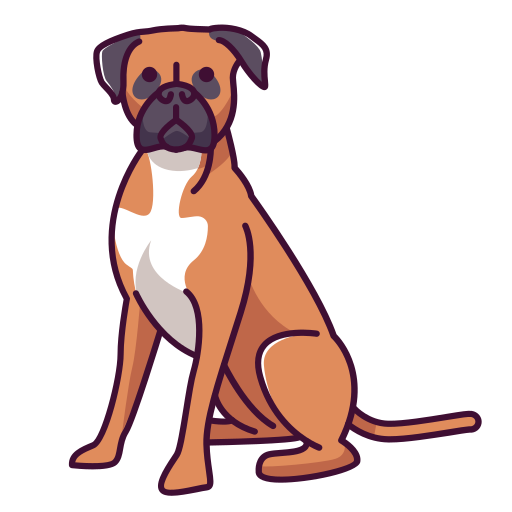
 Boxer
Boxer Dogs evolved a small muscle above their eyes that wolves simply do not have, and the leading theory is that it appeared for one reason: to talk to us. That muscle is why your Boxer can fire off a look from across the living room that lands like a text message.
Here is the part most owners miss, though.
That famous sideways glance, the one that reads as sass or guilt or quiet judgment about your outfit choice, is very often none of those things. It is data. Sometimes it is fairly urgent data.
And Boxers deliver it more visibly than almost any other breed, thanks to a face that was practically engineered for eye contact. Big round eyes. Short muzzle. Expressive brow. Your Boxer is not being dramatic. Your Boxer is being legible.
Once you learn to read the difference between a casual glance and a genuine signal, a lot of confusing behavior suddenly makes sense.
The Science Behind That Sideways Stare
Direct eye contact between dogs is not a friendly gesture. In dog language, a hard stare is confrontational, which is why a socially skilled dog will look away, blink, or turn a shoulder when things get tense.
So when a dog wants to keep watch on something without escalating, the compromise is obvious: keep the head still and slide the eyes over.
That is side eye in its purest form.
Wolves and free ranging dogs do this too. The difference with your Boxer is that you can see it happening from ten feet away.
Whale Eye Versus a Casual Glance
The term trainers use is whale eye, and it describes the moment when a dog’s eyes slide sideways far enough that you see a crescent of white sclera.
A relaxed glance does not usually show much white. The head turns a little, the eyes move with it, and the whole thing looks loose.
Whale eye looks different. The head stays locked forward or slightly away while the eyes strain sideways, and that white crescent shows up like a warning light on a dashboard.
A dog who is comfortable moves the head. A dog who is worried moves only the eyes.
That single distinction will change how you read your Boxer within about a week of paying attention to it.
What Your Boxer Is Actually Saying
Side eye is not one message. It is a category of messages, and context does most of the translating for you.
"I Am Uncomfortable, Please Back Off"
This is the big one, and it is the reason side eye deserves your attention rather than your laughter.
A Boxer who gives whale eye while a toddler drapes across her back is being extremely polite. She is telling you she does not love this, using the quietest tool she has.
Dogs almost always warn before they react. The trouble is that the earliest warnings are so subtle that humans breeze right past them, and the dog learns that whispering does not work.
Reward the whisper and you will rarely hear the shout.
"I Am Guarding Something"
Watch your Boxer’s eyes the next time you walk past her while she is chewing a bully stick or settled into a favorite spot on the couch.
If the head lowers slightly, the chewing slows or stops, and the eyes track you sideways, that is resource guarding in its earliest and most manageable stage.
Nothing about it means your dog is aggressive or ruined. It means she values the item and is not certain you are going to respect that.
The good news is that early guarding responds beautifully to trades and distance. The bad news is that ignoring it, or worse, taking the item to prove a point, tends to escalate things fast.
"I Am Just Being Nosy"
Plenty of side eye means nothing at all.
Boxers are relentlessly curious and, frankly, a little lazy about neck movement when they are comfortable. A dog half asleep on the sofa who hears the treat drawer open will absolutely track you with her eyes alone.
Loose body, soft face, maybe a tail thump. That version is just your dog being your dog.
Why Boxers Give More Side Eye Than Other Breeds
Two things stack here, and together they create a dog who seems to comment on everything.
The Face Was Built For It
Brachycephalic breeds have shallower eye sockets and more forward facing eyes than long muzzled dogs. That anatomy puts a lot of visible sclera on display whenever the eyes move off center.
A Border Collie can give whale eye and you might miss it entirely behind all that muzzle and coat. A Boxer gives whale eye and it looks like a reaction shot from a sitcom.
Same signal. Wildly different visibility.
Boxers are not more expressive than other dogs. They are simply harder to misread, which is a gift most owners never realize they were handed.
The Personality Amplifies It
Boxers were bred as working dogs who needed to think independently and stay tuned in to their handler at the same time. That combination produces a dog who watches you constantly.
Add the breed’s famous goofiness and the sheer amount of opinion packed into that head, and you get a dog who seems to editorialize in real time.
She is not judging your life choices. She is monitoring, because monitoring is what she was built to do.
Reading the Rest of the Body
Eyes never tell the whole story. They are one line in a paragraph, and reading them alone is how people end up confidently wrong.
The Freeze Is the Real Tell
Here is the single most useful thing in this entire article.
Side eye plus movement is usually fine. Side eye plus stillness is worth taking seriously.
A dog who stops mid chew, stops mid pant, or stops wagging while giving you that sideways look has just told you something significant. Stillness in a dog is tension, not calm.
Supporting Signals to Scan For
Once you spot whale eye, run a quick check on everything else.
Ears pinned back or held oddly low. A closed mouth on a dog who was panting a second ago. A tight, wrinkled brow. Lips pulled back into a long thin line. Weight shifted away from whatever the eyes are tracking.
Two or three of those together, and your Boxer is genuinely uneasy.
None of them, and you are probably just looking at a dog who wants your sandwich.
What to Do When You See It
The instinct is to reassure the dog. Talk sweetly, pet her, tell her it is fine.
That rarely helps, because the dog is not asking for comfort. She is asking for the situation to change.
Change the Situation, Not the Dog
If a child is leaning on her, move the child.
If a guest is looming over her, ask them to sit down and stop staring, because most people have no idea that direct human eye contact reads as pressure to a dog.
If she is guarding a chew, walk a wider arc and toss a better treat as you pass. You are teaching her that your approach predicts good things rather than losses.
Small adjustments. Repeated consistently. That is the whole method.
Every time you respond to a quiet signal, you make the loud one less likely. Every time you ignore it, you teach your dog that quiet does not work.
When to Bring In Help
Some situations deserve a professional set of eyes rather than a blog article.
Whale eye paired with growling, snapping, stiffening, or lunging is a conversation for a qualified trainer or a veterinary behaviorist, ideally sooner rather than later.
The same goes for side eye that appears suddenly in a dog who never showed it before, especially in an older Boxer. Pain changes behavior long before it changes gait, and vision changes do the same.
When the Side Eye Is Genuinely Nothing
Not every crescent of white is a crisis, and hypervigilance will make you miserable.
A Boxer sprawled on her back, legs everywhere, tracking a moth across the ceiling with her eyes is not stressed. She is comfortable enough to be lazy about it.
The context makes the call. Loose body, soft face, wiggly everything: that dog is fine.
Tight body, still face, held breath: that dog needs something from you.
Learn the difference and your Boxer will keep talking to you in that quiet, sideways way for the rest of her life, which is exactly what you want from a dog who has so much to say.