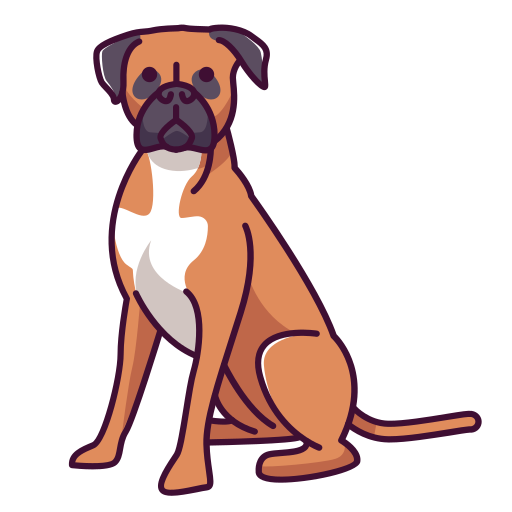
 Boxer
Boxer Fifteen minutes of sniffing and problem solving will flatten a Boxer more thoroughly than a three mile jog, and once that clicks, your whole evening changes.
Boxers were built to work all day and then act surprised when the day ends. The breed spent centuries as a guard dog, a cart puller, a hunter’s partner, and a soldier’s companion, and none of that history evaporated when the breed moved onto your couch.
Which is why you can walk one for an hour and still get the 9pm zoomies, the kidney bean wiggle, and a set of front paws boxing at your knee like you owe money.
The trick is not more exercise. The trick is the right kind, stacked so the body and the brain both clock out at the same time.
Here are ten ways to get there fast.
1. Break Out the Flirt Pole
A flirt pole is a lunge whip with a toy tied to the end, and for a Boxer it might as well be a cheat code.
Five to ten minutes is usually plenty. The chase, the pounce, the sudden stops: it burns through energy at a rate that regular fetch simply cannot touch.
Keep It Joint Friendly
Sweep the lure low along the ground instead of yanking it upward. Boxers will absolutely launch themselves sideways in the air to catch something, and that landing is where hocks and shoulders pay the bill.
Let your dog win the toy every few passes. A chase with zero payoff turns frustrating fast, and a frustrated Boxer just gets louder.
2. Feed Dinner Out of a Muffin Tin
Take a standard twelve cup muffin tin, drop kibble into the wells, then cover each well with a tennis ball.
That’s the whole setup. Total build time: about forty seconds.
Your dog now has to nose, paw, and lift twelve separate obstacles to eat, which turns a thirty second meal into a ten minute thinking exercise.
A dog who has to solve for dinner is doing more work than a dog who has to run for it.
3. Run Stair Sprints (Carefully)
Toss a toy to the top of a staircase, let your Boxer bring it back down, repeat six or eight times.
Uphill effort taxes the hindquarters and the lungs in a way flat ground never will, so the rep count you need is dramatically lower.
The Rule Nobody Follows
Send your dog up for the toy, not down. Repeated downhill charging is hard on the front end, and Boxers are front heavy dogs who tend to hit the brakes with their elbows.
Skip this one entirely for puppies under a year old.
4. Play "Find It" with Scattered Treats
Grab a handful of small treats and fling them across the lawn while your dog watches.
Then say find it and let the nose go to work.
Scent work drops a dog into a focused, methodical state, and that focus is weirdly exhausting. Ten minutes of hunting through grass has folded more Boxers than any tug rope ever has.
For a harder version, ask your dog for a sit stay in the house, hide the treats outside, then release.
5. Tug, But With Actual Rules
Tug gets a bad reputation from people who play it wrong.
Played with structure, it’s one of the fastest energy drains available, and it builds impulse control at the same time.
Ask for a sit before the game starts. Play hard for twenty seconds, then ask for a drop, pause for three full seconds, then restart.
Why the Pauses Matter
Those little stops are the entire point. Your Boxer is doing something physically intense and then slamming on the mental brakes, over and over, which is far more draining than uninterrupted pulling.
Keep the rope low and horizontal. No lifting the dog off the ground, no matter how much they seem to want it.
6. Teach Something Brand New
Not sit. Not down. Something your dog has never attempted before.
Spin. Back up. Chin rest. Put your paws in a box. Touch a target with your nose.
New learning lights up a dog’s brain like a switchboard, and Boxers in particular have a goofy, eager focus that burns hot and then crashes.
Ten minutes of learning a new trick will cost your dog more energy than an hour of doing tricks she already knows.
Cap the session at ten minutes. Ending while your dog is still enthusiastic is what makes tomorrow’s session work.
7. Take a Sniffari Instead of a Walk
Same neighborhood, completely different rules.
Loosen the leash, pick a slow pace, and let your Boxer decide where the nose goes. No heeling, no correcting, no dragging her past the interesting mailbox.
You will cover maybe a quarter of your usual distance. Your dog will come home noticeably more relaxed, because scenting lowers heart rate and gives the brain something real to chew on.
A long line in an open field turns this from good to genuinely excellent.
8. Hide and Seek in the House
Ask someone to hold your dog in another room. Go hide behind a door, in a closet, under a blanket on the bed.
Call once, then stay quiet.
Watching a sixty pound Boxer tiptoe through a hallway with her whole body vibrating is one of the great free pleasures of dog ownership.
Raise the Difficulty
Once she finds you in ten seconds flat, start hiding in places with competing smells: the laundry room, near the kitchen trash, behind the shoe rack.
Reward with a party, not a treat. Boxers work harder for enthusiasm than for food, which is either charming or inconvenient depending on the day.
9. Build a Living Room Obstacle Course
Broom across two chairs to jump over. Blanket draped between the couch and coffee table to crawl under. Laundry basket to weave around.
Walk your dog through it slowly on leash the first time, then let her run it while you point and cheer.
Slow, deliberate movement through odd obstacles is proprioceptive work, which is a fancy way of saying your dog has to think about where every foot is going.
That kind of body awareness challenge tires dogs out at a rate that surprises almost everybody the first time they try it.
10. Find the Right Playmate, Not Just Any Playmate
A Boxer playing with a matched partner will outwork anything you can personally provide.
The problem is that Boxers play with their paws and their mouths, standing upright and swatting, and plenty of dogs find that style genuinely rude.
Look for another boxy, bouncy, physical player: a Boxer, a Pit mix, a Lab with a sense of humor.
Watch the Heat
Boxers have short muzzles and mediocre cooling systems, so a hard play session on a warm afternoon gets dangerous faster than you would expect.
Break every ten minutes. Offer water. If the tongue goes wide and spatula shaped, the session is over regardless of how much fun everyone is having.
A tired Boxer is a good Boxer. An overheated Boxer is an emergency.
Stacking Them Is Where the Magic Happens
Any one of these will take the edge off.
Two or three of them, spaced through the day, will give you a dog who lies down at 7pm and stays there.
Try a sniffari in the morning, dinner out of the muffin tin, then five minutes of flirt pole before bed. That combination hits the nose, the brain, and the body in three separate windows, which is exactly what this breed was built to handle.
Start with whichever one requires the least effort from you tonight, because the plan you actually run beats the perfect plan you skip.