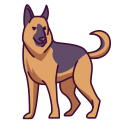
 German Shepherd
 Your German Shepherd’s brain is basically a supercomputer wrapped in fur, but here’s the catch: it’s running on completely different software than yours. While you’re thinking in full sentences and complex reasoning, your GSD is processing body language, tone, and single-word cues at lightning speed. The communication gap isn’t about intelligence. It’s about speaking different languages.
What if you could bridge that gap with just five commands? Not the basic sit and stay everyone teaches, but the powerful instructions that professional trainers use to create unshakeable bonds with their working dogs. These commands don’t just get results; they fundamentally change how your German Shepherd perceives and responds to you.
1. “Place” (The Foundation of Calm Control)
Place is hands down the most underrated command in the dog training universe, yet it’s absolute gold for German Shepherds. This command teaches your dog to go to a specific spot (a mat, bed, or designated area) and remain there until released. Unlike a simple “stay,” place creates a mental state of relaxation and boundaries.
Why does this matter so much for GSDs specifically? These dogs are naturally vigilant and protective. Without a place command, your shepherd might patrol your house, react to every noise, or hover anxiously during meals. Place gives them a job: be calm here. It’s especially transformative when guests arrive, during family dinners, or when you need your dog to settle while you work.
Training place is straightforward but requires patience. Start by luring your dog onto their designated spot with treats. Mark the behavior with “yes!” and reward. Gradually increase the duration they stay on the place before rewarding. The magic happens when your GSD starts offering the behavior automatically, heading to their place when things get busy without being asked.
Your German Shepherd doesn’t need to be involved in everything. Teaching “place” gives them permission to relax, transforming a vigilant guardian into a peaceful companion who knows when it’s their time to simply observe and rest.
2. “Leave It” (The Ultimate Safety Command)
If you could only teach your GSD one command for their entire life, leave it might be the winner. This command potentially saves lives, prevents vet emergencies, and stops countless frustrating behaviors before they start. It means “ignore that thing you’re interested in and focus on me instead.”
German Shepherds are curious, mouthy, and food motivated. They’ll snatch chicken bones off the sidewalk, grab your kid’s toy, or fixate on the neighbor’s cat. Leave it interrupts that fixation instantly. It’s not about dominance or control; it’s about giving your dog a clear alternative behavior when their instincts are screaming “investigate that!”
The beauty of leave it extends beyond physical objects. You can use it for inappropriate greetings (jumping on strangers), chasing behaviors, or even obsessive focus on other dogs. Start training with low-value items in controlled environments, then gradually increase difficulty. Hold a treat in your closed fist, say “leave it,” and only reward when your dog pulls away from your hand. Eventually, they’ll generalize this to anything you point at.
Here’s a progression guide for training leave it:
| Training Stage | Environment | Distraction Level | Success Rate Goal |
|---|---|---|---|
| Week 1-2 | Indoor, quiet | Treats in hand | 90%+ |
| Week 3-4 | Indoor, moderate activity | Toys on floor | 80%+ |
| Week 5-6 | Outdoor, controlled | Food on ground | 75%+ |
| Week 7+ | Real world scenarios | High-value items | 70%+ |
3. “Look” or “Watch Me” (The Connection Command)
Look or watch me is pure relationship magic. This command asks your dog to make direct eye contact with you, creating a moment of complete focus and connection. For German Shepherds, who can become reactive or overstimulated in certain environments, this command is a reset button.
Think about it: if your GSD is staring at you, they literally cannot be lunging at another dog, fixating on a squirrel, or panicking about the garbage truck. Eye contact with you becomes their anchor point in chaos. Professional trainers use this constantly because it redirects your dog’s entire mental state.
Training watch me is surprisingly simple but profoundly effective. Hold a treat near your nose, say “look” or “watch me,” and mark the instant your dog makes eye contact. Start with just a second of contact, then build duration. Practice this in increasingly distracting environments until your dog can hold eye contact even when fascinating things are happening around them.
The command transforms walks, vet visits, and busy environments. When your GSD starts getting worked up, one “look” command brings their attention back to you instead of spiraling into reactivity. It’s preventative communication at its finest.
Eye contact with your German Shepherd isn’t just about obedience. It’s a moment of mutual trust and understanding that says “we’re in this together” louder than any words ever could.
4. “Off” (Boundaries Without Confusion)
Off is the clarity command that prevents so much confusion between you and your GSD. It means “remove yourself from that surface or person right now.” Unlike “down” (which means lie down) or “no” (which is vague and means everything and nothing), off is specific and actionable.
German Shepherds are big dogs who often think they’re lap dogs. They jump on counters, leap on guests, climb on furniture, and generally take up space with enthusiasm. Off gives you a single, consistent word that means “all four paws on the floor” or “get off that thing immediately.” No yelling, no pushing, just clear communication.
The power of off comes from its consistency. Whether your dog is jumping on Grandma, investigating the kitchen counter, or sprawling across your white couch, the command stays the same. Your GSD learns that “off” means immediately remove themselves from elevated surfaces or people. Period.
Training requires capturing the behavior. When your dog jumps up, calmly say “off” without repeating it multiple times. Wait. The instant all four paws hit the ground, enthusiastically reward. If they don’t respond, gently guide them off while saying the word once. German Shepherds are smart; they’ll connect the dots quickly when the reward pattern is consistent.
5. “Heel” (Partnership in Motion)
Heel isn’t about your dog walking slightly near you while pulling occasionally. Real heel means your GSD walks at your left side (or right, stay consistent) with their shoulder roughly aligned with your leg, maintaining that position regardless of distractions. It’s the command that transforms walks from wrestling matches into smooth, cooperative experiences.
Why is this crucial for communication? Because loose leash walking with a 75-pound German Shepherd isn’t just pleasant; it’s essential. When your dog understands heel, you’re moving through the world as a unit. They’re checking in with you, matching your pace, and looking to you for guidance. That’s next-level communication.
True heel requires significant training investment, but it pays endless dividends. Start in a low-distraction environment with high-value treats. Keep your dog at your side using a lure, marking and rewarding every few steps they maintain position. Gradually increase distance between rewards, add turns and pace changes, then introduce distractions systematically.
The transformation is remarkable. Your GSD goes from dragging you toward every interesting smell to moving with you in genuine cooperation. They learn that heel means “your job right now is to stay with me and let me navigate.” It’s not about domination; it’s about establishing who’s handling navigation so your dog can relax and enjoy the walk without making every directional decision.
A German Shepherd in proper heel position isn’t following commands out of fear or submission. They’re choosing to move with you as a trusted partner, which is the ultimate goal of any communication system between human and dog.
The Big Picture
These five commands create a language between you and your German Shepherd that goes far beyond basic obedience. Place teaches emotional regulation. Leave it provides safety and impulse control. Look establishes connection and focus. Off sets clear boundaries without confusion. Heel builds cooperative partnership.
Together, they form a communication framework where your GSD actually understands what you’re asking, why it matters, and what behavior you want instead. That’s the difference between a dog who sometimes listens and a dog who’s genuinely tuned into you as their trusted guide through the world.
The investment in teaching these commands thoroughly (not just sort of, kind of teaching them) pays off every single day for the next decade-plus of your dog’s life. Crystal-clear communication isn’t about having a perfectly obedient robot. It’s about building a relationship where both of you understand each other, trust each other, and genuinely enjoy navigating life together.
Your German Shepherd wants to understand you. These five commands give them the tools to do exactly that.