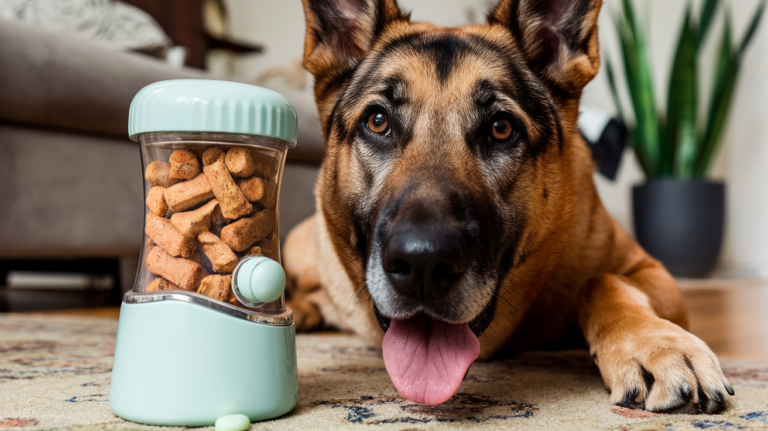
Rainy day? No problem. These indoor games challenge your German Shepherd’s brain and burn energy without leaving the house.
A bored German Shepherd is basically a furry tornado waiting to happen. These dogs were bred to work alongside humans, solving complex problems and making split second decisions. That heritage doesn’t just disappear because they’re living in your apartment.
When the weather turns nasty or you’re stuck inside, your GSD’s brain doesn’t take a vacation. In fact, mental exercise can tire out your German Shepherd even more effectively than physical activity. Ready to discover how to channel all that intelligence into productive indoor fun?
1. Hide and Seek with a Twist
Remember playing hide and seek as a kid? Your German Shepherd will love it just as much, maybe more. This isn’t just about hiding behind the couch, though. We’re taking it up several notches to really challenge that working dog brain.
Start simple: have your GSD sit and stay in one room while you hide in another. Call their name once and watch as they systematically search the house, nose to the ground, ears perked, totally focused. The joy on their face when they find you? Priceless.
Once they’ve mastered finding you, level up by hiding their favorite toy or a special treat. Place it somewhere they need to work for, maybe on a low chair they need to investigate or behind a partially closed door. German Shepherds have incredible noses, around 225 million scent receptors compared to our measly 5 million, so they’re built for this game.
The real magic happens when your dog stops relying purely on luck and starts developing search patterns and strategies.
For advanced players, create a multi-step hunt. Hide treats in three different locations and watch your GSD’s face light up as they realize there’s more than one prize to find. This activity taps into their natural tracking instincts while teaching patience and problem solving skills.
2. The Shell Game (Canine Edition)
You’ve seen street performers do this with cups and a ball. Your German Shepherd can absolutely learn this classic con game, and it’s fantastic for cognitive development.
Grab three identical containers (plastic cups work great) and one treat. Let your dog watch as you place the treat under one cup, then slowly shuffle the cups around. At first, keep it dead simple with just one or two moves. Point to the cups and let them indicate which one holds the treasure.
What makes this brilliant for German Shepherds is it requires focus, memory, and impulse control. They can’t just knock over all three cups; they need to track, remember, and make a choice. This is executive function training disguised as a game.
As your dog improves, increase the complexity. Shuffle faster, use more cups, or add fake shuffles where you pretend to move cups but don’t. Some German Shepherds get so good at this they’ll watch your hands with laser focus, barely blinking. It’s like having a furry card counter in your living room.
3. DIY Puzzle Feeders and Food Dispensing Toys
German Shepherds are natural problem solvers, and puzzle feeders tap directly into that instinct. Instead of scarfing down dinner in 30 seconds, your dog needs to work for every kibble.
You don’t need expensive store bought puzzles (though those are great too). A muffin tin with tennis balls covering treats in each cup? Instant puzzle. A cardboard box filled with crumpled paper hiding treats throughout? Your GSD will demolish it in the best way possible. Toilet paper tubes folded at the ends with kibble inside? Chef’s kiss.
| Puzzle Type | Difficulty Level | Materials Needed | Mental Skills Developed |
|---|---|---|---|
| Muffin Tin Puzzle | Beginner | Muffin tin, tennis balls, treats | Object manipulation, problem solving |
| Snuffle Mat | Beginner to Intermediate | Fleece strips, rubber mat | Scent work, patience, foraging |
| Bottle Spinner | Intermediate | Plastic bottle, dowel, treats | Cause and effect, persistence |
| Box Destruction | Intermediate | Cardboard boxes, paper, treats | Strategic thinking, multi-step solving |
| Kong Wobbler | Intermediate to Advanced | Kong toy, kibble | Balance, coordination, persistence |
The beauty of food puzzles is they combine two powerful motivators: mental stimulation and food rewards. Your German Shepherd’s brain lights up like a Christmas tree as they figure out how to access their meal. Plus, it slows down fast eaters and can help with weight management.
Rotate different puzzles to keep things fresh. A puzzle that takes 20 minutes to solve on Monday might take 5 minutes by Friday. That’s not failure; that’s your dog getting smarter. Time to level up.
4. Advanced Trick Training
Basic commands are great. Sit, stay, down… yawn. Your German Shepherd learned those in a weekend. Now it’s time for the impressive stuff that makes houseguests’ jaws drop.
Teaching complex tricks engages your GSD’s brain on multiple levels. They’re learning new behaviors, sure, but they’re also learning how to learn. That metacognitive skill is what separates a well trained dog from an exceptional one.
Try “play dead” where your dog drops dramatically at a finger gun. Or “put your toys away,” where they actually pick up their scattered toys and drop them in a bin. German Shepherds can learn to close doors, turn off lights, and even fetch specific items by name. One owner taught her GSD to distinguish between 50 different toys and could ask for “Mr. Bear” or “squeaky duck” with perfect accuracy.
Break complex tricks into tiny steps. Want to teach your dog to open a drawer? First, reward touching the drawer. Then reward touching a rope tied to the handle. Then reward pulling the rope slightly. Then pulling it more. Before you know it, your German Shepherd is playing fetch with items from your sock drawer (hopefully).
The training sessions themselves don’t need to be long. Fifteen minutes is plenty. What matters is consistency and making it fun. End on a high note, always, so your dog associates training with success and good times.
5. Scent Work and Nose Games
If there’s one superpower German Shepherds possess, it’s their nose. These dogs work in search and rescue, drug detection, and explosive detection for a reason. You can harness that incredible olfactory ability right in your home.
Start with basic scent discrimination. Take three identical containers and put a treat in one. Let your dog sniff and indicate which container holds the prize. Simple, right? Now make it interesting.
Introduce a specific scent your dog needs to find. Essential oils work great for this (just make sure they’re dog safe; skip tea tree, eucalyptus, and citrus). Put a drop of lavender oil on a cotton ball, pair it with treats a few times so your dog associates lavender with rewards, then hide the lavender scented cotton ball around the house. Your GSD needs to sniff it out and alert you.
Scent work is one of the few activities that can completely exhaust a dog mentally while barely moving physically.
Graduate to hiding the scent in more challenging locations: inside closed cabinets they need to paw open, up on furniture they need to indicate, or in rooms you’ve never practiced in before. German Shepherds excel at generalization, taking what they learned in the living room and applying it to the bedroom, garage, or even outside.
This activity is particularly perfect for older German Shepherds or those with mobility issues. An arthritic senior who can’t run around the block can still work their nose for 20 minutes and be completely satisfied.
6. Interactive Tug and Flirt Pole Play
Tug of war gets a bad rap, but it’s actually an excellent indoor activity when done right. It’s not about dominance (that outdated theory has been thoroughly debunked); it’s about impulse control, following rules, and burning energy in a small space.
The key is having clear rules. Your German Shepherd only grabs the toy when you say “take it” and must drop it immediately when you say “drop it.” No grabbing at the toy when you’re not playing. No keeping the toy when the game ends.
This turns a simple game into a complex exercise in self control. Your GSD wants that toy more than life itself, but they have to wait for permission. That internal battle, that moment of decision, is where the mental workout happens.
For an extra challenge, use a flirt pole, basically a long stick with a rope and toy attached. You can make your German Shepherd sprint, jump, twist, and turn following the toy without needing much space. Five minutes of intense flirt pole play can tire out even the most energetic GSD.
Between rounds, practice training commands. Make your dog sit, down, spin, or perform a trick before releasing them for another round of play. This intermittent reinforcement keeps their brain engaged and prevents them from getting too worked up.
7. Build an Indoor Agility Course
Who says agility is only for outdoor spaces? Your living room can become an obstacle course that challenges your German Shepherd’s mind and body simultaneously.
Use household items creatively. Broomsticks balanced on books become jumps. A blanket draped over chairs creates a tunnel. Couch cushions arranged in a line become weaving poles. A towel on the floor becomes a “place” station where your dog needs to stop and sit.
The mental challenge comes from learning the course and following your directions. Unlike outdoor agility where the course is set, you can change your indoor course constantly. Yesterday the jump was first; today it’s third. Your German Shepherd needs to pay attention to you, not just memorize a pattern.
| Indoor Obstacle | Household Items Needed | Skills Practiced |
|---|---|---|
| Jump | Broomstick, books or boxes | Coordination, following cues |
| Tunnel | Blanket, chairs | Confidence, trust |
| Weave Poles | Couch cushions or plastic bottles | Precision, body awareness |
| Balance Beam | Sturdy plank or board | Balance, slow movement |
| Place Station | Towel or mat | Impulse control, position changes |
Guide your dog through with treats and enthusiasm. “Over the jump! Through the tunnel! Around the cushions! Yes!” Your excitement makes it fun. Their focus on following your directions makes it mentally challenging.
As a bonus, this activity strengthens your communication. Your German Shepherd learns to look to you for guidance, trust your directions even when they’re not sure what comes next, and respond quickly to verbal and hand signals.
8. Name That Toy (Object Discrimination Training)
This activity showcases just how intelligent German Shepherds truly are. They can learn the names of dozens, even hundreds, of objects. It’s not just impressive; it’s deeply satisfying for a breed that loves to work with their human.
Start with two very different toys. Maybe a ball and a rope. Say “get the ball” and reward when they bring the ball. Say “get the rope” and reward when they bring the rope. Repeat until they’re reliably picking the correct toy.
Now add a third toy. Then a fourth. Then a tenth. Some German Shepherds have learned over 200 object names. One famous border collie, Chaser, learned over 1,000, and German Shepherds aren’t far behind in cognitive ability.
What makes this activity so valuable is it teaches language comprehension at a level most people don’t realize dogs can achieve. Your GSD isn’t just following commands; they’re understanding words as representations of specific objects. That’s abstract thinking.
The moment your German Shepherd proves they know the difference between “octopus” and “hedgehog” and “Mr. Pickles” is the moment you realize you’re living with a genius.
Test their knowledge regularly. Scatter ten toys and ask for specific ones in random order. Make it a game where they race to find the right toy. Introduce new toys with new names and see how quickly they catch on. The learning never stops, and neither does the mental workout.
Between formal training sessions, use the names casually. “Go get elephant and we’ll play.” “Where’s your squeaky ball?” This reinforces their vocabulary and keeps them thinking even during downtime.
These eight activities prove that indoor time doesn’t mean downtime for your German Shepherd. Rain or shine, small apartment or sprawling house, you can keep that brilliant mind engaged, happy, and growing. Your furniture (and your sanity) will thank you.