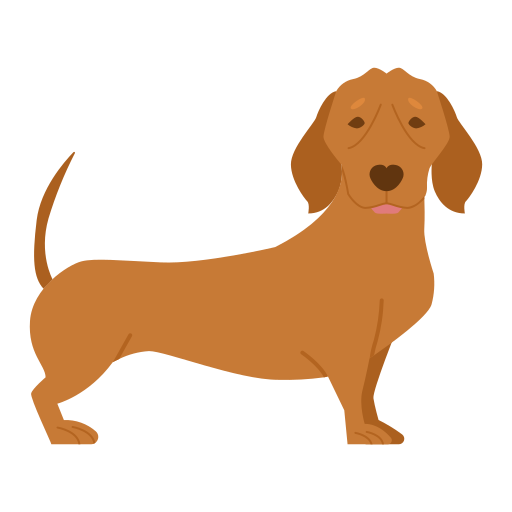
 Dachshund
 Ten thirty at night, and the sausage-shaped tornado in your living room is doing laps around the coffee table like it just discovered caffeine.
You’ve walked her. Twice. She had a full lunch, a nap in the sunbeam, and a solid twenty minutes of chewing on that stuffed hedgehog she’s been slowly murdering since March.
None of it stuck.
Here’s the part nobody warns you about when you fall for those floppy ears and that ridiculous little body: dachshunds were engineered to go underground and fight badgers. Badgers. That drive doesn’t evaporate just because your dog now lives in an apartment and sleeps under a fleece blanket shaped like a hot dog.
So the standard advice (more walks!) tends to fall flat. A tired doxie isn’t made by distance. She’s made by problem solving, sniffing, digging, and the occasional chance to feel like a tiny predator again.
Below are seven things that actually work.
1. Build a Dig Box and Let Her Go Feral
If there’s one instinct hardwired into your dachshund’s DNA, it’s the urge to excavate. Your flowerbeds already know this.
A dig box redirects that urge somewhere useful. Take a shallow plastic bin or a cheap kiddie pool, fill it with something safe to burrow through, and bury treats or toys at various depths.
Then step back and watch a completely different animal emerge.
A dachshund who has been allowed to dig for fifteen minutes is calmer than one who has walked for an hour. Instinct burns more fuel than exercise ever will.
What to Fill It With
Play sand works well outdoors. Indoors, try shredded paper, fleece scraps, or ball pit balls, all of which are easier to vacuum than sand and less likely to end up in the couch cushions.
Start easy. Bury treats near the surface for the first few sessions so she learns the game pays off, then gradually hide things deeper as she gets the hang of it.
Ten minutes of this is genuinely exhausting for a small dog.
2. Run Scent Work Instead of Laps
Dogs process the world through their noses, and dachshunds have an especially good one. Scent work taps directly into that, which is why it drains them so efficiently.
The simplest version costs nothing. Put your dog in another room, hide five or six treats around the living room, then release her and say "find it."
She’ll be slow at first. Give her a week and she’ll be checking behind the bookshelf like a customs agent.
Leveling It Up
Once she’s fast at the easy version, hide treats inside cardboard boxes, under overturned cups, or in a muffin tin covered with tennis balls.
You can also take it outdoors. Scatter kibble in tall grass and let her work the area methodically instead of just marching her down the sidewalk.
Fifteen minutes of nose work equals roughly an hour of walking in terms of mental fatigue. That trade is one of the best deals in dog ownership.
3. Play Tug (Yes, Really)
Tug got an undeserved reputation years ago as something that makes dogs aggressive or dominant. That idea has been thoroughly debunked, and honestly, tug is one of the best energy outlets available for a breed built to grip and pull.
Dachshunds love it. The full body engagement, the growling, the theatrical head shaking: it’s all deeply satisfying to a dog whose ancestors dragged badgers out of tunnels.
Use a long tug toy so her teeth stay far from your hands, and keep the motion low and horizontal rather than lifting her off the ground. Her back matters more than the drama.
Add Rules to Double the Value
Teach a "drop it" and a "take it," then work them into the game. Now she’s getting physical exercise and impulse control practice in the same five minutes.
Let her win sometimes. It keeps her invested, and no, it will not make her think she runs the household.
4. Set Up an Indoor Obstacle Course
Rainy day, hot afternoon, or a dog who’s already been outside and still won’t settle? Furniture becomes agility equipment.
Drape a blanket over two chairs to make a tunnel. Lay a broomstick flat on the floor to walk over. Use a cushion as a platform she has to climb onto and hold a sit.
Keep everything low. Dachshunds should not be jumping down from heights, and a long spine plus a hard landing is a combination you want to avoid entirely.
The best dachshund exercise isn’t the one that makes her run fastest. It’s the one that makes her think hardest while keeping her spine safe.
Make Her Work the Course
Guide her through with a treat the first few times, then start naming the obstacles. "Tunnel." "Over." "Up."
The sequence itself becomes the challenge, and following a chain of cues is far more tiring for her brain than any single trick.
5. Feed Her Out of Puzzles, Not Bowls
Bowls are efficient. That’s the whole problem.
Your dachshund inhales breakfast in ninety seconds, then has an entire morning of unspent energy and nothing to do with it. Meanwhile she’s a dog who was bred to work for every meal.
Swap the bowl for a snuffle mat, a treat-dispensing ball, or a slow feeder. Same food, same calories, dramatically different outcome.
Cheap Versions That Work Just as Well
Roll kibble inside an old towel. Poke holes in an empty plastic bottle and let her figure out the rest. Stuff a rubber toy with wet food and freeze it overnight.
None of this requires spending money, and all of it turns a two minute meal into a twenty minute project.
6. Teach Ridiculously Specific Tricks
Basic obedience is fine, but it stops being mentally taxing once she’s fluent in it. Novelty is what tires a dog out.
So get weird about it. Teach her to close a cabinet door with her nose, to spin left versus right on separate cues, to put her toys back in the basket one at a time.
Training sessions should be short: five minutes, twice a day, always ending while she still wants more.
Why Specificity Matters
A trick that requires her to distinguish between two similar cues forces real discrimination work. That’s cognitively expensive in a way that "sit" simply isn’t anymore.
You’ll notice she starts offering behaviors on her own, testing ideas, watching your face for feedback. That’s a brain that’s finally being used at capacity.
Mental work doesn’t just tire a dachshund out. It makes her a better dog to live with, because a bored terrier-adjacent hunting dog will always find her own job if you don’t give her one.
7. Book Regular Playdates With the Right Dogs
Nothing burns energy quite like another dog who wants to play at the same intensity.
The catch is that dachshunds are small, long, and structurally fragile, and a well-meaning Labrador can injure one without any intention of doing so. Size and play style both matter.
Look for dogs of similar build and energy. Other dachshunds, corgis, miniature schnauzers, terriers who play with their mouths rather than their body weight.
Keep the Sessions Short and Supervised
Twenty to thirty minutes is plenty. Beyond that, most dogs get overstimulated rather than tired, and overstimulation is how good playdates turn into scuffles.
Watch for loose, bouncy body language and frequent role reversals. If one dog is doing all the chasing and the other is trying to leave, it’s time to call it.
Interrupt the game every few minutes for a quick sit or a treat, which teaches her to come down from high arousal on cue. That skill transfers to every other situation in her life.
Mixing and Matching Through the Week
Rotate these so nothing gets stale. A dig box on Monday, scent work Tuesday, tug and a puzzle feeder Wednesday.
Variety is doing half the work here. Repetition is what makes a smart dog bored, and a bored dachshund is a dog with opinions about your baseboards.
Start with two of these and see what shifts in her behavior over the next week. Most owners notice a difference within days, usually somewhere around the time the 10:30 PM zoomies quietly stop happening.