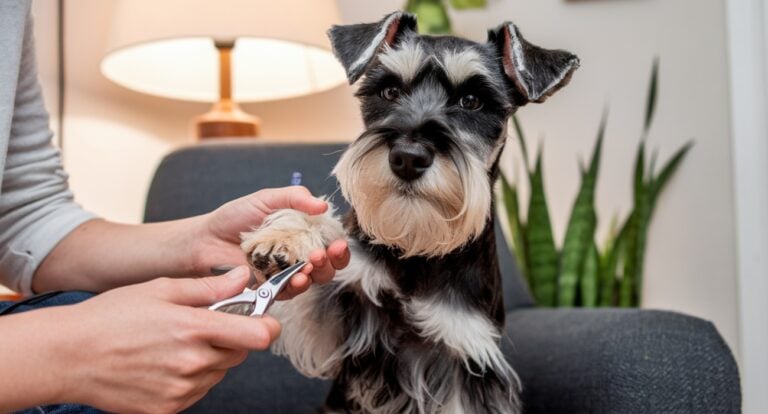
Jealousy shows up in clear ways. Here are the signs that prove your Schnauzer may be feeling possessive.
Your Schnauzer was your one and only. Then you brought home a baby, adopted another pet, or started dating someone new. Suddenly, your once perfect angel has transformed into a furry little drama queen who acts out at every opportunity.
Jealousy in dogs is real, and Schnauzers are masters at expressing it. These intelligent, stubborn little characters don’t hide their feelings well. They’ll make sure you know when they’re unhappy about sharing your attention. The good news? Once you recognize the signs, you can help your territorial terrier work through these big feelings.
1. The Physical Barrier Technique
Your Schnauzer has suddenly decided to become a furry wedge. Whenever you try to interact with another pet, person, or even hug a family member, there they are. Pushing themselves between you and the object of their concern. This isn’t accidental.
Body blocking is one of the most obvious signs of canine jealousy. Your Schnauzer is literally trying to separate you from whatever or whoever has stolen your attention. They might shove their snout into your hand, leap onto your lap when it’s occupied, or plant themselves firmly between your legs and the “threat.”
Some Schnauzers take this behavior to impressive extremes. They’ll practically climb you like a tree if it means reclaiming your focus. The behavior escalates when they sense you’re about to give attention to someone else. Watch how your dog positions themselves when you reach for another pet or lean in to kiss your partner.
When your Schnauzer transforms into a four-legged roadblock, they’re sending a crystal-clear message: “Excuse me, but I was here first.”
2. The Attention-Seeking Performance
Suddenly, your normally well-behaved Schnauzer has forgotten every trick they ever learned. Or have they? The moment you start interacting with someone else, your dog launches into an elaborate show. Barking, whining, bringing toys, doing unsolicited tricks, or engaging in deliberately naughty behavior.
This attention-seeking escalation is jealousy in action. Your clever Schnauzer knows exactly what gets your attention, whether positive or negative. They’d rather have you yelling at them for jumping on the couch than ignoring them while you cuddle the cat.
The timing is the giveaway here. If your Schnauzer only acts up when you’re busy with someone or something else, jealousy is likely the culprit. They might start barking at nothing, scratching at the door to go out (even though they just came in), or suddenly “finding” their squeakiest toy.
3. Aggressive Displays Toward the Rival
This one’s serious. Some jealous Schnauzers move beyond attention-seeking into territorial aggression. Growling, snapping, or showing teeth toward the person or pet receiving your attention indicates your dog sees them as competition.
Schnauzers were bred to be ratters and guard dogs, so they’ve got a protective streak a mile wide. When jealousy triggers this instinct, they may perceive the “rival” as a genuine threat to their position in the household. The aggression might be subtle at first (a low growl, a hard stare) but can escalate if not addressed.
Important distinction: Jealous aggression typically only appears in specific contexts (when you’re giving attention to the rival) and disappears when that trigger is removed. If your Schnauzer shows aggression in other situations too, you’re dealing with a broader behavioral issue that needs professional assessment.
Jealousy-driven aggression isn’t about being a “bad dog.” It’s about insecurity and resource guarding, where you are the resource.
4. Sulking and Withdrawal
Not all jealousy manifests as drama. Some Schnauzers go the opposite route: the silent treatment. Your typically social dog suddenly acts aloof. They retreat to another room, refuse to make eye contact, or turn their back on you with obvious attitude.
This passive-aggressive behavior is surprisingly sophisticated. Your Schnauzer is essentially saying, “Fine, if you’re going to ignore me, I’ll ignore you right back.” They might refuse treats from you, decline to play, or choose to sit with someone else instead.
The pouty behavior often continues even after the rival has left the scene. Your Schnauzer nurses their grudge, making you work to get back in their good graces. Some will even sigh dramatically or give you lingering sad looks from across the room.
5. Destructive Behavior in Your Absence
You come home to chaos. The trash is scattered, a shoe is destroyed, or mysterious “accidents” have appeared on the floor. Before you chalk it up to separation anxiety, consider the context. Did this happen after you spent the day with someone else? After a new pet joined the family?
Jealousy-motivated destruction is your Schnauzer’s way of expressing displeasure with recent developments. They’re not getting revenge (dogs don’t think that way), but they are experiencing stress about their changing position in your life. That stress manifests in destructive ways.
The behavior pattern matters here. If destruction only occurs following situations that trigger jealousy, that’s your clue. A Schnauzer might specifically target items that smell like the “rival” (the new baby’s toys, your partner’s belongings, the other pet’s bed).
6. Changes in Eating or Sleeping Patterns
Your Schnauzer has always been a champion eater and sleeper. Suddenly, they’re picking at their food or pacing at night instead of snoozing. Jealousy creates stress, and stress affects basic behaviors.
Some jealous Schnauzers go the opposite direction, stress eating or sleeping more to cope. Either extreme indicates emotional turmoil. You might notice your dog watching you constantly instead of napping, or refusing to eat unless you’re standing right there (when they normally eat independently).
These changes often correlate with the arrival of a new family member or pet, or increased attention to someone else. The shifts in routine disrupt your Schnauzer’s sense of security, manifesting in disrupted eating and sleeping patterns.
| Jealousy Sign | What It Looks Like | Severity Level | Action Needed |
|---|---|---|---|
| Physical Blocking | Pushing between you and others | Moderate | Redirect attention; teach “place” command |
| Attention Seeking | Excessive barking, tricks, mischief | Low to Moderate | Ignore unwanted behavior; reward calm behavior |
| Aggression | Growling, snapping, teeth showing | High | Immediate professional training intervention |
| Sulking | Withdrawal, ignoring, pouty behavior | Low | Give space; gradually rebuild positive interactions |
| Destructive Acts | Chewing, accidents, trash raiding | Moderate to High | Increase exercise; provide mental stimulation |
| Eating/Sleeping Changes | Loss of appetite, insomnia, lethargy | Moderate | Monitor closely; vet check if persistent |
7. Excessive Clinginess
Your independent Schnauzer has become your shadow. They follow you from room to room, panic when you close a door, and practically velcro themselves to your side. This anxious attachment often develops when a dog feels their position is threatened.
The clinginess intensifies around the source of jealousy. If you’re holding the baby, your Schnauzer is pressed against your legs. If your partner sits beside you, your dog immediately jumps up to claim the other side. They can’t relax unless they’re physically touching you or in your direct line of sight.
This behavior stems from insecurity. Your Schnauzer is trying to monopolize your presence because they fear losing access to you entirely. The more threatened they feel, the more desperately they cling. Some dogs will even try to follow their owners into the bathroom or whine anxiously outside closed doors.
When your independent Schnauzer becomes your constant companion, they’re not just being affectionate. They’re guarding their most precious resource: you.
Understanding the Root Cause
Jealousy in Schnauzers (and all dogs) isn’t about spite or pettiness. It’s rooted in resource guarding and social hierarchy. Your Schnauzer sees you as their most valuable resource, providing food, shelter, comfort, and entertainment. When someone or something threatens their access to that resource, their anxiety manifests as jealousy.
Schnauzers are particularly prone to this because of their breeding. These terriers were developed to work closely with one person, bonding intensely with their handler. That selective breeding created dogs with strong attachment tendencies and a need for clear social structure. Disruptions to that structure (new family members, other pets, lifestyle changes) create stress.
The good news? Jealousy is manageable. It requires patience, consistency, and often some creative problem solving, but it’s absolutely possible to help your Schnauzer feel secure again. Recognition is the first step, which you’ve already accomplished by learning these seven signs.
Managing jealousy successfully means:
- Maintaining routines as much as possible
- Ensuring your Schnauzer gets one on one time with you daily
- Gradually introducing rivals rather than forcing immediate acceptance
- Rewarding calm, non-jealous behavior with praise and treats
- Never punishing jealous displays (it increases anxiety)
- Providing adequate mental and physical stimulation
Some situations require professional help. If your Schnauzer’s jealousy involves aggression, or if your own interventions aren’t working, consult a certified dog behaviorist. They can develop a customized plan addressing your specific household dynamics.
The Schnauzer Personality Factor
Let’s be honest: Schnauzers are a lot of dog in a small to medium package. They’re intelligent, stubborn, vocal, and intensely loyal. These traits make them wonderful companions but also more challenging when behavioral issues crop up.
Their intelligence means they’re very aware of household dynamics and quick to notice when things change. Their stubbornness means they won’t simply accept changes without protest. Their vocal nature ensures you’ll definitely hear about their displeasure. And their intense loyalty creates those strong attachments that fuel jealousy in the first place.
Understanding your Schnauzer’s personality helps you approach jealousy with empathy rather than frustration. Your dog isn’t being difficult on purpose. They’re responding to perceived threats in the only ways they know how, using behaviors that have worked for them in the past.
Different Schnauzer varieties (Miniature, Standard, and Giant) may show slightly different jealousy expressions, but the core signs remain consistent. The smaller Miniature Schnauzers might rely more on vocal protests and attention-seeking, while larger Standards and Giants might use their size for physical blocking. All varieties share that characteristic Schnauzer determination, though.
Your Schnauzer’s jealousy might be frustrating, but it’s also a testament to how much they love you. These bearded little personalities don’t form casual bonds. When a Schnauzer loves, they love fiercely and completely. Learning to recognize and address their jealousy helps you honor that bond while maintaining harmony in your home. After all, there’s enough of your love to go around, even if your Schnauzer isn’t quite convinced yet.