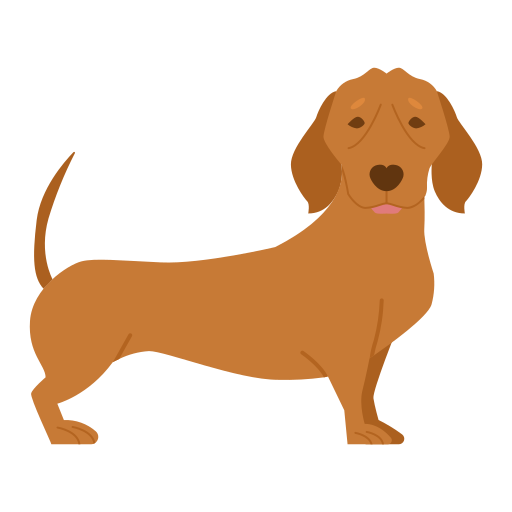
 Dachshund
 Ask any longtime dachshund owner which dog worries them most, and the honest answer is almost never the one that yelped.
A yelp gets you moving. A yelp gets keys off the hook and a vet on the phone before lunch.
The dachshunds who end up in real trouble are usually the stoic ones. They compensate quietly for months, shifting weight off the sore side, shortening their stride, quietly editing their own routine, and their people read every bit of it as slowing down or finally mellowing out.
That is the counterintuitive truth about joint problems in this breed: silence is the symptom, not the sound.
There’s a structural reason for it, too. Dachshunds carry a long spine over famously short legs thanks to chondrodystrophy, the same genetic quirk that gives them their shape and gives their cartilage a head start on wearing out. Hips, knees, elbows, and the discs stacked along that beautiful sausage back all take on loads they were never engineered for.
Below are seven signs, listed roughly in the order most owners miss them.
1. The Couch Suddenly Grew Six Inches
Nothing about the couch changed. The dog’s math did.
A dachshund who used to launch onto the sofa without breaking eye contact now pauses at the base of it. Maybe there’s a little stutter step. Maybe two false starts before the jump, or a decision to just lie on the rug instead and look wounded about it.
Owners almost universally file this under good dog, finally learning boundaries. It is almost never that.
Why the pause matters more than the landing
Jumping up loads the hips and stifles. Jumping down slams the shoulders and compresses the spine. A dog in early joint pain will usually quit the jump up first, because that’s the movement where they can feel the effort building before it happens.
A dog does not complain. A dog negotiates. Every skipped jump is a negotiation you were never invited to join.
Watch for the hesitation, not the failure. By the time your dachshund physically can’t make the jump, the problem has been running unsupervised for a while.
2. A Bunny Hop Where a Trot Used to Be
Healthy dachshunds move their back legs independently, one and then the other, like tiny pistons.
A dog with hip pain or a bad knee will start moving both hind legs together in a hop, especially when trotting or going up stairs. It looks weirdly cute. It is not cute.
Bunny hopping is a compensation pattern. Instead of asking one painful joint to take full weight during a stride, the dog splits the load across both and powers through in a single motion.
Where you’ll spot it first
Grass, honestly. Loose footing and a little speed will expose it long before a slow walk on tile does.
Film ten seconds on your phone from behind while your dachshund trots away from you. Slow the video down. Patterns you can’t see in real time are painfully obvious at half speed, and your vet will be thrilled you brought footage instead of a description.
3. Morning Stiffness That Disappears by Noon
This one earns an award for the most under-reported symptom in dog medicine.
Your dachshund gets up creaky, takes a few short, careful steps, then loosens up within ten or fifteen minutes and spends the rest of the day behaving normally. By the time you would have thought to mention it, everything looks fine.
That warm-up-and-improve pattern is textbook degenerative joint disease. Inflammatory fluid pools in the joint overnight, movement redistributes it, and the dog feels better temporarily.
Arthritis is a morning liar. It tells you everything you need to know in the first four minutes of the day, then spends the next twelve hours taking it back.
Cold snaps make it louder. If your dachshund is stiff on chilly mornings and springs out of bed in July, you have your answer.
4. Obsessive Licking in One Very Specific Spot
Dogs lick joints that hurt. They just do.
Look for a patch of fur over a wrist, an elbow, a hip, or the inside of a knee that’s damp, discolored, thinner than the surrounding coat, or stained a rusty pink from saliva. On a red or black dachshund, that rust color shows up beautifully.
The catch is that most owners find the licking annoying rather than informative, so it gets treated like a behavior problem. A cone goes on. The dog stops licking. The joint keeps degrading.
The tell within the tell
Chronic licking driven by pain tends to be repetitive and focused, aimed at the same square inch every time, often while the dog is settling down or resting.
Allergy licking is usually broader and involves the paws, the belly, and the face. Pain licking picks a target and stays loyal to it.
5. The Personality Change Nobody Connects to the Body
Dachshunds are opinionated by design. That’s the charm.
An opinionated dog in pain gets a new set of opinions, and they usually sound like this: grumbling when picked up a certain way, snapping at a kid who leans on their back end, retreating under a bed at odd hours, or losing interest in a toy they’ve loved for six years.
Sudden irritability in a middle-aged dachshund is a medical sign until proven otherwise. Behavior is often the very first system to change, because pain is exhausting and exhausted creatures have short fuses.
Pay particular attention to how your dog reacts to being lifted. Reaching under the chest and rear is comfortable for a healthy dachshund; a dog with spinal or hip involvement may tense, freeze, or turn their head toward your hands.
The dog who stops asking for the things they love is not being difficult. They are conserving something.
6. Sitting Like a Frog, Standing Like a Question Mark
Posture tells on a dog constantly, and dachshunds have two classics.
The first is the sloppy sit: instead of tucking both hind legs neatly underneath, the dog sits with one leg kicked out to the side, or with the whole back end sagging off center. Puppies do this and it means nothing. An adult dachshund who suddenly develops it is avoiding a joint angle that hurts.
The second is a subtle arch through the lower back while standing, sometimes with the head carried low and the tail held tight. That roached topline is a spine trying to unload pressure from a disc.
A quick at-home check
Ask your dog to sit and stand five times in a row while you watch from the side.
Look for slowness on the way down, a hind end that drops rather than folds, or a front end doing extra work to push the body upright. Any of those is worth a phone call.
7. Sound Effects You Didn’t Used to Hear
Joints get chatty when cartilage thins.
Soft clicks or pops when your dachshund stands up, a faint grinding you can feel more than hear if you rest a hand on the hip during movement, or a low grunt when they lie down: all of it is data.
Grunting deserves its own mention because it’s so easy to laugh off. Dachshunds are dramatic little creatures and everybody assumes the noise is personality. Sometimes it is. Sometimes it’s the sound a dog makes when settling their weight onto something inflamed.
The rule of thumb: new noises are worth investigating, old noises are worth mentioning at the next checkup. A pop your dog has had since age two is probably a benign ligament snapping over bone. A pop that started last month is not the same thing.
What to Do With Any of This
Bring specifics to your veterinarian, not vibes.
Note when the sign appears, how long it lasts, what surfaces make it worse, and whether rest helps or makes it stiffer. Video is worth more than any description you can write down, and joint problems are famously shy in exam rooms.
Weight management, controlled exercise, ramps instead of jumps, and traction on slick floors all buy your dachshund real time. So does catching the pattern in month two rather than month twenty.
Anything involving dragging back feet, a wobbly hind end, sudden refusal to move, or crying out with no clear trigger stops being a slow watch-and-wait situation. That’s an emergency in this breed, and it should be treated like one immediately.