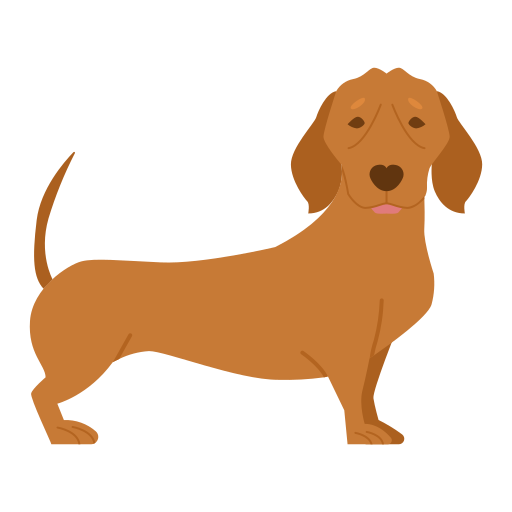
 Dachshund
 Two hundred and twenty million scent receptors sit inside that long, narrow nose, roughly forty times the number packed into yours.
That one number reframes the whole dog, doesn’t it?
Most people look at a dachshund and see a couch loaf with opinions, a comedy shape invented for birthday cards and sausage jokes. What they are actually looking at is purpose built equipment. The paddle feet, the barrel chest, the almost absurd ratio of body to leg: German breeders chose every one of those traits on purpose, because they needed a dog willing to crawl into a badger’s tunnel and argue with the badger.
None of that programming vanished when the breed moved indoors and discovered blankets.
It just got repurposed, usually at the expense of your flower beds.
1. Scent Tracking That Rivals a Bloodhound
Here is the part that surprises new owners: the nose is not a party trick. It is the primary interface between a dachshund and reality.
Sight comes second. Hearing comes second. Smell runs the show.
The instinct never got the memo
A badger den is pitch black and full of dead ends, so the dog that hunted them had to build a three dimensional map using scent alone. Your dachshund still does this. The difference is that the tunnel is now your kitchen, and the badger is a crumb of cheddar that fell behind the fridge in March.
Watch the head drop and the ears swing forward on a walk. That is not stubbornness. That is a working animal clocking in.
A dachshund who ignores you on a scent trail is not being defiant. She simply cannot hear you over the volume of what her nose is telling her.
Why your walks take forever
Twenty feet of sidewalk can hold an hour of information. Let the sniffing happen on at least part of every outing, because scent work tires a dachshund faster than distance does.
Ten minutes of nosework in the backyard beats a mile of forced marching. Genuinely.
2. Excavation Engineering
Ask any dachshund owner about their lawn and watch their eye twitch.
These dogs do not dig the way other breeds dig. Retrievers scratch. Terriers scrabble. A dachshund excavates with a rhythm, front paws throwing dirt back under the body while the rear legs kick it clear, a bucket brigade of one.
That loose skin around the neck? Protection, so a badger’s claws slid off instead of catching. The paddle shaped front feet turn outward for a reason, and the reason is displacement of soil.
The couch cushion tell
Even dachshunds who have never seen dirt in their lives will burrow into blankets, laundry piles, and the exact spot where you were sitting.
Nobody teaches this. It arrives fully installed.
Give them a designated dig zone if you can, a sandbox or a raised bed of soft soil with a few treats buried inside. Redirection works far better than correction, because you are not fighting a bad habit. You are fighting nine hundred years of breeding.
3. A Bark Built for Broadcasting
Sound travels strangely through packed earth, which means a hunter standing above ground needed to know exactly where his dog had stopped, sometimes under six feet of soil.
Solution: give the dog a chest cavity out of proportion to its size and a bark that carries like a fire alarm.
That deep, resonant, weirdly enormous voice coming out of an eleven pound animal is not an accident of personality. It is acoustic design.
Reading the language
Most dachshunds run several distinct vocalizations, and once you learn them, you can tell a great deal from another room.
The short repeated alert bark means something moved outside. The low sustained bay means something is here and I have found it. The yodel style howl usually means loneliness or excitement, and the impatient single yip is almost always about food.
Long before doorbells existed, this bark was a location beacon. Complaining that a dachshund barks is a bit like complaining that a smoke detector makes noise.
4. Problem Solving Bordering on Lock Picking
Hunting alone, underground, out of earshot means no waiting for instructions. Independent decision making was the whole job description.
Which is why the breed scores oddly on obedience rankings while running circles around those same lists in practice.
A dachshund is not slow to learn. A dachshund learns quickly and then decides whether compliance is worth it.
The gate, the latch, the zipper
Owners trade stories about this constantly. Crate doors nudged open from the inside. Baby gates defeated by leverage. Trash cans with pedal lids operated on purpose, repeatedly, with the enthusiasm of a dog who has cracked a safe.
They test hypotheses. Push, fail, push differently, repeat.
Puzzle feeders and snuffle mats are not enrichment fluff for this breed. They are the closest thing you can offer to the original job, and a bored dachshund with an unoccupied brain will absolutely invent a project of its own choosing.
5. Reading You Like a Book
Small dogs living closely with humans for centuries developed a specialty that has nothing to do with badgers.
They read us. Constantly. Obsessively.
Your dachshund knows the sound of your car three houses away, knows which shoes mean work and which mean walk, and knows the exact shift in your voice that precedes a bath.
Velcro dogs by design
That famous shadowing behavior gets labeled clinginess, but it is closer to surveillance. Staying near you means better data.
They also pick up emotional weather with uncomfortable accuracy. Cry once and you will find a warm loaf pressed against your leg, uninvited and unmoving.
This sensitivity cuts both ways. Harsh training methods land hard on a breed this attuned, and a dachshund who feels unfairly scolded will remember it far longer than you expect.
6. Swimming, Which Nobody Sees Coming
Set aside the shape for a moment and look at the mechanics.
Deep chest for lung capacity. Webbed front feet. A rudder of a tail. Strong shoulders driving that paddle stroke.
Plenty of dachshunds swim well, and some love it with genuine abandon.
Cautious enthusiasm
The catch is that back, and the risk of injury from awkward entry and exit rather than from swimming itself. Ramps beat stairs. A life vest is smart in open water, especially since a soaked dachshund tires faster than a leggier dog.
Warm water hydrotherapy is used regularly in rehab for exactly this reason: the body moves freely with almost no spinal compression.
Water is one of the few places where a dachshund’s proportions stop being a liability and start being an advantage.
7. Speed You Will Underestimate Once
Somebody, at some point, drops a leash.
Then they discover that a healthy adult dachshund hits somewhere between fifteen and twenty miles per hour, and that those little legs turn over at a rate that makes them nearly impossible to catch in open ground.
Built for bursts
Sprinting matters more than endurance in this breed. The muscle profile favors short explosive efforts, which is why wiener dog races exist and why they are genuinely competitive events rather than novelty acts.
Agility work suits them too, within reason. Low jumps, tunnels (obviously tunnels), weave poles at a sensible height.
Combine that speed with a nose that has just locked onto something interesting and you get the single most common emergency in dachshund ownership: a dog moving at full tilt, deaf to the world, following a trail that means far more to her than your voice does.
Train a rock solid recall early, and never trust an unfenced yard.