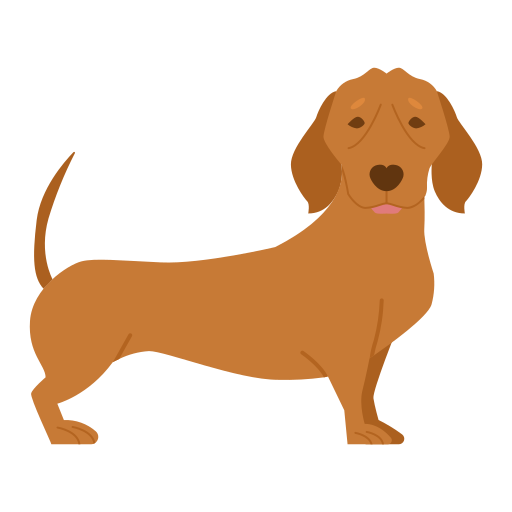
 Dachshund
 Watch closely. Give a dachshund thirty seconds alone with a closed bedroom door and a treat on the other side, and you will start to understand why owners of this breed keep insisting their dog is running some kind of long game.
Dachshund intelligence gets a bad rap. Flip through most breed rankings and you will find them sitting somewhere in the middle of the pack, well below the border collies and poodles of the world, filed under stubborn.
But those rankings measure one narrow thing: how fast a dog obeys a command it has just learned.
That is obedience. It is not the same as brains.
Dachshunds were bred to crawl into a dark tunnel, alone, with no human anywhere nearby, and make life or death decisions about a badger that outweighed them and wanted them dead. That job did not reward dogs who waited for instructions. It rewarded dogs who could think.
Here are seven reasons the little hunter napping under your blanket is smarter than the rankings give him credit for.
1. They Were Built to Solve Problems Without You
Go back to the original job description. A badger den is a maze of tight, pitch black tunnels with dead ends, sharp turns, and an extremely angry occupant somewhere at the bottom.
The dachshund went in alone.
No handler yelling directions. No line of sight. Nothing but a dog making a hundred small judgment calls in the dark.
Why That Matters at Home
That independence never got bred out. It just moved from the burrow to your living room.
When your dachshund ignores you calling him off the couch, he is not failing to understand. He is weighing your request against the couch and finding your request lacking.
A dog bred to make decisions alone in the dark will always take a second to decide whether your decision is better than his.
2. Their Food Motivation Is Basically Applied Engineering
Watch a dachshund work on a puzzle feeder. Really watch, the whole time, not just the first ten seconds.
Most dogs paw at it. Dachshunds test it.
Nose. Paw. Different paw. Flip it over. Push it against the wall so it stops rolling away. Try the nose again now that the angle has changed.
That is iteration. It is a dog running experiments and adjusting based on the result, which is a lot more impressive than a dog who sits when you say sit.
The frustrating part for owners is that the same brain that solves the puzzle feeder also solves the trash can lid, the baby gate, and the "dog proof" latch on the pantry.
3. They Read People With Uncomfortable Accuracy
Dachshunds are staggeringly good at figuring out which human in the house is the soft touch.
They know who drops food. They know who caves at the whining. They know which visitor is nervous around dogs and which one has treats in a coat pocket.
And they adjust their behavior per person, which is the part people underestimate.
The Two Household Rules Problem
Plenty of dachshund owners discover their dog behaves beautifully for one partner and like a tiny anarchist for the other. That is not inconsistency in the dog.
That is the dog correctly identifying two different sets of enforceable rules and optimizing for each.
Any dog can learn a rule. A dachshund learns who actually enforces it.
4. They Have Absurd Spatial Awareness for Their Shape
Consider what a dachshund is actually working with: a long spine, short legs, and a center of gravity that makes no structural sense.
Now watch one navigate a crowded room at speed without clipping a single table leg.
They map space constantly. They know which gap under the fence they fit through and which one they do not, and they know it before they try, which is more than can be said for a lot of larger breeds.
Burrowing dogs need this. Getting stuck underground is fatal, so the breed developed a sharp sense of its own dimensions relative to the hole in front of it.
Your dachshund is doing that math every time he wedges himself behind the sofa cushions.
5. Their Stubbornness Is Actually Risk Assessment
Here is the reframe that changes how you see the breed.
A dachshund who refuses to walk down the icy driveway is not being difficult. He has evaluated the surface, considered his own long unstable frame, and decided the risk is not worth it.
He is usually right.
Stubborn Versus Strategic
The classic dachshund standoff, where the dog plants all four feet and simply declines, is a negotiation tactic. He is waiting to see what you offer next.
Most owners escalate. They repeat the command louder, then produce a treat, then eventually pick the dog up.
The dog has now learned that refusing produces a treat or a lift, and he will run that same play tomorrow, because it worked.
Every time you negotiate with a dachshund, you are teaching him that negotiating works.
6. They Have a Memory That Holds Grudges and Maps
Dachshunds remember specifics with an accuracy that borders on unsettling.
They remember the exact tree where the squirrel was three months ago. They remember which pocket of which bag held the treats. They remember the route to the park well enough to pull toward the correct turn.
They also remember the vet’s parking lot, which is why the sulking often starts before the car has stopped moving.
Scent hounds are built for this. The breed’s nose collects an enormous amount of information, and the brain files it geographically, layering scent memory over physical space into something like a working map of the neighborhood.
That is not a small cognitive feat.
The Downside of a Long Memory
It cuts both ways. One bad experience with a grooming table, one startling encounter with a bigger dog, and a dachshund can hold that association for years.
Which means patient, gradual introductions matter more with this breed than with a dog who forgets by Thursday.
7. They Train You Back
The most convincing evidence of dachshund intelligence is not what they learn. It is what they teach.
Somewhere in your house right now there is a rule the dog installed.
Maybe you sit on a specific cushion because that is his spot. Maybe you keep a blanket on the couch purely so he can burrow into it. Maybe there is a particular bark that gets you off your chair, and you have never once questioned why you obey it.
He tested that behavior, got a result, and repeated the version that worked.
Two Way Training
Owners tend to think of training as a one direction transaction. The dachshund does not share that assumption.
He is watching your patterns, noting what produces food, attention, warmth, and door access, then reproducing whatever gets him there fastest.
Every household with a dachshund in it has quietly reorganized itself around the dachshund, and almost nobody notices it happening.
Working With That Brain Instead of Against It
None of this means dachshunds are impossible to train. It means the standard approach, repetition plus authority, lands poorly on a dog bred to question authority.
What works instead is making your idea look like the better option.
Keep sessions short, because a bored dachshund checks out fast and a checked out dachshund is unreachable. Five focused minutes beats twenty repetitive ones.
Pay well. This is a dog who does cost benefit analysis, so the reward needs to actually beat whatever he was planning to do instead.
Give the brain a job. Puzzle feeders, scent games, a treat hidden under one of three cups, snuffle mats, anything that lets him work a problem. A dachshund with nothing to solve will invent something to solve, and you will not like his choice of project.
Stay consistent across every human in the house, because he is absolutely tracking the difference.
And build in real digging opportunities where you can, a sandbox or a designated corner of the yard, since that drive is not going anywhere and it will surface in your flowerbeds otherwise.
The dogs at the top of those obedience rankings are brilliant at doing what they are told. Dachshunds are brilliant at deciding what to do.
Different skill. Arguably the harder one.