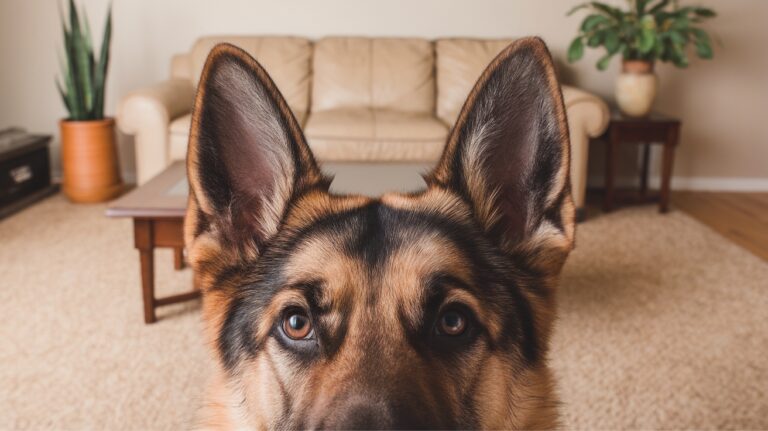
Unsure if your shepherd gets enough exercise? These clear signs reveal whether they need more activity or if their daily routine is already just right.
German Shepherds don’t do well with a slow life. They were bred to herd, protect, track, and work alongside humans for hours at a time, and that drive didn’t disappear just because they moved into your house.
When a GSD doesn’t get enough exercise, they don’t just get a little restless. They unravel. Here are the signs your dog is desperately waving a flag and begging you to take them outside.
1. They’re Destroying Everything in Sight
Let’s start with the obvious one. If your GSD has decided that your couch cushions, baseboards, or favorite pair of shoes are chew toys, exercise deprivation is almost always a top suspect.
Chewing and destruction aren’t signs of a “bad dog.” They’re signs of a dog with too much energy and not enough outlet for it.
A dog that tears things apart isn’t being rebellious. It’s being resourceful with the energy it has nowhere else to put.
German Shepherds are problem solvers by nature. If the problem is “I have all this pent-up energy,” they will absolutely solve it by redecorating your home without your permission.
2. They Can’t Seem to Settle Down
You’ve probably noticed your GSD pacing, circling, or simply refusing to lie down and relax. It’s exhausting to watch, honestly.
A dog that can’t settle is a dog whose nervous system is still in “go mode.” Exercise is one of the most effective ways to flip that switch off.
Restlessness is your dog’s body telling you it hasn’t been pushed enough that day. It’s not a personality flaw, it’s a physical need that hasn’t been met.
3. They’re Barking (Way) More Than Usual)
Excessive barking in a German Shepherd can mean a lot of things. But when it ramps up suddenly or becomes a constant soundtrack in your home, lack of exercise is one of the first things to rule out.
Barking is stimulating. For a dog that isn’t getting mental and physical stimulation elsewhere, it becomes its own reward.
If your dog is narrating every passing car, squirrel, and leaf, they may simply be looking for something, anything, to engage with.
4. They’re Acting Out Toward Other Dogs or People
A well-exercised GSD is typically confident, calm, and socially appropriate. An under-exercised one can become reactive, snappy, or just plain rude at the dog park.
This isn’t aggression in the clinical sense most of the time. It’s frustration leaking out sideways.
Think of it like this: if you went weeks without physical activity and then got dropped into a crowded, stimulating environment, you might not be your best self either. Your dog is no different.
5. They’ve Started Following You Everywhere (More Than Usual)
GSDs are known for being velcro dogs. They love their people and they like to know where you are. That part is totally normal.
But when the following becomes frantic, anxious, or obsessive, something has tipped out of balance. Under-stimulated dogs often fixate on their owners as the only source of entertainment and comfort they have.
If your GSD is glued to your ankles every second of the day and seems distressed when you leave the room, exercise (along with enrichment) can make a significant difference.
6. They’re Gaining Weight or Losing Muscle Tone
This one is less about behavior and more about what you can actually see and feel. German Shepherds are naturally lean, muscular dogs, and a GSD that isn’t moving enough will start to look and feel different physically.
Weight gain is the more obvious sign. But muscle atrophy, the subtle softening of a dog that used to feel solid and athletic, is equally important to notice.
A GSD’s body is built for work. When it isn’t working, you’ll start to see it in the way they carry themselves.
Beyond appearance, inactivity in a breed this size and this athletic puts real strain on joints, metabolism, and overall health. This isn’t just a cosmetic concern.
7. They’re Having Trouble Sleeping Through the Night
A properly tired German Shepherd will sleep hard. That deep, twitchy, dreaming kind of sleep that tells you their brain and body are fully spent.
If your GSD is restless at night, waking you up repeatedly, or seems to operate on a different timezone than the rest of the household, the math is pretty simple.
They have energy left over. Energy that should have been spent on a trail, at a training session, or chasing a ball until their tongue dragged on the ground. Nighttime restlessness is often just daytime under-activity showing up at the worst possible time.
So How Much Exercise Does a GSD Actually Need?
Most adult German Shepherds need a minimum of 1.5 to 2 hours of real physical activity per day. Not just a walk around the block. We’re talking fetch, running, hiking, swimming, agility work, or structured play.
Mental stimulation matters just as much as physical exercise. A dog that has to think (through training, puzzle feeders, or nose work) will tire out faster and behave better than one that only gets cardio.
Puppies and seniors have different needs, of course. But for a healthy adult GSD in their prime, “a little walk” is not going to cut it.
The good news? Most of these behaviors improve quickly once a consistent exercise routine is in place. German Shepherds respond fast when their needs are being met. Within a week or two of stepping things up, you’ll likely notice a calmer, happier, and significantly le