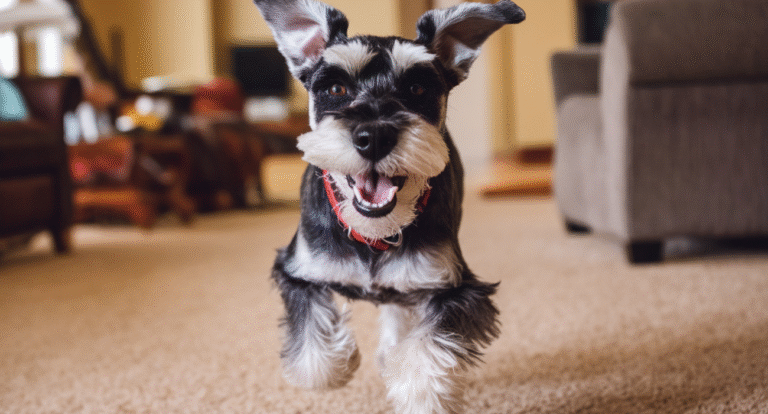
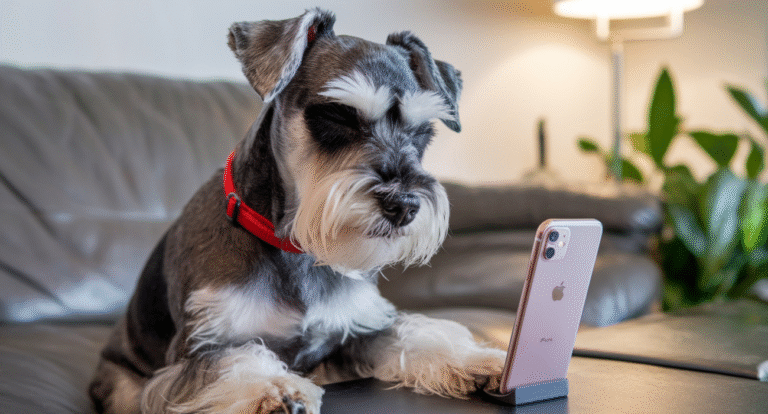
Wondering why your Schnauzer seems distant lately? Try this simple fix for better communication and a more loving, attentive companion.
You’re standing in your living room, treats in hand, calling your Schnauzer’s name with increasing desperation. Meanwhile, Mr. Whiskers (yes, you named your dog Mr. Whiskers) is staring intently at a dust particle floating through a sunbeam, completely oblivious to your existence. Sound familiar? You’re not alone, and no, your Schnauzer isn’t plotting world domination. Well, probably not.
The truth is, Schnauzers are wickedly smart dogs with independent streaks wider than the Grand Canyon. When they ignore you, it’s rarely defiance and almost always something far more fixable. Let’s dive into why your bearded buddy treats your commands like spam emails and, more importantly, how to become the most interesting thing in their world.
The Schnauzer Brain: Built Different
Schnauzers come in three sizes (Miniature, Standard, and Giant), but they all share one critical trait: an oversized brain packed into that distinctive bearded face. These dogs were developed in Germany to be farm dogs and ratters, which required them to work independently and make quick decisions without human guidance.
This history matters because it means your Schnauzer is genetically programmed to think for themselves. Unlike breeds that were created to follow commands without question, Schnauzers evaluate whether your request makes sense to them. They’re not being difficult; they’re doing exactly what centuries of selective breeding designed them to do.
The Intelligence Problem
Smart dogs are wonderful until you realize they’re smart enough to figure out your patterns, predict your behavior, and occasionally outsmart you entirely. A Schnauzer who ignores you has often calculated that:
- The consequence of ignoring you is minimal or nonexistent
- What they’re currently doing is more rewarding than listening
- Your command doesn’t benefit them in any tangible way
- They can get away with it (because they usually do)
This isn’t disrespect. It’s cost benefit analysis, and your Schnauzer is an expert accountant.
Why Your Commands Fall on Furry Ears
Let’s get brutally honest about the most common reasons Schnauzers tune out their owners. These aren’t character flaws in your dog; they’re communication breakdowns that you have the power to fix.
You’re Boring (Sorry, But It’s True)
Imagine someone asking you to file spreadsheets while Netflix is playing in the background. That’s what your recall command feels like when your Schnauzer is sniffing something fascinating. You’re competing with an entire sensory world of smells, sounds, and sights, and “Come here right now!” doesn’t exactly light up the dopamine receptors.
Dogs learn through association and consequence. If calling your Schnauzer usually results in something neutral or negative (bath time, leaving the park, end of playtime), they learn that responding to their name is a raw deal. You’ve accidentally taught them that ignoring you is the smarter choice.
Inconsistency Is Your Enemy
Here’s where most Schnauzer owners sabotage themselves without realizing it. You enforce rules on Tuesday, ignore them on Thursday, and then wonder why Saturday looks like complete chaos. Schnauzers are pattern recognition machines, and when your patterns are unpredictable, they default to doing whatever they want.
Your Schnauzer isn’t being stubborn. They’re being logical. If a command sometimes matters and sometimes doesn’t, the rational choice is to treat all commands as optional until proven otherwise.
Consider this scenario: You tell your Schnauzer “Off!” when they jump on the couch. Sometimes you mean it, so they get down. Other times you’re tired and don’t enforce it, so they stay. You’ve just taught them that “Off!” is merely a suggestion, a opening bid in a negotiation rather than an actual rule.
The Motivation Factor
Let’s talk about what actually motivates a Schnauzer, because it’s probably not what you think. Many owners operate under the assumption that their dog should listen out of love, respect, or some Disney movie understanding of loyalty. Meanwhile, your Schnauzer is thinking, “What’s in it for me?”
| Weak Motivator | Why It Fails | Strong Motivator | Why It Works |
|---|---|---|---|
| Your verbal praise alone | Schnauzers aren’t typically praise-driven | High value treats (cheese, chicken) | Immediate, tangible reward |
| Petting when they’re overstimulated | Touch can be annoying when they’re excited | Brief play session with favorite toy | Engages their prey drive |
| Stern voice and disappointment | They don’t actually feel guilty | Release to go do what they want | Freedom as a reward |
| Repeating commands louder | They heard you the first time | Unpredictable reward schedule | Creates eager anticipation |
The Simple Fix That Actually Works
Ready for the good news? Transforming your Schnauzer from a selective listener into an attentive companion doesn’t require months of expensive training classes. It requires understanding what makes them tick and adjusting your approach accordingly.
Make Yourself More Interesting Than Everything Else
This is the fundamental principle. Your Schnauzer ignores you because something else has captured their attention more effectively. Your job is to become the most exciting, unpredictable, and rewarding thing in their environment.
Start carrying treats everywhere. Not regular kibble, but the good stuff. We’re talking small pieces of cheese, hot dogs, chicken, or whatever makes your Schnauzer lose their composure with desire. Every single time they check in with you voluntarily (a glance, coming near you, responding to their name), mark it with an enthusiastic “Yes!” and deliver a reward.
You’re not bribing them. You’re establishing yourself as a slot machine that occasionally pays out jackpots, which is infinitely more compelling than a vending machine that always dispenses the same mediocre snack.
The Name Game Revolution
Most Schnauzers have learned that their name means absolutely nothing. You say “Bella” two hundred times a day as background noise, so Bella has learned to tune it out completely. Time to rehabilitate that name.
For the next two weeks, only say your Schnauzer’s name when you have something genuinely rewarding to offer. Call their name once, and when they look at you, immediately provide something wonderful (treat, toy, freedom to sniff something interesting). If they don’t respond within two seconds, do not repeat yourself. Instead, make a weird noise, move unpredictably, or create curiosity that makes them check in with you.
Your Schnauzer’s name should become a promise, not a threat. When they hear it, they should think “Something awesome is about to happen” rather than “Here comes another demand I can safely ignore.”
Stop Negotiating, Start Following Through
This might be the hardest fix because it requires changing your behavior more than your dog’s. Every single command you give must be followed through to completion, or you shouldn’t give it in the first place.
Think before you speak. Are you actually going to enforce “Come” right now, or are you just hoping your Schnauzer cooperates? If you’re not prepared to physically guide them through the behavior (using a leash, going to get them, or making compliance inevitable), don’t issue the command. Empty threats are worse than silence because they actively teach your dog that your words are meaningless.
When you do give a command, you have two options: the Schnauzer complies, or you calmly and immediately make compliance happen. There is no third option where they ignore you and life continues as normal.
Training Tactics for the Schnauzer Brain
Understanding breed specific quirks makes training exponentially easier. Schnauzers respond particularly well to certain approaches that might not work as effectively with other breeds.
Use Their Independence Against Them
Schnauzers value autonomy, so use freedom as a reward. Practice recalls in a safe area where your Schnauzer wants to explore. Call them to you, reward generously, then immediately release them with “Go play!” or “Go sniff!” They learn that coming when called doesn’t end the fun; it’s a brief interruption that leads to more freedom.
This is psychologically brilliant because it removes the punishment aspect from recalls. Your Schnauzer no longer thinks “If I go to them, playtime ends.” Instead, they think “If I check in quickly, I get a treat AND permission to continue doing what I want.”
Incorporate Problem Solving
Remember, your Schnauzer’s brain craves mental stimulation. Training sessions that feel like puzzles or games will hold their attention far better than repetitive drilling. Teach new tricks regularly, even silly ones. Hide treats and have them “find it.” Practice commands in new locations with different distractions.
A mentally tired Schnauzer is far more biddable than a bored one. When their brain is engaged and satisfied, they’re much more likely to check in with you and respond to direction.
The Premack Principle in Action
This fancy term describes a simple concept: a more desirable activity can reinforce a less desirable one. In practical terms, your Schnauzer has to do what you want before they get to do what they want.
Want to sniff that telephone pole? Great! First, sit when asked. Want to greet that other dog? Excellent! First, make eye contact with me. Want dinner? Perfect! First, wait at the door instead of barging through.
Every single thing your Schnauzer wants becomes an opportunity to reinforce listening to you. You control access to all resources, which makes you inherently valuable and worth paying attention to.
The Reality Check You Need
Let’s address the elephant in the room: some Schnauzer owners will read this entire article and still not implement these strategies. Why? Because it requires consistency, patience, and effort. It’s easier to complain that your Schnauzer is stubborn than to admit you’ve been inadvertently training them to ignore you.
The beautiful truth is that Schnauzers are incredibly trainable when you speak their language. They’re not Golden Retrievers who live to please you, and that’s okay. They’re independent thinkers who need to see the value in cooperation, and once they do, they’re loyal, responsive, and utterly devoted companions.
Your Schnauzer isn’t ignoring you because they’re defective or disrespectful. They’re ignoring you because, up until now, listening hasn’t been worth their while. Change that equation, and you’ll change everything.
Your Action Plan Starting Today
Here’s your action plan for the next 48 hours:
- Immediately Start: Carrying amazing treats everywhere. Rewarding every voluntary check in with you. Only saying your dog’s name when you have something good to offer.
- Immediately Stop: Repeating commands multiple times. Giving commands you won’t enforce. Using your dog’s name as background noise. Calling your dog for things they dislike (baths, nail trims, leaving the park) without serious counterconditioning first.
- This Week’s Focus: Make yourself unpredictable and interesting. Practice name recognition in low distraction environments. Follow through on every single command you give, or don’t give commands at all. Use life rewards (access to things they want) as training opportunities.
Your Schnauzer has been telling you exactly what they need; you just needed to learn their language. They’re not ignoring you out of spite. They’re responding rationally to the training environment you’ve created, even if that wasn’t your intention. The fix really is simple, but simple doesn’t mean effortless. It means clear, consistent, and strategic.
Now go transform that selective listener into your most attentive companion. Your Schnauzer is ready when you are.