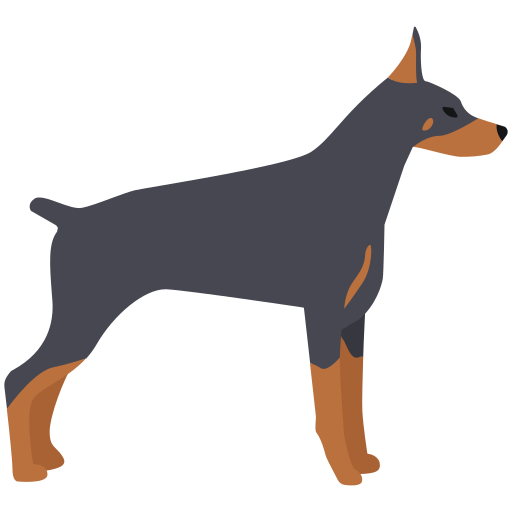
 Doberman
 Karl Friedrich Louis Dobermann, the German tax collector who created this breed in the 1890s, wanted a dog intimidating enough to keep angry debtors away from his coin bag on collection day.
What he accidentally engineered was a 75 pound animal that has enormous trouble falling asleep unless some part of its body is physically touching a human.
That contradiction is the whole breed in one sentence. The silhouette says keep your distance. The dog itself says scoot over, I need half that pillow.
New owners discover this within about 48 hours. Strangers at the park take considerably longer, and plenty of them never figure it out at all.
Below are five reasons this breed tends to take up permanent residence in your chest cavity, usually before you’ve finished puppy proofing the kitchen.
1. They Bond Like It Is a Full Time Position
Lots of dogs love their families. Dobermans approach it more like a career with mandatory overtime.
The Velcro Reputation Is Completely Earned
You will not be alone in the bathroom again. That is not a joke, and it is not a training failure.
This breed was developed to work in close partnership with one handler, and that wiring never went away. A Doberman wants to know where you are, what you are doing, and whether the thing you are doing requires supervision.
Cooking dinner? Supervised. Folding laundry? Supervised, and possibly sabotaged.
They will sleep with their spine against your leg. They will follow you from room to room and then sigh dramatically when you get up again after only nine minutes.
A Doberman does not consider the couch to be furniture. A Doberman considers the couch to be a shared bed that happens to be located in the living room.
Devotion Comes With a Bill
Here is the honest part of the sales pitch, because the intensity cuts both ways.
A dog that bonds this hard does not handle being left alone for ten hours a day. Separation anxiety shows up in this breed more often than in most, and it can get genuinely difficult if nobody addresses it early.
Crate training, gradual departures, and a job to do all help enormously. Ignoring it does not.
The devotion is the whole point, though. Nobody adopts a Doberman hoping for an aloof roommate who tolerates them politely.
2. That Brain Never Actually Powers Down
Dobermans consistently land in the top five of canine intelligence rankings, sharing space with Border Collies and Poodles.
Living with that is thrilling and occasionally exhausting.
Training Starts Feeling Like a Conversation
Most breeds learn commands. Dobermans learn patterns, which is a very different experience.
Your dog will notice that you always grab the leash after you put on a specific pair of shoes. Your dog will then start losing composure at the sight of those shoes, regardless of whether a walk was on the agenda.
They pick up new cues fast, often within a handful of repetitions, and they remember them for years.
The flip side: they learn the things you did not mean to teach with equal speed. Give in to counter surfing once and you have now established a policy.
Boredom Becomes a Renovation Project
An under stimulated Doberman does not simply lie around feeling bored. It goes looking for a project.
Sometimes the project is a baseboard. Sometimes it is figuring out how the pantry door works, which they can and will do.
Fifteen minutes of scent work or trick training drains this dog more thoroughly than a mile of walking. Puzzle feeders help. So does teaching genuinely useless tricks, because they seem to enjoy the mental exercise for its own sake.
Physical exercise builds a tired Doberman. Mental exercise builds a satisfied one. The difference shows up in your baseboards.
3. There Is an Absolute Clown Behind That Serious Face
Movies gave this breed a permanent villain role. The reality is closer to a stand up comedian in a very sharp suit.
The Lean
Dobermans lean. Full body weight, no warning, straight into your shins.
It reads as affection but it started as a working behavior, a way of maintaining physical contact with a handler while staying alert. Now it mostly functions as a way to knock over a distracted human holding coffee.
Some of them escalate to what owners affectionately call the sit. Your dog reverses toward you, locates your lap, and lowers itself down as though it weighs eleven pounds.
Correcting this is possible. Almost nobody bothers.
Zoomies at Genuinely Alarming Speed
A Doberman running at full tilt hits roughly 30 miles per hour, and they enjoy demonstrating this indoors.
The classic version arrives after a bath: ears pinned, back arched, four laps of the house, followed by a hard stop and direct eye contact.
They also talk. Not barking, exactly, but a whole vocabulary of groans, grumbles, and complaints delivered when you have wronged them in some minor way.
Anyone expecting a stoic guardian is going to be pleasantly confused.
4. The Protection Instinct Comes With a Filter
Here is what surprises people who have only encountered the stereotype.
They Read the Room Before They React
A well bred, well socialized Doberman is discerning rather than reactive. This breed was designed to assess a situation and respond appropriately, not to go off like a car alarm at every passing skateboard.
Your dog notices the mail carrier and does nothing, because the mail carrier comes every day. Your dog notices somebody lingering by the car at 11pm and adjusts its posture without making a sound.
That quiet shift is more effective than barking ever was.
The deterrent value is largely visual anyway. Very few people approach a house with a Doberman standing in the window, and the dog does not have to lift a paw for that to work.
Socialization Is Not Optional
None of the above happens automatically. A Doberman that never met strangers, children, or other dogs during its first year is a different animal entirely.
The genetics give you potential. The first eighteen months determine what that potential turns into.
Good breeders matter here more than almost anywhere else, because temperament is heritable and nervous parents tend to produce nervous puppies.
5. They Grow Into Something Softer Than You Expected
Puppyhood with this breed is a lot. Adolescence, roughly eight to eighteen months, is frequently worse.
Then something shifts.
The Adult Dog Is a Genuine Partner
Somewhere around two or three, most Dobermans settle into a calm, deeply steady version of themselves.
The frantic energy organizes into focus. The dog that could not stop moving now naps for four hours and gets up when you get up.
You end up with an animal that anticipates your routine, matches your pace on a walk without being asked, and seems to track your mood with slightly unsettling accuracy.
Owners describe it as having a shadow with opinions.
The Gray Muzzle Years Hit Hard
Dobermans typically live ten to twelve years, and that number is the one real cruelty of the breed.
The gray creeps into the muzzle around seven. The zoomies get shorter and less frequent. The lean stays exactly the same.
Anyone who has loved a Doberman will tell you the same thing: the years are not enough, and you would sign up for them again immediately.
That is the trade. Intense devotion, a brain that requires management, a body that ages faster than you want, and roughly a decade of a dog who genuinely cannot relax unless it can feel you breathing.
Which is why people who own one Doberman almost never stop at one.