From fun party tricks to useful skills, these impressive moves can be taught today and will leave your German Shepherd eager to show off.
Your German Shepherd is probably smarter than some people you know. These dogs consistently rank in the top three most intelligent breeds, and they have the problem-solving skills to prove it. But intelligence without direction is like having a Ferrari with no gas. Your GSD needs mental challenges the way other dogs need belly rubs.
The beautiful part? German Shepherds are incredibly trainable, which means you can teach them tricks that range from practical to absolutely jaw-dropping. We’re not talking about boring old “shake hands” here. These are tricks that will make strangers stop and ask if your dog is secretly training for the circus. Ready to unlock your dog’s full potential?
1. The Tactical Tidy-Up (Cleaning Up Toys)
Teaching your German Shepherd to clean up their own toys is possibly the most practical trick on this list, and yes, it’s absolutely as amazing as it sounds. This trick combines multiple skills: identifying objects, picking them up, carrying them, and dropping them in a specific location. It’s like a cognitive workout wrapped in helpfulness.
Start with a sturdy toy box or basket that won’t tip over easily. German Shepherds are enthusiastic learners, which sometimes means enthusiastic crashes into furniture. Begin by rewarding your dog for simply touching a toy with their nose or mouth. Then progress to picking it up. Once they’ve got that down, hold the toy box near them and reward them for dropping the toy inside.
The magic happens when you gradually increase the distance between your dog and the toy box. Consistency is everything here. Use the same command every time (try “clean up” or “tidy”) and celebrate every success like they’ve just won an Olympic medal. Within a week or two, you’ll have a dog that actually helps with household chores.
Training a German Shepherd isn’t about dominance or being the “alpha.” It’s about building a partnership where your dog genuinely wants to work with you because it’s rewarding and fun.
2. The Directed Retrieve (Fetching Specific Items by Name)
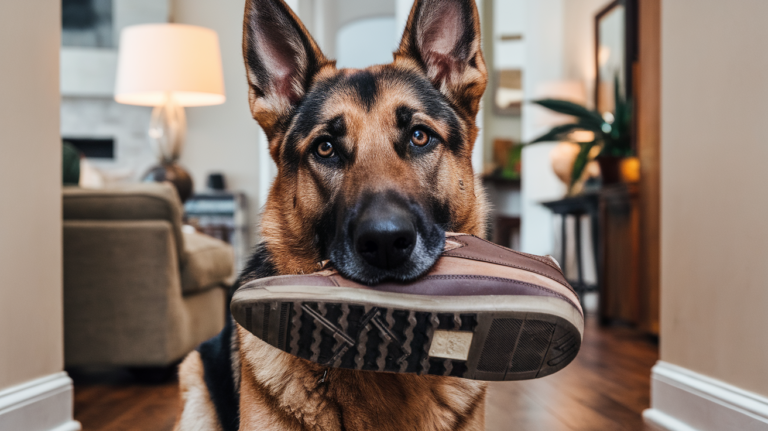
Now we’re entering impressive territory. Teaching your German Shepherd to fetch specific items by name showcases their incredible memory and ability to discriminate between objects. This isn’t just “fetch the ball.” This is “fetch the keys” or “fetch your leash” or even “fetch the TV remote.”
Begin with two distinctly different items. Let’s say a rope toy and a ball. Place both on the floor and ask for one specifically: “Get the rope!” When your dog picks up the correct item, throw a celebration. If they grab the wrong one, simply say “nope” cheerfully and try again. No frustration, just redirection.
| Training Phase | Duration | Key Milestone |
|---|---|---|
| Introduction (2 items) | 3-5 days | Dog understands different items have names |
| Expansion (3-5 items) | 1-2 weeks | Dog can distinguish between multiple objects |
| Distance & Distraction | 2-3 weeks | Dog retrieves correct item from across the room |
| Advanced (6+ items) | Ongoing | Dog has extensive vocabulary of object names |
The real fun starts when your dog knows 5+ items. Suddenly you can send them to retrieve your slippers, their food bowl, or a specific toy from their collection. German Shepherds excel at this because they’re naturally motivated to work and please, plus they have excellent scent memory to help differentiate objects.
3. The Tactical Weave (Walking Through Your Legs)
This trick looks incredibly impressive and it’s actually easier to teach than you might think. Your German Shepherd will learn to weave through your legs as you walk, creating this beautiful synchronized movement that looks like you’ve been training together for years.
Start standing still with your legs apart. Hold a treat low between your legs and lure your dog through. Immediately reward them when they emerge on the other side. Practice this until it becomes second nature. Then comes the fun part: adding movement.
Take one step forward with your left leg and lure your dog through to the right side. Reward. Step forward with your right leg, lure them through to the left. Reward. You’re creating a figure-eight pattern between your legs as you walk. Yes, you’ll look ridiculous during training. Yes, it’s completely worth it.
Pro tip: German Shepherds are large dogs, so you might need to spread your stance wider than you would with a smaller breed. Comfort matters for both of you! Start with just three or four steps, then gradually increase the distance as your dog gets the rhythm.
4. The Sneak & Crawl (Military Style Crawl)
Want your German Shepherd to look like they’re on a covert military operation? The crawl command teaches them to move forward while staying completely flat on their belly. It taps into their natural instinct to stay low, and it provides fantastic core exercise.
Begin with your dog in a down position. Hold a treat right in front of their nose, then slowly drag it forward along the ground. The key word here is slowly. If you move too fast, your dog will just stand up and walk. You want them to realize that staying flat gets them the reward.
The crawl isn’t just a party trick. It’s genuine obedience training that reinforces impulse control and body awareness. Plus, it’s an excellent way to tire out a high-energy German Shepherd on rainy days.
Many dogs will try to cheat by popping their rear end up. When this happens, you can gently place your hand on their back (never pushing, just as a reminder) or practice under a low coffee table where they physically can’t stand up. German Shepherds are problem solvers, so they’ll figure out the rules quickly.
Once your dog can crawl a few feet, add the verbal command and hand signal. Most trainers use a downward sweeping motion with their hand. Practice in different locations around your house to help your dog generalize the behavior. Soon you’ll have a pup who can stealth-mode across any room.
5. The Balance & Wait (Object Balancing)
This trick never fails to impress visitors. Teaching your German Shepherd to balance an object on their nose or head requires patience, stillness, and trust. It’s the ultimate exercise in impulse control for a breed that’s naturally active and alert.
Start small. Literally. Use a lightweight treat or small toy. With your dog in a sit or down position, gently place the object on their nose while giving a clear “wait” or “stay” command. At first, they’ll probably shake it off immediately. That’s normal! The secret is starting with just one second of balance, then gradually increasing the duration.
Your hand positioning matters enormously here. Keep your hand close (but not touching) to catch the object when it falls, which it will. Many times. German Shepherds are athletic and energetic, so asking them to be still goes against every fiber of their being. Make it a game. Celebrate the tiniest victories.
Work up to different objects: a small stuffed toy, a tennis ball, even a treat balanced on their snout. The ultimate challenge? Teaching them to wait for a release command before tossing the object up and catching it. When your GSD can balance a treat on their nose for 30 seconds and not eat it until you say “okay,” you’ve achieved dog training nirvana.
6. The Directional Send (Go To A Specific Location)
Teaching your German Shepherd to go to specific locations on command is incredibly useful and mentally stimulating. This could be “go to your bed,” “go to the door,” or “go to the kitchen.” It demonstrates your dog’s ability to understand spatial concepts and follow through even when you’re not physically guiding them.
Choose a target location and give it a consistent name. Let’s use “bed” as an example. Walk with your dog to their bed and reward them for getting on it. Repeat this 10 to 15 times. Then stand one step away and point, using the command “go to bed.” When they go, jackpot reward!
Gradually increase your distance from the bed. This is where German Shepherds really shine; they’re incredibly good at understanding directional cues and spatial relationships. Soon you’ll be able to send them to their bed from across the room, or even from another room entirely.
Expand this trick by teaching multiple locations. “Go to the door” when someone knocks. “Go to your crate” at bedtime. “Go to the car” when it’s adventure time. Each location needs its own training session initially, but German Shepherds are quick learners. Within a month, your dog could know 5+ location commands, making your household run more smoothly.
7. The Spin & Twist Combo (Directional Spins)
Let’s end with something flashy and fun! Teaching your German Shepherd to spin in both directions on command creates a beautiful behavior chain you can incorporate into longer trick sequences. Plus, it’s just plain adorable watching a 70-pound dog pirouette like a ballerina.
Start with a treat in your hand and create a lure circle above your dog’s head. They’ll naturally follow the treat in a circle. The moment they complete a full spin, reward immediately and add your verbal cue (try “spin” for clockwise and “twist” for counterclockwise). German Shepherds pick this up incredibly fast, often mastering it within a single training session.
The real skill comes in teaching both directions separately and then being able to cue them independently. This requires your dog to listen carefully to the verbal command rather than just following your hand motion. Once they’ve got both down, you can create combinations: “Spin, spin, twist!” or incorporate spins between other tricks for a whole routine.
Practice in front of a mirror occasionally. Why? Because you need to make sure you’re giving consistent hand signals and that your dog is completing full rotations. German Shepherds are precise workers; they’ll perform exactly what you’ve taught them, so if you accidentally teach a three-quarter spin, that’s what you’ll get.
| Trick | Difficulty Level | Training Time | Best Use |
|---|---|---|---|
| Tactical Tidy-Up | Intermediate | 1-2 weeks | Daily practical help |
| Directed Retrieve | Advanced | 2-4 weeks | Impressive & useful |
| Tactical Weave | Intermediate | 1-2 weeks | Show off coordination |
| Sneak & Crawl | Beginner to Intermediate | 3-7 days | Rainy day exercise |
| Balance & Wait | Intermediate | 1-3 weeks | Impulse control mastery |
| Directional Send | Advanced | 2-4 weeks | Household management |
| Spin & Twist Combo | Beginner | 1-3 days | Fun & energizing |
Remember, every German Shepherd learns at their own pace. Some might nail the spin in five minutes but take weeks to master the directed retrieve. Others might surprise you by picking up the most complex trick first. The journey is just as important as the destination. Training sessions should be fun, energetic, and filled with positive reinforcement.
Keep your sessions short (10 to 15 minutes maximum) but frequent (two or three times daily works great). German Shepherds have excellent focus, but even they can experience mental fatigue. End every session on a high note, even if that means asking for something simple your dog already knows perfectly.
Your German Shepherd is capable of so much more than you might realize. These seven tricks are just the beginning of what you two can accomplish together. So grab those treats, clear some space in your living room, and get started. Your incredibly talented GSD is ready to show the world what they can do!