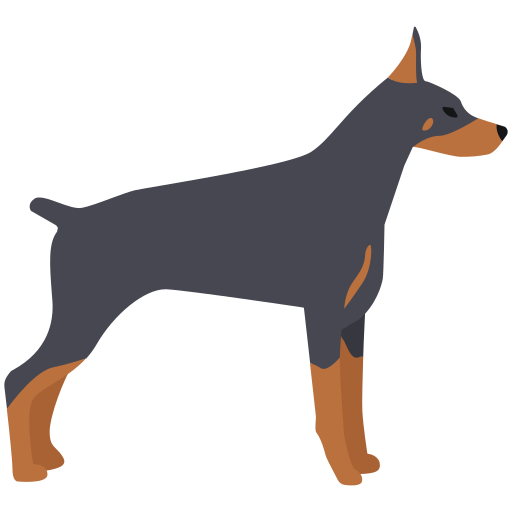
 Doberman
 Velcro dogs. That is the nickname Doberman owners give their dogs, and once you have lived with one pressed against your leg while you brush your teeth, the name stops being cute and starts being a documented physical law.
Dobermans are strange creatures, honestly. They were engineered in the 1890s by a German tax collector who wanted a bodyguard that could walk beside him into unfriendly neighborhoods, and somewhere in that mix of Rottweiler, Greyhound, Weimaraner, and whatever else Karl Dobermann threw into the blender, something unusual happened.
The breed came out with abilities that other dogs simply do not have.
Not "does better." Does only.
Below are five of them, and if you own a Doberman, you have probably watched at least three happen this week without realizing they were remarkable.
1. Read a Room Faster Than the People In It
Walk a Doberman into a party and watch what happens in the first eight seconds.
The head lifts. The ears orient. The dog does a slow visual sweep of every human present, and then, without any command, picks a spot to stand.
That spot is almost never random.
The Threat Assessment Nobody Taught Them
Guarding breeds are common. Guarding breeds that evaluate rather than react are not.
A livestock guardian barks at the unfamiliar. A terrier commits to the fight before checking the odds. A Doberman, by contrast, gathers information first, and the gathering is visible on its face.
You can watch the calculation happen. Ears forward, weight shifted back onto the hindquarters, body still but loaded, eyes moving person to person. It is the canine equivalent of someone doing math in their head.
A Doberman does not decide whether you are dangerous. It decides how dangerous you would be if you turned out to be dangerous, and then positions itself accordingly.
This is why so many owners describe the same eerie moment: a stranger approaches, the dog does nothing, and three minutes later the stranger says something slightly off and the dog is suddenly standing between you.
The dog was never relaxed. It was simply waiting for the data.
Why This Matters More Than Barking
Reactive dogs are exhausting. They alarm at squirrels, delivery drivers, wind, and their own reflections, and by month four you have stopped listening entirely.
Dobermans are different because their alerts carry information.
When a well socialized Doberman genuinely reacts, something is actually happening.
2. Sprint Like a Sighthound in a Bodybuilder’s Frame
Here is a thing that should not be physically possible.
A 90 pound male Doberman, all chest and shoulder and muscle density, can hit roughly 32 miles per hour. Greyhounds top out around 43, and they are built like coat hangers with skin stretched over them.
No other dog that heavy moves that fast.
The Blueprint Nobody Else Got
Most powerful breeds pay for their strength with speed. Rottweilers, Mastiffs, Bullmastiffs, Cane Corsos: strong, slow, built for leverage rather than pursuit.
Most fast breeds pay for their speed with fragility. Whippets and Salukis are gorgeous and would lose an argument with a firm handshake.
The Doberman refused to pick.
Square proportions, deep chest for lung capacity, long legs with a shockingly efficient stride, and lean muscle instead of bulk. The result is a dog that can chase you down and still matter when it gets there.
Speed without power is a warning. Power without speed is a wall. Only one breed was designed to be both, and it happened by accident in a German tax office.
Watch a Doberman at a full run sometime. There is a floating quality to it, almost weightless, and then the dog stops on a dime and turns 90 degrees without decelerating.
That combination is why they dominated military and police work for half a century.
3. Anticipate Your Next Move Before You Make It
This one unsettles new owners.
You are sitting on the couch, phone in hand, and you have a passing thought about getting up for water. You have not moved. You have not shifted your weight or set the phone down.
The Doberman is already standing.
Reading Micro Signals
Nobody fully understands how this works, but the leading theory is that Dobermans track an absurd number of tiny behavioral cues simultaneously: breathing rate, eye direction, small muscle tension in the legs, the specific way your shoulders change before you stand.
Every dog reads some of this. Dobermans appear to read all of it, constantly, and to build predictive models from it.
The practical result is a dog that seems to run about half a second ahead of your life.
The Velcro Problem
This ability comes bundled with a cost, and the cost is that you will never be alone again.
Bathrooms. Showers. The three foot walk from the kitchen to the fridge.
A Doberman cannot predict your movements if it cannot observe your movements, so it solves the problem by never stopping the observation. This is genuinely difficult for owners who wanted a dog rather than a shadow with opinions, and it is the single most common reason Dobermans get rehomed by people who did not research the breed.
They are not clingy. They are monitoring.
4. Switch Off Completely
The most underrated Doberman trait has nothing to do with intensity.
It is the off switch.
From Guard Dog to Furniture in Four Seconds
An intense dog is easy to breed. Border Collies, Malinois, and working line German Shepherds are proof that you can make a dog that never stops.
What is hard is making a dog that goes from full alert to horizontal and snoring, and then back again instantly, without any wind down period.
Dobermans do this constantly. The threat resolves, the dog exhales, and thirty seconds later there are 80 pounds of muscle draped upside down across your lap with the legs in the air.
A Malinois needs a job or it will invent one, usually involving your drywall. A Doberman needs a job, and then it needs a nap on the couch with its head on your knee, and both of those needs are equally serious.
This is the reason Dobermans work as house dogs and Malinois, generally, do not.
The Lap Dog Delusion
Every Doberman on earth believes it is small.
The mechanics are always identical: the dog approaches, sits directly in front of you, then reverses slowly like a truck backing into a loading dock until it is fully seated in your lap.
No hesitation. No acknowledgment that it weighs more than a fourth grader.
5. Bond So Hard It Rewires Their Health
Here is where things get genuinely strange, and slightly sad.
Dobermans do not attach to a household. They attach to a person, and the attachment is closer to a merge than a preference.
One Human, Fully Committed
Many breeds have favorites. Dobermans have a primary, and the difference is measurable in behavior.
The dog will accept food from anyone but eats better when the primary is in the room. It will sleep anywhere but sleeps deeply only in that person’s space. It obeys the whole family but responds to the primary in a completely different register, faster and looser and without the small hesitation that other dogs show.
Some owners describe it as the dog treating them as a limb rather than a leader.
The Cost of Loving That Hard
Rehomed adult Dobermans grieve in ways that show up physically.
Appetite collapses. Coat quality degrades. Some develop stress colitis, and many go through a period of weeks where they simply stand at doors, waiting.
Puppies adapt. Adults, frequently, do not adapt well at all, and rescue organizations that specialize in the breed will tell you it is the hardest part of the work.
The bond runs in both directions with unusual force, which is exactly why people who have owned one Doberman almost never switch to another breed.
They already know what they would be giving up.