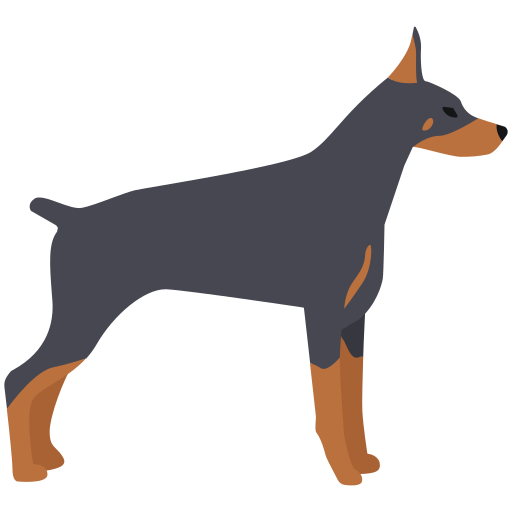
 Doberman
 Most people think they know Dobermans. Sleek, intimidating, loyal. Maybe you’ve admired one from a distance or scrolled past a photo thinking, "gorgeous dog, probably not for me." That’s the before.
The after? Once you know what’s actually going on inside that elegant, muscular frame, you’ll never look at a Doberman the same way again. These aren’t just pretty guard dogs. They’re walking contradictions, evolutionary marvels, and honestly, some of the most fascinating animals on the planet.
Buckle up.
1. They Were Literally Engineered by One Man
Louis Dobermann wasn’t a breeder in the traditional sense. He was a tax collector in 19th century Germany who needed a dog tough enough to protect him on dangerous collection routes.
So he built one.
By selectively crossing Rottweilers, German Pinschers, Weimaraners, and possibly Greyhounds, Dobermann created a breed that was fast, fearless, and fiercely loyal. The fact that this happened in the 1880s with zero modern genetics knowledge makes it all the more remarkable.
2. The Breed Is Younger Than You Think
Most ancient-looking breeds have centuries of documented history. Dobermans don’t. The breed was only officially recognized in 1900, making it one of the younger purebred dogs in existence.
That’s roughly the same era as the invention of the airplane.
For a dog that feels so iconic, so deeply embedded in pop culture and security lore, the Doberman is practically a newborn in the dog world.
3. Their Ears Aren’t Naturally Pointy
This one surprises almost everyone.
Those sharp, upright ears that define the classic Doberman silhouette? Cropped. Naturally, Dobermans are born with floppy ears, similar to a Labrador’s. Ear cropping became a standard practice historically to make the dogs appear more intimidating and to reduce the risk of ear injuries in working situations.
"A Doberman with natural ears looks like a completely different dog. Softer. Gentler. Like the same animal wearing a different costume."
Many countries have banned the procedure entirely. In places like the UK and Australia, natural-eared Dobermans are the norm, not the exception.
4. They Have a Serious Heart Problem Written Into Their DNA
This isn’t a fun fact. It’s an important one.
Dilated Cardiomyopathy (DCM) affects Dobermans at an alarming rate. Studies suggest that up to 58% of Dobermans will develop the condition at some point in their lives. It causes the heart to enlarge and weaken, often with no visible symptoms until it’s advanced.
The cruel part? Many Dobermans appear completely healthy right up until a cardiac event.
Regular cardiac screenings are non-negotiable for this breed. Holter monitors, echocardiograms, and annual vet checks aren’t optional extras. They’re lifesaving tools.
5. They Were War Heroes
During World War II, Dobermans served alongside U.S. Marines in the Pacific Theater as scout dogs, messenger dogs, and sentries.
Twenty-five Dobermans gave their lives during the Battle of Guam in 1944. They are honored at the United States Marine Corps War Dog Cemetery in Guam, where a bronze statue called "Always Faithful" stands in their memory.
"These dogs didn’t choose to serve. They just did, with everything they had."
That’s not just history. That’s legacy.
6. Albino Dobermans Exist (But It’s Complicated)
You may have seen photos of pale, almost ghostly Dobermans with blue eyes and white coats. They look stunning. The reality behind them is more complicated.
Albino Dobermans aren’t true albinos in the genetic sense. They carry a mutation that causes a lack of pigmentation, and with that comes a long list of health issues: photosensitivity, skin tumors, vision problems, and a higher likelihood of temperament difficulties.
The first "white" Doberman was registered in 1976. Since then, responsible breeders have actively discouraged breeding these dogs. The Doberman Pinscher Club of America maintains a "white registry" specifically to track and avoid perpetuating the gene.
Beautiful? Yes. Worth pursuing? Most experts say absolutely not.
7. They’re Velcro Dogs in a Muscular Package
People assume Dobermans are aloof. Independent. The kind of dog that patrols the perimeter while you watch TV.
Wrong.
Dobermans are famously clingy. Not in an anxious way, but in an "I want to be in the same room as you at all times, preferably touching" kind of way. The breed nickname "Velcro dog" exists for a reason.
They bond deeply with their families and can develop separation anxiety if left alone too long, too often. This isn’t a dog that thrives in an empty house.
8. Their Intelligence Is Almost Unsettling
"Training a Doberman isn’t about teaching them what to do. It’s about keeping up with a dog who already figured out what you want and is deciding whether to cooperate."
They consistently rank among the top five most intelligent dog breeds in the world. Stanley Coren’s landmark research on dog intelligence placed Dobermans fifth overall, based on their ability to learn new commands quickly and obey them reliably.
What that means in practice: a bored Doberman is a destructive Doberman. They need mental stimulation just as much as physical exercise. Puzzle feeders, scent work, obedience training, agility, schutzhund. These aren’t luxuries. They’re necessities.
9. The "Dobie Lean" Is a Real Thing
Ask any Doberman owner and they’ll smile immediately.
The Dobie Lean is when your Doberman presses their entire body weight against your legs, usually while you’re standing still, as if they’re trying to merge with you. It’s their version of a hug.
For a dog that can weigh 90 pounds, this is both adorable and occasionally a threat to your balance.
Nobody really knows if it started as a dominance behavior or pure affection. Most owners don’t care about the origin. They just brace themselves and enjoy it.
10. Blue and Fawn Dobermans Come With Extra Baggage
Most people know about the classic black and tan or red and rust Doberman colorings. Fewer people know that blue (a diluted black) and fawn (a diluted red) Dobermans exist, and that they come with a specific condition called Color Dilution Alopecia (CDA).
CDA causes patchy hair loss, dry skin, and recurring skin infections. It’s linked directly to the dilution gene responsible for those unusual coat colors.
Blue and fawn Dobermans can live full, happy lives with proper care. But potential owners need to know what they’re signing up for before falling in love with an unconventional color.
The coat color might be rarer. The vet bills might be too.
The truth about Dobermans is that they’re layered in ways that most casual admirers never see. Behind that chiseled exterior is a dog with a complicated genetic history, a surprisingly soft personality, serious health vulnerabilities, and an almost eerie level of intelligence.
Knowing all of this doesn’t make them less impressive.
It makes them more.