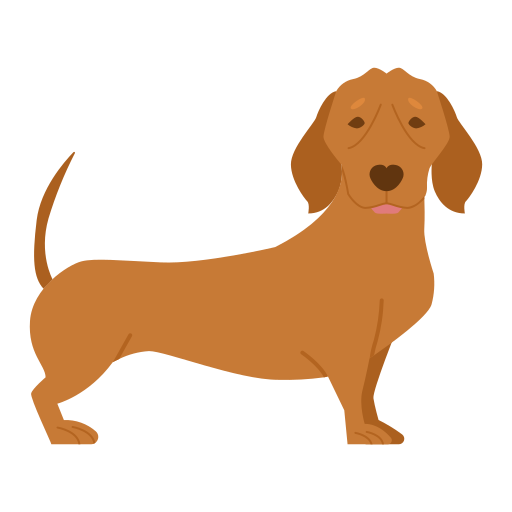
 Dachshund
 Ask a room full of people to describe a dachshund and you will get a version of the same answer: a cuddly little sausage who mostly wants to nap under a blanket.
That picture is wrong in nearly every direction that matters.
This breed was engineered to squeeze into a badger den, corner an animal that outweighed it, and hold the line until a human could dig down and pull everyone out. The chest, the voice, the nose, the absolute refusal to back down: all of it was designed for that job.
The myth survives because the shape is disarming. Short legs read as slow. Small dog reads as low maintenance. And since dachshunds really do love a warm blanket, people mistake the off switch for the entire personality.
Ten things worth knowing before one of them moves in, or shortly after, when the negotiating begins.
1. The confidence is not a bit
A dachshund does not know it is small. Nobody told it, and it would not have believed them anyway.
This is the dog that will stand at the top of the stairs and bark down a Great Dane, then trot away like the matter has been settled permanently.
That boldness is charming right up until it walks your eleven pound hound into a situation eleven pound hounds should avoid. Supervision at the dog park is not optional. Neither is a solid recall, which brings us to a later item on this list.
Why it matters more than people expect
Small dog syndrome gets blamed for a lot of behavior that is actually just breed function showing up on schedule. A terrier chases. A retriever fetches. A dachshund escalates.
Working with that instinct goes far better than trying to embarrass it out of existence.
2. The back is the whole ballgame
Roughly one in four dachshunds will deal with intervertebral disc disease at some point. That is not a scare statistic; it is the single most important number attached to the breed.
The long spine and short legs come from a genetic quirk that also makes spinal discs harden and degenerate earlier than they should.
Prevention looks boring, and boring is exactly the point. Ramps to the couch. Ramps to the bed. Two hands under the chest and rear when lifting, never a scoop under the front legs alone.
A dachshund who has never learned to launch off furniture is a dachshund who never has to unlearn it. Habits set early are cheaper than surgery set later.
Sudden reluctance to jump, a hunched posture, shaking, yelping when picked up, or dragging back feet all mean vet today, not vet Thursday.
3. Weight is the one risk you fully control
Genetics loaded the dice on the spine. Body condition is the part that stays in your hands.
Every extra pound on a dachshund is proportionally enormous, and it lands directly on the structure least able to absorb it.
The trouble is that dachshunds are magnificent liars about food. They will convince a houseguest they have not eaten in days, and the houseguest will believe them completely.
The house rule that actually works
Measure meals, count treats as part of the daily total, and tell visitors the rules out loud before the begging starts.
You should be able to feel ribs under a thin layer with light pressure, and see a waist from above. If neither is true, the back is already carrying more than it was built for.
4. The bark is not a bug
Dachshunds were bred to bark underground so the hunter above could locate them through several feet of soil.
That vocal equipment is still installed, and it is still fully operational at eight in the morning when a delivery truck slows down two houses over.
You will not train this out. You can absolutely train it down, by teaching a reliable "quiet" cue, rewarding silence rather than only correcting noise, and reducing the visual triggers that set off the alarm in the first place. Film over the bottom half of a front window does more good than most people expect.
5. Housetraining takes longer than the internet claims
Many dachshund owners report the process stretching well past the timeline that generic puppy guides promise.
Part of it is bladder size. Part of it is a genuine, unshakeable objection to wet grass, cold air, and rain.
Consistency wins here, along with heavy praise the instant business is done outdoors. A covered potty area in the yard solves more problems than any amount of firmness.
Crate training helps too, provided the crate stays a good place and never becomes a punishment.
6. The nose overrides everything
A dachshund on a scent trail is not ignoring you. A dachshund on a scent trail has genuinely stopped receiving transmissions.
This is a hound, and the hound brain hands the nose priority over ears, eyes, and any promise made during training class.
Off leash freedom is a lovely idea until the day a rabbit disagrees. Fenced yards and long lines exist so that day stays theoretical.
Recall is still worth training hard, and high value rewards make real progress. Trusting it in an unfenced space near a road is a different decision entirely.
7. Digging is not misbehavior, it is the résumé
Holes in the flower bed. Blankets tunneled into knots. Couch cushions excavated with the focus of an archaeologist.
Burrowing is baked in at the same level as breathing.
Fighting it goes badly. Redirecting it works beautifully: a designated digging spot in the yard, a sandbox with toys buried in it, and a pile of soft blankets in the crate that they can arrange to their own exacting standards.
Most dachshunds will sleep under the covers rather than on top of them. This is normal, and yes, they can breathe fine down there.
8. Training is a negotiation, not a command structure
Smart, absolutely. Obedient by default, absolutely not.
A dachshund hears a cue, evaluates the offer, considers the exchange rate, and then decides. Repetition without reward simply teaches them that the word is meaningless.
Living with a dachshund means dealing with someone who has read the contract more carefully than you have.
Short sessions beat long ones. Food beats praise. Patience beats volume every single time, and harsh corrections tend to produce a dog who is sneaky rather than a dog who is trained.
9. Coat type changes daily life more than people realize
Three coats, three different experiences, and buyers often pick based on looks without knowing what comes attached.
Smooth
Lowest maintenance of the three. Weekly brushing, minimal shedding drama, and almost no grooming appointments.
They feel the cold badly, though. A sweater in winter is practical rather than decorative.
Longhaired
Silky, feathered, and prone to mats behind the ears, under the legs, and along the tail.
Brushing several times a week is realistic, not optional.
Temperament tends to run a little softer and calmer, which many families find easier.
Wirehaired
The coat needs hand stripping or regular trimming to hold its texture.
Terrier blood in the mix gives this variety the most mischief and often the most energy. Delightful for the right owner, exhausting for the wrong one.
10. Attachment runs deep, and so does the flip side
A dachshund typically picks a person. Not a favorite in a casual sense: a person, followed from room to room, including into the bathroom, forever.
That devotion is the best part of the breed for a lot of owners.
The cost is that separation anxiety shows up more often here than in many small breeds. A dog who has never spent time alone will not handle it gracefully the first time work travel comes up.
Build tolerance early with short, unremarkable absences. Leave quietly, come home quietly, and make the whole event as dull as possible.
Puzzle feeders and frozen stuffed toys give the brain something better to do than monitoring the front door.