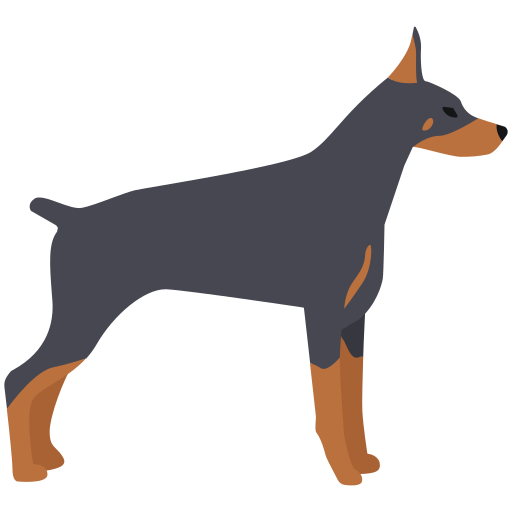
 Doberman
 Anyone who hands the "smartest dog" crown to a Border Collie without a second thought has clearly never lived with a Doberman.
That is not a spicy take I throw around for attention. That is a hill I will stand on, preferably with 75 pounds of sleek black dog leaning against my leg, watching me type and silently judging my grammar.
Here is the problem with most intelligence rankings. They measure one narrow skill: how quickly a dog learns a new command and how often it obeys on the first request.
Useful information. Also wildly incomplete.
Doberman intelligence is a stranger, sharper thing. It shows up in the half second pause before they act, in the way they read the mood of a room before anyone speaks, and in the fact that they will solve a problem you were desperately hoping they had not noticed.
Ten reasons the breed belongs much higher on that famous list than it usually lands.
1. They Learn New Commands at a Slightly Unfair Speed
Formal obedience research puts Dobermans in the top five for working and obedience intelligence, which means they typically pick up a brand new command in fewer than five repetitions.
Five. That is one short training session.
I have watched a nine week old Doberman puppy figure out "sit" before the treat bag was fully open, then sit again unprompted because she had already connected the dots between behavior and payment.
The flip side of that speed is a small warning: they learn your bad habits just as fast. Give in to the counter surfing once and congratulations, you have officially trained a counter surfer.
2. They Read Human Body Language Like a Second Language
Dobermans were bred to work in tight partnership with a person, and that history shows up in how intensely they study us.
Your posture. Your breathing. The particular way you reach for your keys versus the way you reach for the treat jar.
The Doorway Test
Try this sometime. Stand in a doorway and shift your weight slightly toward one side without looking at your dog.
A Doberman will usually clock the movement and adjust before you take a single step.
A dog that watches your hands is trainable. A dog that watches your eyes is thinking. Dobermans watch your eyes.
3. Their Job Description Was Never "Just Guard the House"
Louis Dobermann needed a dog that could walk beside him while he collected taxes in 1890s Germany, which is possibly the least popular job in recorded history.
That dog needed to be intimidating on demand, calm the rest of the time, and smart enough to know the difference.
Pure aggression would have been useless. What he actually built was a thinking protector, a dog whose primary tool is judgment rather than teeth.
4. They Are Genuinely Excellent Problem Solvers
Ask any Doberman owner about latches, gates, or "dog proof" containers and watch their eye twitch.
These dogs experiment. They will nose a handle, then paw it, then apply body weight, then step back and consider the situation from a new angle.
That is not random flailing. That is a sequence of tested hypotheses, which is a pretty solid definition of reasoning.
Puzzle Toys Are Not Optional
A standard treat ball will buy you roughly ninety seconds of peace.
Rotate multiple puzzle types, hide toys around the house, and make them work for portions of their meals. Mental work tires a Doberman more efficiently than a long walk ever will.
5. Their Memory Is Uncomfortably Good
Dobermans remember people, places, routines, and grudges.
Mine remembers which neighbor once dropped a piece of bacon in 2021 and greets that man with the enthusiasm of a lottery winner every single time.
They also remember the vet parking lot, the specific jingle of your work bag, and the one time a stranger moved too fast toward your kid. That last category is the one that matters most, and it forms fast and holds tight.
6. They Distinguish Threats from Non Threats Without Coaching
Here is the trait that separates a smart guardian from a liability.
A well raised Doberman does not bark at every leaf, delivery van, and passing bicycle. It assesses.
The mail carrier who comes daily gets logged as background noise. The stranger who lingers by the car at 11pm gets a very different response, usually a silent reposition between you and them rather than a noisy display.
Barking at everything is not protection. Knowing exactly what deserves a reaction is protection, and that requires a brain doing real work.
7. They Adapt to Almost Any Job You Hand Them
Police work. Military service. Search and rescue. Diabetic alert. Therapy visits in hospitals and schools.
Very few breeds show up credibly across that entire range.
Adaptability is one of the more honest measures of intelligence, because it means the dog is not just running a single hardwired program. It is figuring out what a new situation requires and adjusting.
8. They Will Absolutely Manipulate You
Social intelligence deserves way more credit than it gets, and Dobermans have it in embarrassing quantities.
Watch one develop a limp that appears only when it is time to leave the park and vanishes the moment a squirrel enters the frame.
Watch one learn that the deep, mournful sigh gets you off the couch faster than a bark does. They test which behaviors move you, then they keep the winners.
The Velcro Factor
The nickname "velcro dog" exists for a reason, and it is partly strategic.
Staying physically close to you gives them more data. More data means better predictions about what happens next, and Dobermans are relentlessly interested in what happens next.
9. They Learn by Watching, Not Just by Doing
Observational learning is a genuinely advanced cognitive skill, and Dobermans are notorious for it.
Bring a second dog into a Doberman household and the newcomer usually learns the house rules from the resident Doberman rather than from you.
More impressively, they learn from watching humans. Door handles, light switches, refrigerator doors, and the exact cabinet where the good stuff lives all get absorbed through quiet observation while you assume nobody is paying attention.
The scariest sentence in the Doberman community is not "my dog escaped." It is "my dog watched me do it once."
10. Their Boredom Is Loud, and That Is the Proof
A bored Labrador naps. A bored Doberman starts a renovation project.
Destructive behavior in this breed is almost never spite and almost always an unmet cognitive need. The brain was built to work, and if you do not assign it a job, it will invent one.
That is honestly the most convincing evidence of intelligence on this entire list. Simple dogs are content with simple lives; complex dogs demand complex ones.
What Actually Fixes It
Training sessions of five to ten minutes, several times a day, beat one long weekly session every time.
Teach nonsense tricks. Teach the names of individual toys. Teach them to put those toys away, because they can, and because a Doberman with an assignment is a Doberman who is not eating your baseboards.
Scent games are the cheapest win available. Hide treats in a towel roll, in a cardboard box, under cups on the floor, and let that nose run the show for fifteen minutes.
Rotate the challenges constantly. Novelty is the entire point, and a puzzle they solved yesterday is not a puzzle today.