Mental workouts matter just as much as physical ones. These brain games challenge your German Shepherd while strengthening your bond.
Ever watched your German Shepherd solve a problem and thought, “Wow, you’re way too smart for your own good”? These dogs are basically the valedictorians of the canine world, ranking third in Stanley Coren’s dog intelligence rankings. That massive brain needs regular workouts, or you’ll find yourself dealing with a bored, destructive genius.
Think of brain games as CrossFit for your dog’s mind. Just like physical exercise keeps their body fit, mental challenges prevent cognitive decline and behavioral issues. The beautiful part? Most of these games are ridiculously fun for both of you.
1. The Classic Shell Game (Three Cup Shuffle)
Remember that street hustle where someone hides a ball under cups and shuffles them around? Your German Shepherd will love this game, and it taps into their natural tracking abilities. Start with three opaque cups and a tasty treat. Let your dog watch as you place the treat under one cup, then slowly shuffle them around.
The beauty of this game lies in its scalability. Begin with just two cups and minimal shuffling, then gradually increase the difficulty as your pup masters each level. Some German Shepherds catch on frighteningly fast, while others need more practice. Either way, their intense concentration is absolutely adorable.
Pro tip: Use cups that won’t slide easily on your floor surface. Nothing disrupts the game faster than runaway cups crashing across the kitchen!
2. Name That Toy
German Shepherds have an incredible capacity for learning vocabulary. Some studies suggest they can learn hundreds of words, so why not put that talent to use? Gather your dog’s favorite toys and start assigning specific names to each one. “Ball,” “rope,” “squeaky,” and “bunny” become part of your shared language.
Practice by asking your dog to fetch specific toys by name. Start in a small area with just two toys, rewarding heavily when they bring the correct one. Gradually add more toys and increase the distance. Before you know it, your GSD will be fetching “blue ball” versus “red ball” with impressive accuracy.
This game transforms your living room into a vocabulary classroom, proving that German Shepherds aren’t just physically impressive but intellectually extraordinary.
3. The Muffin Tin Puzzle
Grab a muffin tin and some tennis balls, and you’ve got yourself an instant puzzle feeder. Place treats in several cups of the muffin tin, then cover each cup with a tennis ball. Your German Shepherd needs to figure out how to remove the balls to access the goodies underneath.
This deceptively simple game engages multiple cognitive skills: problem solving, paw coordination, and persistence. Watch as your dog experiments with different techniques, maybe nosing the balls out first, then switching to paw strategies. Each dog develops their own unique approach.
The muffin tin game is particularly excellent for slowing down fast eaters, too. It turns treat time into an engaging activity rather than a two second vacuum session.
4. Hide and Seek (Canine Edition)
Your German Shepherd’s tracking instincts make them natural champions at hide and seek. Start simple: have your dog sit and stay in one room while you hide in an obvious spot nearby. Call them enthusiastically and celebrate like crazy when they find you. This builds their confidence and understanding of the game.
As they improve, hide in increasingly challenging spots. Behind doors, in closets, even outside in the yard. The search activates their natural prey drive and scent tracking abilities, providing serious mental stimulation. Plus, the sheer joy on their face when they finally discover you is absolutely priceless.
You can also play the reverse version where you hide their favorite toy or treats. German Shepherds excel at scent work, making this variation particularly satisfying for them.
5. Interactive Puzzle Toys
The market is flooded with puzzle toys designed specifically for intelligent breeds, and German Shepherds deserve the advanced versions. Look for puzzles with multiple compartments, sliding pieces, and flip lids. These toys require sequential problem solving: do step A to reveal step B to finally access the reward.
| Puzzle Difficulty | Features | Best For |
|---|---|---|
| Beginner | Single compartment, simple flip or slide | Puppies, first time puzzlers |
| Intermediate | Multiple compartments, combination of mechanisms | Young adults learning puzzle solving |
| Advanced | Sequential steps, memory required, complex manipulation | Experienced puzzle enthusiasts |
Rotate different puzzles to prevent boredom. What challenges your dog today might become too easy next month. These brilliant pups need escalating difficulty to stay engaged.
6. The Box Treasure Hunt
Save your Amazon boxes for this fantastic free game! Place treats or toys inside boxes of various sizes, some nested within others. Seal some with tape (your dog will love shredding it), leave others partially open. Create a cardboard obstacle course of discovery.
German Shepherds approach this game with the intensity of archaeologists on a dig. They’ll rip, tear, nose, and paw their way through cardboard to claim their prizes. The destruction is completely acceptable here, making it a perfect outlet for dogs who might otherwise channel that energy into your furniture.
Important safety note: Supervise this game carefully. While cardboard ingestion in small amounts isn’t typically dangerous, you don’t want your dog actually eating significant quantities. Remove soggy, small pieces as they play.
7. Scent Discrimination Training
Take advantage of your German Shepherd’s incredible nose (they have around 225 million scent receptors compared to our measly 5 million). Start with essential oils like lavender or vanilla. Place a drop on a cotton ball, hide it among several unscented cotton balls, and reward your dog for indicating the scented one.
This game mimics professional scent detection work and taps into instincts German Shepherds were literally bred for. As they master basic scent discrimination, you can progress to more challenging scenarios. Hide the scented item in different rooms, at varying heights, or among competing smells.
Scent work provides unparalleled mental exhaustion. Fifteen minutes of focused scent training can tire your German Shepherd more effectively than an hour long walk.
8. The Which Hand Game
This simple game requires zero equipment and can be played anywhere. Hold treats in both closed fists, then present them to your dog. They need to indicate (usually by nosing or pawing) which hand contains the treat. Start by letting them see you load the treats, then progress to hiding the process.
The cognitive challenge escalates when you start switching hands behind your back or using verbal misdirection. German Shepherds often develop fascinating strategies, watching your body language for subtle tells. Some even track which hand you favor naturally!
This game strengthens impulse control, too. Your dog learns to make a deliberate choice rather than frantically attacking both hands. Patience becomes part of the puzzle.
9. Obstacle Course Navigation
Set up a homemade agility course using household items: chairs to weave through, broomsticks balanced on books to jump over, blankets draped to create tunnels. The mental component comes from teaching your German Shepherd to navigate the course in a specific sequence while following your directional cues.
This combines physical and mental exercise beautifully. Your dog must remember the pattern, respond to your signals, and coordinate their impressive body through space. Start slowly, rewarding each correct obstacle completion, then gradually link them together.
German Shepherds typically excel at this type of work since it mirrors their heritage as versatile working dogs. The focused training satisfies their need for a “job” while strengthening your bond through teamwork.
10. Food Dispensing Toys and Slow Feeders
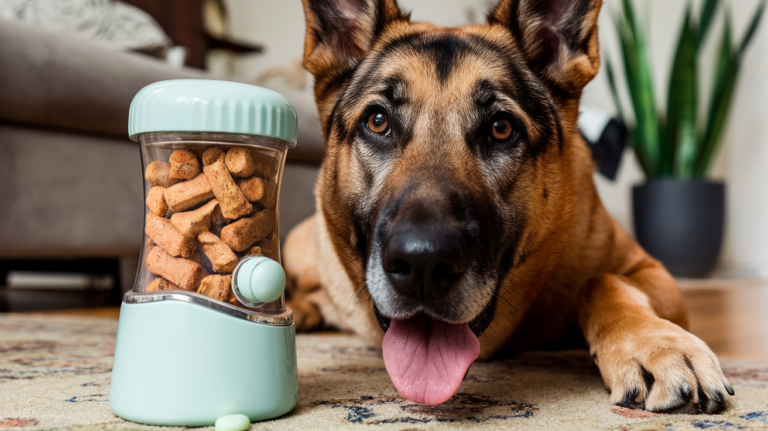
Transform mealtime into an extended brain game with food dispensing toys like Kongs, puzzle feeders, or snuffle mats. Instead of inhaling kibble in thirty seconds, your German Shepherd works for 20 to 30 minutes to extract their food. This mimics natural foraging behavior and provides crucial mental stimulation.
Frozen Kongs stuffed with wet food, kibble, and peanut butter become a long lasting challenge. Snuffle mats engage the nose and require systematic searching. Rolling toys dispense kibble unpredictably, requiring your dog to problem solve the physics of food extraction.
The simple act of making your dog work for food dramatically increases meal satisfaction while channeling their problem solving abilities productively.
Variety matters here. Rotate different dispensers so your clever German Shepherd doesn’t memorize one solution and phone it in. Keep them guessing, keep them thinking, keep them happily occupied.
Final Thoughts on Mental Enrichment
These brain games aren’t just entertainment; they’re essential maintenance for your German Shepherd’s psychological health. A mentally stimulated GSD is calmer, happier, and significantly less likely to develop destructive behaviors born from boredom. Mix and match these activities, keep sessions short and positive, and watch your already amazing dog become even more balanced and content. Your German Shepherd’s brain is their greatest asset. Give it the workout it deserves!