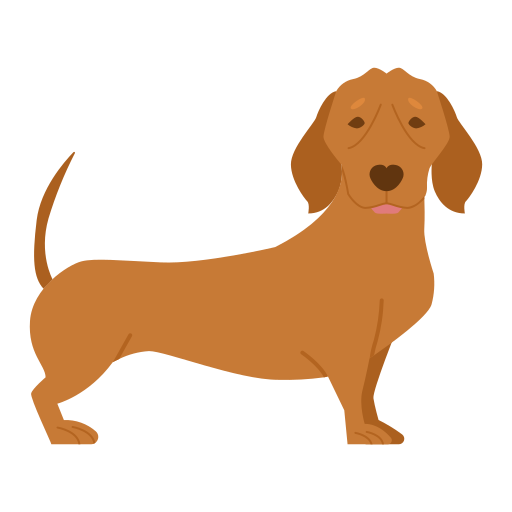
 Dachshund
 Common wisdom says dachshunds are stubborn little tyrants who refuse to be trained, and honestly, that reputation gets repeated so often that most new owners accept it before they’ve even brought the puppy home. The truth is messier and far more interesting.
Dachshunds aren’t ignoring you. They’re running a completely different mental operating system, one built underground, in the dark, several hundred years ago, without a human anywhere nearby to give instructions.
Once you understand what that little body was actually engineered to do, almost every "bad" behavior starts making a strange kind of sense.
Here are ten things about this breed that tend to reorganize how people see them.
1. They Were Built to Fight Badgers, Not Sit on Laps
The name translates roughly to "badger dog," which sounds cute until you look up what a badger actually is.
Badgers weigh up to thirty pounds. They have claws designed for tearing through packed earth and a temperament best described as deeply unpleasant. A dachshund’s job was to squeeze into that badger’s tunnel, corner it underground, and hold the line until the hunters arrived.
Alone. In total darkness. Against an animal that outweighed it.
A breed selected for the courage to face a cornered badger will not be intimidated by a stern voice from the kitchen.
That’s the dog currently burrowing into your throw blanket.
Why This Matters for Training
Underground, a dachshund couldn’t take orders. There was no handler down there. Independent decision making wasn’t a flaw in the design, it was the entire point.
So when your dachshund pauses and appears to weigh your recall command against the more compelling option of continuing to sniff that patch of grass, that’s not defiance. That’s four centuries of selective breeding working exactly as intended.
2. Their Bark Is a Technical Achievement
That enormous, chest rattling bark coming out of a fifteen pound animal isn’t an accident of anatomy.
It was engineered. Hunters standing above ground needed to locate a dog working several feet below them, through packed soil and root systems. A yappy little squeak wouldn’t carry.
So dachshunds were bred with a resonant, unusually deep bark that travels through earth. Your neighbors are experiencing the consequences of highly specialized 17th century acoustic engineering.
3. There Are Three Coat Types, and They Come With Different Personalities
Smooth, wirehaired, and longhaired. Most people know the coats vary. Fewer realize that each variety was created by crossing in different breeds, and those crosses brought temperament along with texture.
Wirehaired dachshunds got terrier blood, which shows up as extra mischief and a noticeably higher appetite for chaos. Longhaired dachshunds were crossed with spaniels, and they tend to be the mellowest of the three, often described as sweeter and more people focused.
Smooth coats are the original template: bold, confident, and the most likely to act like they own the property.
Choosing a coat type is not a cosmetic decision. It is a personality decision wearing a cosmetic disguise.
4. That Long Back Is Genuinely Fragile, and Stairs Are the Enemy
Time for the serious one, because it matters more than anything else on this list.
Dachshunds carry a gene for chondrodystrophy, the same gene responsible for their short legs. It also causes the discs in their spine to degenerate early and abnormally.
Roughly one in four dachshunds will experience intervertebral disc disease at some point. That’s not a rare tragedy, it’s a coin flip with unfavorable odds.
Jumping off the couch, taking stairs, and being picked up incorrectly all stack risk onto a spine that’s already working under structural disadvantage. Ramps aren’t pampering. Supporting the back end when you lift them isn’t fussiness.
The Single Best Thing You Can Do
Keep them lean.
Every extra pound multiplies the load on those discs. A dachshund at a healthy weight has a dramatically better outlook than one carrying even modest extra weight, and this is the one risk factor entirely within your control.
5. Digging Isn’t a Behavior Problem
Your dachshund destroying the flower bed is not misbehaving. Your dachshund is doing its job, and doing it well, in the only location available.
These dogs were bred to excavate. The paddle shaped front paws, the deep chest housing oversized lungs, the loose skin that lets them twist through tight tunnels: it’s all a digging apparatus.
Punishing the instinct never works. Redirecting it does. A sandbox, a dig pit, a snuffle mat, anything that gives that hardware a legitimate outlet.
6. They Once Took Down Wild Boar in Packs
Standard dachshunds handled badgers solo. But the breed had a larger variant, and packs of them were used to hunt wild boar.
Wild boar. Animals capable of killing an adult human.
The miniature dachshund came later, developed specifically to fit into narrower rabbit warrens. Same dog, scaled down for a different tunnel.
7. They Were Nearly Cancelled by Two World Wars
Dachshunds were so strongly associated with Germany that their popularity collapsed in Britain and America during World War I. Owners reported dogs being harassed on the street. Some breeders abandoned the breed entirely.
American kennel clubs briefly rebranded them as "liberty hounds" to salvage the reputation.
The numbers cratered again in World War II. That the breed survived both periods and came back to become one of the most popular dogs in America says something about how hard they are to give up once you’ve lived with one.
8. That Nose Is Doing Serious Work
Dachshunds are scent hounds. Real ones, with the tracking equipment to prove it.
They’re still used in Europe to trail wounded game through dense forest, sometimes for miles, sometimes over terrain a person can barely cross. That long low body puts the nose right where the scent is, at ground level, where the trail actually lives.
When your dachshund freezes mid walk and refuses to move, they haven’t gone stubborn on you. They’ve picked up something, and their brain has switched from walking mode to working mode.
You’re not walking a small dog. You’re being towed by a hound running an investigation.
9. The Blanket Burrowing Is Hardwired
Every dachshund owner discovers this within about a week: these dogs disappear under things.
Under comforters. Into laundry piles. Beneath couch cushions. Sometimes into places you’ll spend ten worried minutes searching before you spot the suspicious lump.
It’s the tunnel instinct with nowhere else to go. Enclosed, dark, pressure on all sides: that’s the environment the breed was designed to operate in, and reproducing it is genuinely calming for them.
A dachshund without something to burrow under is a dachshund with an unmet job description.
Give them a proper burrow bed. The difference in how well they settle can be striking.
One Safety Note
Burrowing dachshunds become invisible dachshunds. Check couches before sitting. Check beds before flopping down. This is not a hypothetical hazard, and every longtime owner has a near miss story.
10. The Stubbornness Isn’t Stubbornness at All
Circling back, because this is the thing that changes everything once it clicks.
Dachshunds score low on typical obedience rankings, and those rankings measure one specific quality: how quickly a dog complies with a command it was given for reasons it doesn’t understand.
That is not a measurement of intelligence. It’s a measurement of deference.
Dachshunds were selected against deference. A dog that stopped to await instructions in a badger tunnel was a dog that didn’t come back out.
What Actually Works
Make compliance the obviously better option. Short sessions, high value rewards, genuine enthusiasm on your end.
Motivate rather than command. Give them a reason instead of an order, and you’ll find they learn quickly, remember reliably, and figure out shortcuts you never taught them.
Then they’ll use those shortcuts to get onto the counter, and you’ll be forced to admire the problem solving even while you’re annoyed about the butter.