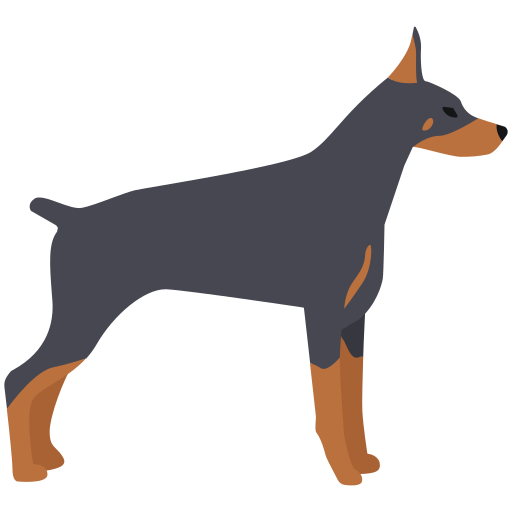
 Doberman
 Ask ten people to describe a Doberman and about eight of them will land somewhere near "intimidating." Sleek, sharp, all business, the dog you cast when the script calls for a junkyard and a chain link fence at midnight.
That reputation has staying power for a reason. Hollywood spent forty years using the breed as visual shorthand for menace, and the cropped, tail-docked silhouette did the rest of the work without a single line of dialogue.
Here is what nobody warns you about before you bring one home: Doberman owners spend a shocking percentage of their lives being sat on.
The dog that looks like it was designed in a wind tunnel turns out to be a 75 pound goofball who whines at closed doors and believes your pillow belongs to him now. Ten facts below, all of them softer than the reputation.
1. A tax collector invented them because he was lonely on the job
Karl Friedrich Louis Dobermann had one of the least beloved jobs in 1880s Germany. He collected taxes in Apolda, a town in Thuringia, and he wanted something walking beside him while he did it.
Conveniently, he also ran the local dog pound. That gave him access to more breeding stock than almost anyone else in the region, which is a very tidy example of using your day job to your advantage.
So the whole breed exists because a guy wanted protection and, let’s be honest, a friend. The Doberman was purpose-built to stick close to one person. More than a century later, they are still doing exactly that, whether or not you asked them to.
2. They are the original Velcro dog
Bathroom privacy is a thing you trade away when you get a Doberman.
Other breeds check in on you. Dobermans relocate to wherever you are and then look mildly betrayed when you get up again.
The two foot rule
Ask any owner and they will describe the same phenomenon: the dog exists within a two foot radius of a chosen human at all times. Kitchen, couch, shower, garage.
A Doberman does not follow you around the house. A Doberman moves the house to wherever you happen to be standing.
3. The lean is a love language
Sometime in the first month, your Doberman will back into your legs and slowly transfer roughly half its body weight onto you.
This is called the lean, and it is not an accident. It is affection delivered with the subtlety of a falling bookcase.
Big, confident dogs tend to greet with their bodies rather than their faces. Your Doberman is essentially hugging you, just sideways and with terrible balance.
4. They talk, and they will not stop talking
Nobody expects the noises. New owners are consistently blindsided by the noises.
Dobermans produce a low rolling grumble that sounds vaguely like a distant motorcycle, and they deploy it for basically everything: happiness, mild irritation, boredom, the outrage of a delayed dinner.
Grumbling is not growling
Worth separating the two, because the grumble catches a lot of people off guard. A true growl is stiff, still, and paired with hard body language.
The grumble comes with a wagging back half and a dog flopping dramatically onto your feet. It is commentary, not a threat, and once you learn to hear the difference you will realize your dog has opinions about everything.
5. Dobermans get cold and they are not brave about it
Single coat, almost no undercoat, very little body fat, and skin stretched over a frame built for speed. The result is a dog that starts shivering the second the thermostat drops below comfortable.
Yes, the fearsome guard dog owns sweaters. Often several.
Owners in cold climates buy fleece jackets, insulated coats, and heated beds, and their giant sleek athlete wears every bit of it with total dignity. There is no shame in the Doberman community about this. Everyone has been there.
6. They burrow like enormous, unsubtle moles
Because of that thin coat, Dobermans have a deep and abiding love for blankets.
Not lying on top of them. Under them, fully submerged, arranged in a shape no skeleton should be able to make.
You will lift a throw blanket off the couch and discover an entire adult dog folded up beneath it like laundry. Some of them do this so aggressively that owners keep a dedicated "dog blanket" purely as a sacrifice to the cause.
The scariest dog on the block is currently upside down under a fleece throw with one paw sticking out.
7. Those eyebrows are actually markings
Look at a black and rust Doberman straight on and you will swear the dog has eyebrows. Expressive ones. Judgmental ones.
They are tan points, part of the same rust colored pattern that shows up on the muzzle, chest, and legs.
Why it changes everything
Those two little patches sit exactly where human eyebrows would be, and they move whenever the dog shifts the muscles above its eyes. The effect is a face that appears to be reacting in real time to your poor decisions.
It is the reason Doberman photos read as so emotional. The dog is not doing anything special. The markings are just doing free comedic work.
8. They genuinely believe they are lap dogs
Size does not register. Weight does not register. Your Doberman has run the numbers and concluded that it fits.
What follows is a slow motion negotiation in which the dog places one paw on your knee, waits, adds a second paw, waits, and eventually deposits its entire ribcage across your thighs while maintaining unbroken eye contact.
Resistance is possible but rarely successful.
9. They soak up your mood like a sponge
Here is the trait that surprises people most, and the one that matters most for training.
Dobermans are enormously sensitive to human emotion. Raise your voice and a well-adjusted Doberman does not shrug it off; it deflates, checks your face, and worries about it for the next ten minutes.
This is a breed that responds to praise far better than pressure. Harsh correction tends to shut them down rather than sharpen them up, which is why so many experienced owners lean hard into reward based training and keep their tone light.
The flip side is lovely. On a bad day, your dog will find you, press against you, and refuse to leave until the mood lifts.
10. They are smart enough to become a personal problem
Dobermans consistently rank near the top of canine intelligence lists, usually in the same conversation as Border Collies and Poodles. That sounds like a selling point until you live with it.
A bored Doberman does not sit quietly and reflect. A bored Doberman learns how the pantry door works.
The greatest hits
Owners trade the same stories constantly: dogs opening lever handled doors, popping crate latches, working out which cabinet holds the treats, and figuring out that the leash coming off the hook means something wonderful is about to happen.
They also learn routines with unsettling precision. Your Doberman knows what time you get home, which shoes mean a walk, and what your "we are leaving without you" voice sounds like.
Give a Doberman a job and you get a partner. Give a Doberman nothing to do and you get a very handsome roommate with a screwdriver.
Fifteen minutes of training a day, some puzzle feeders, and a decent walk will redirect most of that brainpower into something useful. Skip all three and the dog will invent its own curriculum, and you will not enjoy the syllabus.