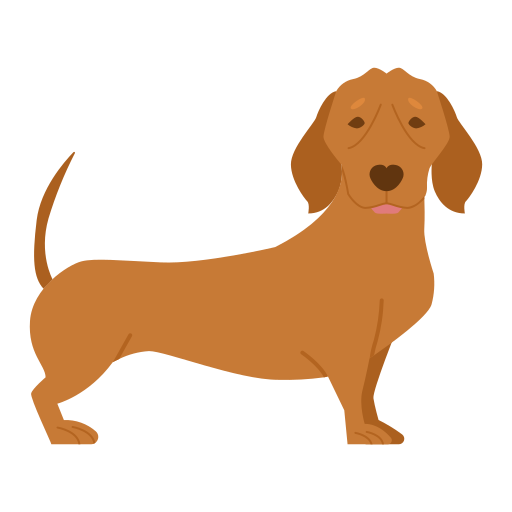
 Dachshund
 Sausage-shaped comedy is what most people see when a dachshund trots by, and that assumption sticks harder than dog hair on a black couch. The stubby legs, the wobble, the ears that flop like oversized oven mitts: it all reads as novelty pet. Cute, sure, but not serious.
That misconception persists because dachshunds have been marketed to us as living cartoons for over a century. Cartoon strips, hot dog jokes, birthday cards, wiener dog races. Nobody puts a dachshund on a poster next to a German Shepherd and calls them both working dogs.
But here’s the thing. That silly little body was engineered on purpose, and the dog inside it is far stranger and far tougher than the merchandise suggests.
Ready to have your assumptions rearranged?
1. They Were Bred to Fight Badgers Underground
The name says it out loud. Dachs means badger. Hund means dog. Badger dog.
German breeders in the 1600s wanted an animal that could follow a badger into its tunnel and hold it there, which is a genuinely terrifying job description. Badgers weigh up to 35 pounds, have claws built for digging through packed earth, and do not surrender politely.
So the dachshund got short legs for tunnel navigation, a long body for burrowing, and a chest cavity roomy enough to keep breathing while wedged in a hole.
The dachshund was not designed to be adorable. Adorable was an accident that happened along the way.
The Loose Skin Has a Purpose
That slightly baggy fit around the neck and shoulders? Not a design flaw.
Extra skin meant a badger’s teeth had something to grab besides muscle, and it let the dog twist free in tight quarters. Every part of this animal was solving a problem.
2. Their Bark Is Absurdly Loud for Their Size
Anyone who has been startled by a dachshund at 6 a.m. knows this already, but there’s a reason behind the volume.
A hunter standing above ground needed to hear the dog barking from deep inside a tunnel, through several feet of soil and roots. Quiet dachshunds got left behind in the gene pool.
The result is a chest that acts like a resonance chamber. That’s why a 12-pound dog can produce a bark that sounds like it belongs to something four times heavier, and why apartment neighbors have opinions.
3. There Are Six Official Varieties, Not Two
Most people know smooth and long-haired. Some know wirehaired.
But dachshunds come in two sizes (standard and miniature) crossed with three coat types (smooth, wirehaired, long-haired), which gives you six recognized varieties. In Germany there’s actually a third size category called the Kaninchen, or rabbit dachshund, measured by chest circumference rather than weight.
Each coat came from a different crossbreeding project. Long-haired dachshunds likely got their flowing coat from spaniels. Wirehaired versions picked up their scruffy eyebrows and beard from terrier crosses, which also handed them a slightly more chaotic personality.
Coat Type Predicts Temperament More Than You’d Think
Smooth dachshunds tend to bond intensely with one person.
Long-haired ones are usually the mellowest of the bunch, thanks to that spaniel influence. Wirehaired dachshunds are the class clowns, the ones most likely to dig up your garden and then look genuinely proud about it.
4. Their Sense of Smell Rivals Much Larger Hounds
Scent hound is the correct category, and it’s not a technicality.
Dachshunds track by nose with real precision, following blood trails and burrow scent underground where visibility is zero. Some European hunters still use them for tracking wounded deer, a job that requires following a faint trail for hours across difficult terrain.
This is also why your dachshund suddenly becomes deaf on walks. That nose overrides everything, including your voice, your treats, and your dignity.
5. A Dachshund Was the First Official Olympic Mascot
The 1972 Munich Summer Olympics introduced Waldi, a striped dachshund who became the first official Olympic mascot in history.
Waldi wasn’t chosen randomly. Organizers wanted an animal representing the qualities they associated with athletes: endurance, tenacity, and agility. They picked a wiener dog.
A committee of Olympic officials looked at every animal in Germany and decided the sausage dog best embodied athletic determination. They were not joking.
The marathon route that year was even shaped like Waldi’s silhouette when viewed on a map. Commitment to a bit, honestly.
6. They Are Statistically One of the Most Aggressive Breeds Toward Strangers
This one surprises people, and it’s worth sitting with.
A large behavioral study of dog breeds found dachshunds ranked remarkably high for aggression directed at unfamiliar people and other dogs. Not injury-causing aggression, generally, but genuine defensive hostility.
The explanation loops back to fact number one. A dog bred to face down a cornered badger in the dark had to be fearless to the point of poor judgment. That trait doesn’t switch off just because the badger has been replaced by a mail carrier.
What This Means Practically
Early socialization matters more for dachshunds than for many breeds.
They aren’t mean. They’re wired for confrontation with things much bigger than themselves, and without guidance that instinct finds strange targets, like the vacuum cleaner or your visiting mother-in-law.
7. Their Spines Are Their Greatest Vulnerability
The long back that made them perfect tunnel hunters comes with a serious cost.
Dachshunds have a genetic condition called chondrodystrophy, which affects cartilage development throughout the body. It’s what gives them those short, slightly curved legs. It also makes their spinal discs age prematurely, sometimes hardening by the time the dog is only a year old.
Roughly one in four dachshunds will experience intervertebral disc disease at some point.
Jumping off furniture, using stairs repeatedly, and carrying extra weight all increase the risk substantially. Ramps aren’t overprotective pet parenting. They’re spine insurance.
8. They Have a Documented Habit of Burrowing Into Blankets
That thing where your dachshund disappears entirely under the duvet and stays there for three hours? Pure instinct.
Den-dwelling behavior is baked into the breed. Confined dark spaces feel safe, not claustrophobic, because tunnels were the workplace.
This is one of the few dachshund traits that translated perfectly into modern pet life. The dog gets to satisfy a deep ancestral urge, and you get a warm lump at the foot of the bed.
9. Picasso, Warhol, and Queen Victoria Were All Obsessed
Pablo Picasso’s dachshund Lump appears in numerous paintings, including several of his reinterpretations of Velázquez’s Las Meninas.
Andy Warhol had two, Archie and Amos, and famously brought Archie to interviews so the dog could field questions Warhol didn’t feel like answering. Queen Victoria kept dachshunds and helped popularize the breed across Britain in the 1800s.
David Bowie, Marlon Brando, and E.B. White all owned them too. White wrote an entire essay about how thoroughly his dachshund refused to obey him.
Something about this breed attracts people who have spent their lives refusing to follow instructions. Perhaps they recognize a kindred spirit.
The Artistic Connection Isn’t Random
Dachshunds are extraordinarily expressive.
Those long faces and mobile eyebrows communicate disappointment, suspicion, and outrage with unusual clarity, which makes them irresistible to anyone who works visually.
10. Wiener Dog Races Exist and Are Fiercely Competitive
Dozens of official dachshund races happen across the United States every year, with the largest events drawing hundreds of competitors and thousands of spectators.
The Wienerschnitzel Wiener Nationals in California has been running for decades. Buda, Texas hosts one that funds local charities and treats the whole affair with municipal seriousness.
Here’s the fun part: dachshunds are terrible at racing.
They sprint fifteen feet, notice something interesting, stop entirely, and wander toward a stranger holding a hot dog. Actual finishes are rare enough that crowds go genuinely wild when a dog completes the course in a straight line.
Breed clubs occasionally push back on these events, worried about spinal strain from sudden sprinting. It’s a fair concern, and one worth weighing before you sign your own dog up.